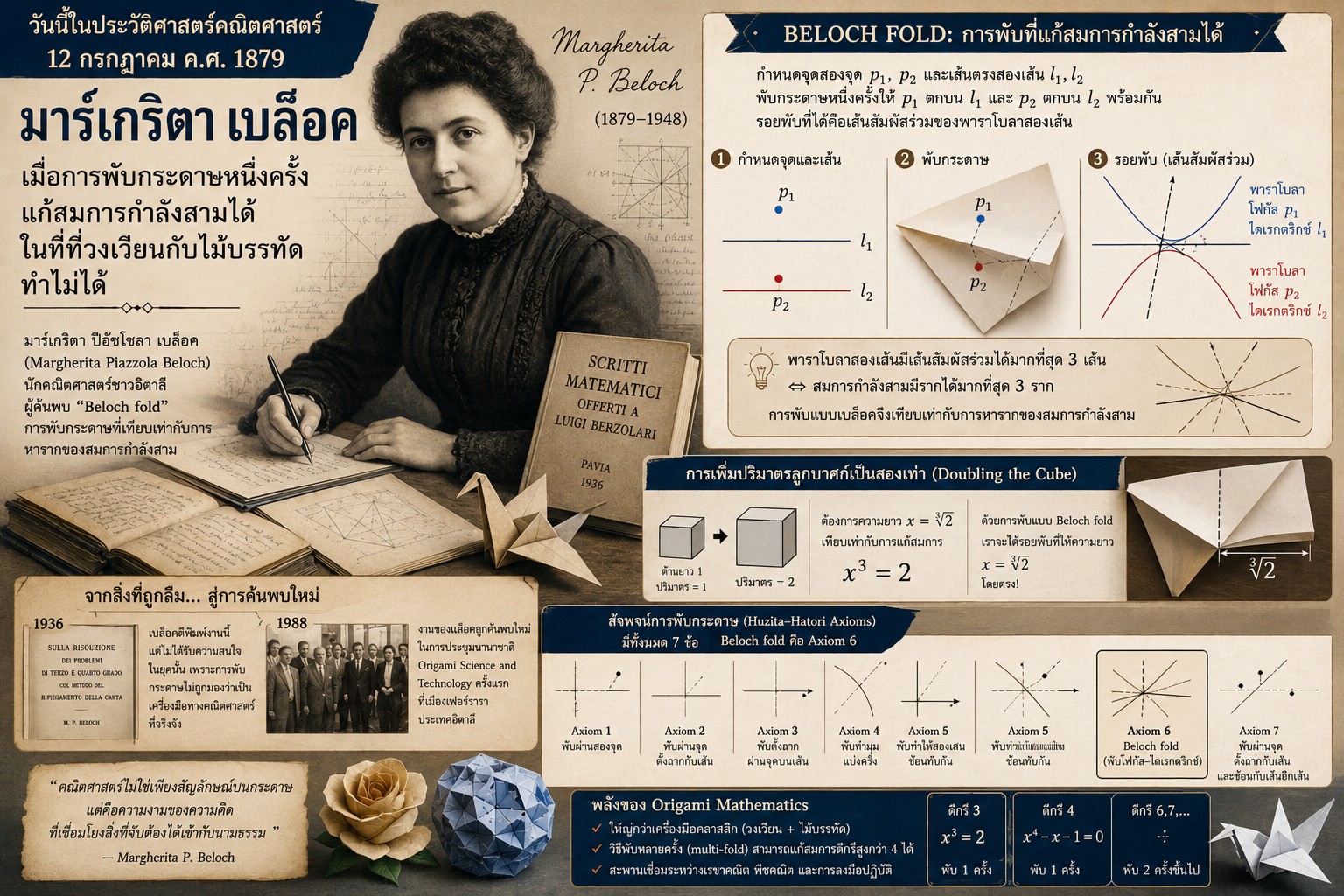
Margherita Beloc: When a single fold of paper solves a cubic equation where a compass and ruler can't.
Today in the history of mathematics | July 12, 1879
Introduction: A problem that the Greeks had been unable to solve for two thousand years.
One of the three classic problems of ancient Greek geometry was doubling the cube — given a cube of length 1 unit, construct a new cube with twice its volume using only a compass and ruler. This problem is equivalent to constructing a line segment of length $\sqrt[3]{2}$, which in 1837 Pierre Wantzel proved was impossible with both classic tools because $\sqrt[3]{2}$ is not a constructible number in the algebraic sense.
But almost a century later, an Italian female mathematician showed that if the tool was changed from a compass and ruler to folded paper, the problem could be solved beautifully. She was Margherita Piazzolla Beloch, born on July 12, 1879, in Frascati, Italy.
From a historian's daughter to an algebraic geometer.
Beloch is the daughter of Karl Julius Beloch, a German historian of antiquity who taught at the University of Sapienza in Rome for 50 years, and Bella Bailey, an American. She grew up in a rigorous academic environment and pursued mathematics, becoming a specialist in algebraic geometry and algebraic topology, with over a dozen publications on the topological properties of algebraic curves on smooth and ruled surfaces.
In the late 1940s, her interest shifted to the application of mathematics to photogrammetry, the science of measuring distances and creating models from photographs.
A fold that solves a cubic equation: Beloch Fold
In 1936, Bellock published an article entitled… Sulla risoluzione dei problemi di terzo e quarto grado col metodo del ripiegamento della carta ("On solving cubic and quartic problems using paper folding") proposing a folding technique now known as the Beloch fold.
The basic concept is: Given two points $p_1, p_2$ and two straight lines $l_1, l_2$ on a piece of paper, we can fold the paper once so that $p_1$ lies on line $l_1$ and $p_2$ lies on line $l_2$ simultaneously (where such a fold is possible). The resulting fold lines will be the common tangent lines of the two parabolas. One parabola has its focus at $p_1$ and its directrix at $l_1$, and the other has its focus at $p_2$ and its directrix at $l_2$.
The key algebraic point is that two parabolas on a plane can have at most three common tangents, which directly corresponds to the fact that a cubic equation can have at most three roots. This means that the Belleau fold is equivalent to finding the roots of any cubic equation.
Specifically, to double the volume of a cube, we need to find the answer to...
$$x^3 = 2$$
Bellock demonstrated that by choosing the right points and straight lines on the paper and folding it once according to the above conditions, the resulting fold would directly give the value $x = \sqrt[3]{2}$ — confirming that origami numbers are actually a larger set than constructible numbers.
From forgotten work to new discoveries.
Sadly, Beloch's work went largely unnoticed in her time, as paper folding wasn't considered a "serious mathematical tool." It wasn't until the late 1980s, when Humiaki Huzita and Benedetto Scimemi held the first international conference on Origami Science and Technology in Ferrara, Italy, in 1988, that Beloch's work was rediscovered and recognized.
Currently, the Huzita–Hatori axioms, which form the basis of modern origami mathematics, accept the Beloch fold as one of the seven fundamental axioms (Axiom 6). Furthermore, research has shown that multiple simultaneous folds (multi-fold) can solve equations of degree higher than four, such as sixth and seventh-degree equations using 2-fold origami techniques.
Why is this important for geometry students?
Bellock's story is a superb example for teaching students the concept of constructibility, showing them how the tools we choose to construct geometric figures—whether a compass, ruler, or origami—directly affect the “set of numbers” we can construct. It serves as a beautiful bridge between Euclidean geometry, abstract algebra (field theory), and tangible, hands-on activities like paper folding, making it ideal for hands-on classroom teaching.
Thought-provoking activities
- Explain why the equation $x^3 = 2$ cannot be solved with a compass and ruler, but can be solved by the Beloch fold (Hint: Consider what degree $\sqrt[3]{2}$ lies in the extension field above $\mathbb{Q}$).
- Try folding a real piece of paper using the Beloch fold concept, placing two pairs of points and lines on an A4 sheet of paper and measuring the length obtained from the fold. Compare this to the value $\sqrt[3]{2} \approx 1.2599$.
- There are seven axioms of Huzita–Hatori. Try to determine which geometric constructions each of the other axioms (besides Axiom 6, which is a Beloch fold) corresponds to in the traditional compass-ruler system.
- Compare whether two classic ancient Greek problems, the angle trisection and the squareing of the circle, can be solved by folding paper, and why or why not.
References
- Hull, T. C. (2011). Solving cubics with creases: The work of Beloch and Lill. American Mathematical Monthly, 118(4), 307–315.
- Beloch, M. P. (1936). Sulla risoluzione dei problemi di terzo e quarto grado col metodo del ripiegamento della carta. Scritti Matematici Offerti a Luigi Berzolari, Pavia, 93–96.
- Magrone, P., & Talamanca, A. (2018). Folding cubic roots: Margherita Piazzolla Beloch’s contributions to elementary geometric constructions. Journal of Mathematics and the Arts.
- Alperin, R. C., & Lang, R. J. (2009). One-, two-, and multi-fold origami axioms. Origami 4: Fourth International Meeting of Origami Science, Mathematics, and Education, 371–393.
- Wikipedia contributors. (2025). Margherita Piazzola Beloch. Wikipedia.
This series of articles, "Today in the History of Mathematics," presents mathematical stories connected to important dates on the calendar.