Today in the History of Mathematics: Richard von Mises (died July 14, 1953)
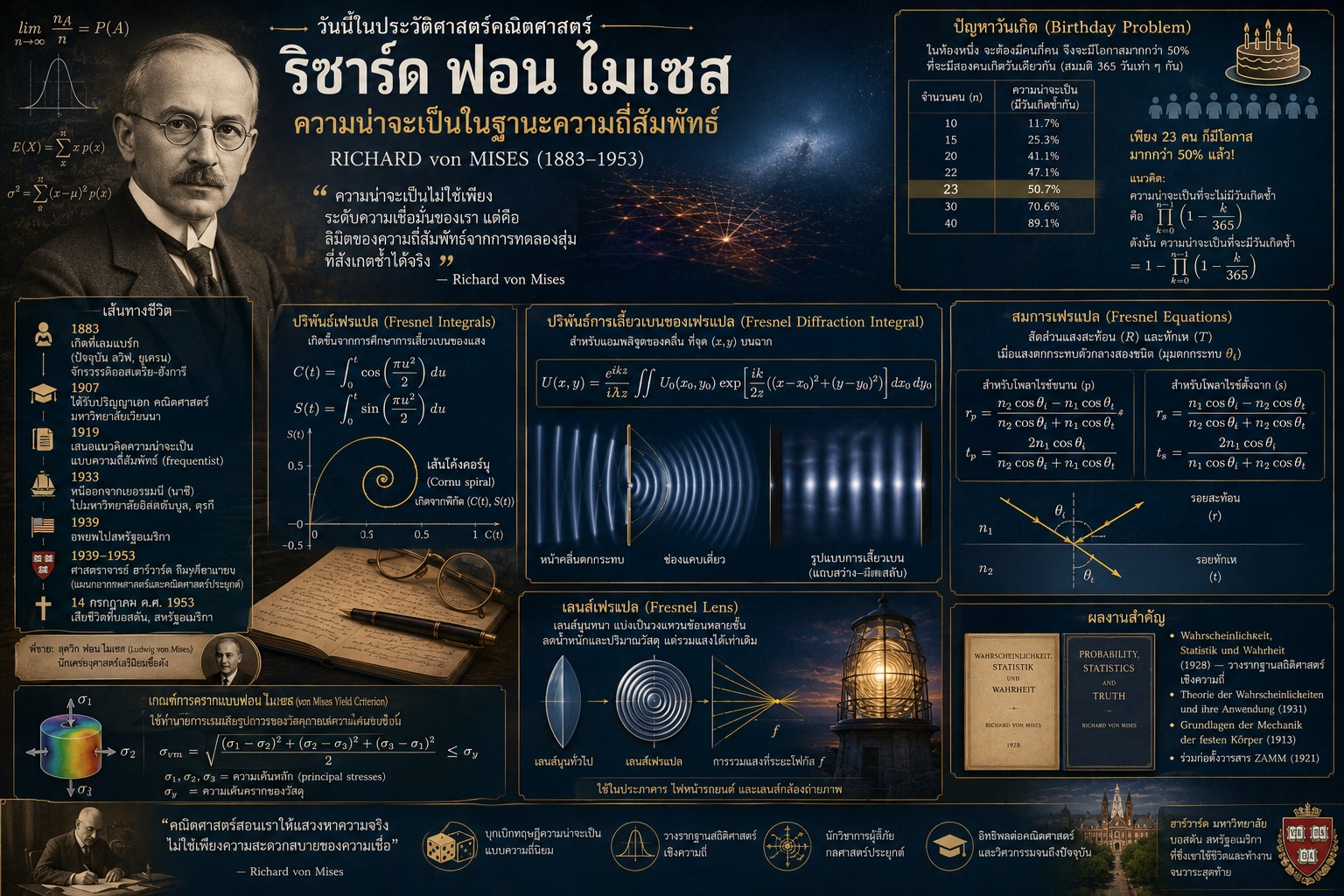
When students study probability and ask, "What exactly is probability?" one of the most influential answers in the history of mathematics comes from Richard von Mises, an Austrian-American applied mathematician who proposed that probability is the limit of relative frequency, rather than merely a subjective interpretation. He passed away in Boston on July 14, 1953.
Life amidst historical turmoil
Von Mises was born in Lemberg (now Lviv, Ukraine) in 1883, a city then part of the Austro-Hungarian Empire. He studied mathematics, physics, and engineering at the Technische Hochschule in Vienna and earned his doctorate from the University of Vienna in 1907. His older brother was Ludwig von Mises, the renowned liberal economist.
Von Mises’s professional life was marked by repeated relocations due to political circumstances. Although he was a practicing Catholic, the Nazi government classified him as Jewish based on his ancestry; consequently, he fled Germany in 1933 to take up a position at Istanbul University in Turkey. He later emigrated to the United States in 1939, where he served as the Gordon McKay Professor of Aerodynamics and Applied Mathematics at Harvard University until his retirement.
Frequentist Probability
In 1919, von Mises proposed a revolutionary concept: the probability of an event should be defined based on a "collective"—a sequence of repeated trials characterized by true randomness (irregularity) and a relative frequency that converges to a constant value as the number of trials increases.
$$ P(A) = \lim_{n \to \infty} \frac{n_A}{n} $$
Here, $n_A$ represents the number of times event $A$ occurs across a total of $n$ trials. This concept differs from the Bayesian perspective, which views probability as a degree of subjective belief; von Mises insisted that probability must be grounded solely in phenomena that can be repeatedly observed. This concept was systematically presented in the book. Wahrscheinlichkeit, Statistik und Wahrheit (1928), which was later translated into English under the title Probability, Statistics and Truth and became a cornerstone of frequentist statistics, which is widely used in the scientific community to this day.
It is interesting to note that von Mises also introduced the "birthday problem" in 1939—a classic probability puzzle asking how many people must be in a room for there to be a greater than 50% chance that at least two of them share the same birthday. The surprising answer is just 23 people.
Work in Applied Mechanics
In addition to probability theory, von Mises made significant contributions to solid mechanics and fluid dynamics—most notably the von Mises yield criterion, used to predict the point at which a material begins to undergo permanent deformation under complex stress; this remains a standard tool in structural engineering to this day. He also co-founded a journal. Zeitschrift für Angewandte Mathematik und Mechanik (ZAMM), a leading European journal of applied mathematics
Thought-provoking activities
- Compare the advantages and disadvantages of von Mises's relative frequency definition of probability and the Bayesian definition.
- Try to prove mathematically why the birthday problem requires only 23 people for the probability to exceed 50%.
- Why did von Mises insist that probability must be defined based on a repeatedly observable “collective” rather than on personal belief? What are the limitations of this concept?
- Discuss the significance of the von Mises yield criterion in engineering structural design.
References
Britannica. (2026, April). Richard von Mises. Encyclopædia Britannica. https://www.britannica.com/biography/Richard-von-Mises
O’Connor, J. J., & Robertson, E. F. (n.d.). Richard von Mises. MacTutor History of Mathematics Archive. University of St Andrews. https://mathshistory.st-andrews.ac.uk/Biographies/Mises/
Schield, M., & Burnham, T. (2008). Von Mises’ Frequentist Approach to Probability. Joint Statistical Meetings, American Statistical Association.
This article is part of the “This Day in Mathematical History” series—retracing the stories of the mathematicians who shaped the world of mathematics, day by day throughout the year.