Today in the History of Mathematics: Lorenzo Mascheroni (died July 14, 1800)
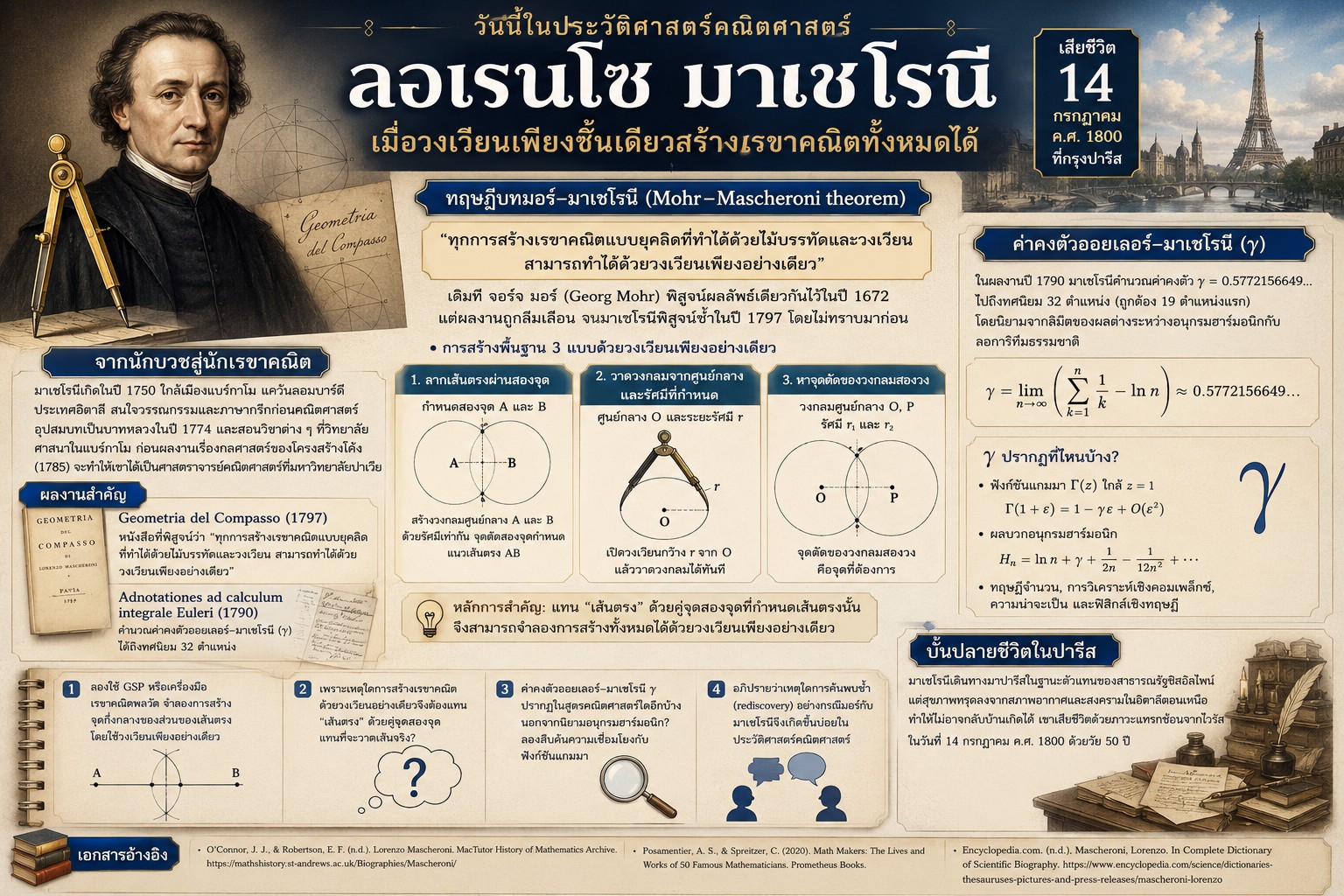
Imagine having to construct every possible geometric figure using a ruler and a compass, but with the condition that you cannot use the ruler at all—it sounds impossible, doesn't it? Yet, the Italian mathematician Lorenzo Mascheroni proved as early as 1797 that it could actually be done; he passed away in Paris on July 14, 1800.
From Monk to Geometer
Maceroni was born in 1750 near Bergamo, Lombardy, Italy, into a landowning family. In his early life, he was more interested in literature and the Greek language than in mathematics. He was ordained a Catholic priest in 1774 and taught rhetoric, mathematics, and physics at a theological college in Bergamo for over a decade before his work on the mechanics of curved structures (Nuove ricerche su l’equilibrio delle vòlte, 1785) would lead to his appointment as Professor of Mathematics at the University of Pavia.
Compass Geometry
The work that has kept Mascheroni's name in mathematics textbooks to this day is the book Geometria del Compasso (Geometry of the Compass) was published in Pavia in 1797; he dedicated it to Napoleon Bonaparte in the form of a poem. In this book, he proves that...
Every Euclidean geometric construction that can be performed with a straightedge and compass can be performed with a compass alone.
This result is now known as the Mohr–Mascheroni theorem, as it was later discovered that the Danish mathematician Georg Mohr had already proven the same result in 1672. However, Mohr's work had fallen into obscurity until its rediscovery in 1928; consequently, Mascheroni was unaware that someone else had discovered the same thing more than a century earlier.
The core principle of the proof is demonstrating that every basic construction performed with a straightedge and compass—drawing a line through two points, drawing a circle with a given center and radius, and finding the intersection of two circles—can be replicated using only a compass by representing the "straight line" as the pair of points that define it. This result holds immense theoretical significance for the foundations of constructive geometry and links directly to dynamic geometry software, such as Geometer’s Sketchpad (GSP), which utilizes geometric construction principles for instruction.
Euler–Mascheroni constant
In addition to geometry, Mascheroni also left his mark on number theory through his work. Adnotationes ad calculum integrale Euleri (1790), in which he calculated the value of γ (gamma)—or the Euler–Mascheroni constant—to 32 decimal places (although only the first 19 were correct; the remaining digits were later corrected by Johann von Soldner in 1809). This constant is defined as the limit of the difference between the harmonic series and the natural logarithm.
$$ \gamma = \lim_{n \to \infty} \left( \sum_{k=1}^{n} \frac{1}{k} – \ln n \right) \approx 0.5772156649\ldots $$
The value $\gamma$ remains one of the most mysterious mathematical constants, as no one has yet been able to prove whether it is a rational or an irrational number.
Later life in Paris.
Mascheroni traveled to Paris as a representative of the Cisalpine Republic, but the harsh weather there took a severe toll on his health. Furthermore, the ongoing war between Austria and France in northern Italy prevented him from returning to his homeland. Mascheroni died in Paris on July 14, 1800, at the age of 50, due to complications from a viral infection.
Thought-provoking activities
- Try using GSP or a dynamic geometry tool to simulate the construction of the midpoint of a line segment using only a compass.
- Why does geometric construction using only a compass require representing a “straight line” as a pair of points, rather than drawing the actual line?
- In which mathematical formulas—other than the definition involving the harmonic series—does the Euler–Mascheroni constant $\gamma$ appear? Explore its connection to the gamma function.
- Discuss why "rediscoveries"—such as the case of Mohr and Mascheroni—occur frequently in the history of mathematics.
References
O’Connor, J. J., & Robertson, E. F. (n.d.). Lorenzo Mascheroni. MacTutor History of Mathematics Archive. University of St Andrews. https://mathshistory.st-andrews.ac.uk/Biographies/Mascheroni/
Posamentier, A. S., & Spreitzer, C. (2020). Math Makers: The Lives and Works of 50 Famous Mathematicians. Prometheus Books.
Encyclopedia.com. (n.d.). Mascheroni, Lorenzo. In Complete Dictionary of Scientific Biography. https://www.encyclopedia.com/science/dictionaries-thesauruses-pictures-and-press-releases/mascheroni-lorenzo
This article is part of the “This Day in Mathematical History” series—retracing the stories of the mathematicians who shaped the world of mathematics, day by day throughout the year.