Remembering Henri Poincaré: The Father of Modern Topology and the Discoverer of Chaos
Henri Poincaré was one of the greatest mathematicians of all time. He laid the foundations of modern topology and discovered phenomena that would later become the foundation of chaos theory, even though his original goal was simply to solve a seemingly ordinary problem in astronomy. On this occasion, we look back at the life and achievements of this remarkable genius, who has been described as the “last universalist mathematician” of the world.
The Final Chapter of His Life: July 17, 1912
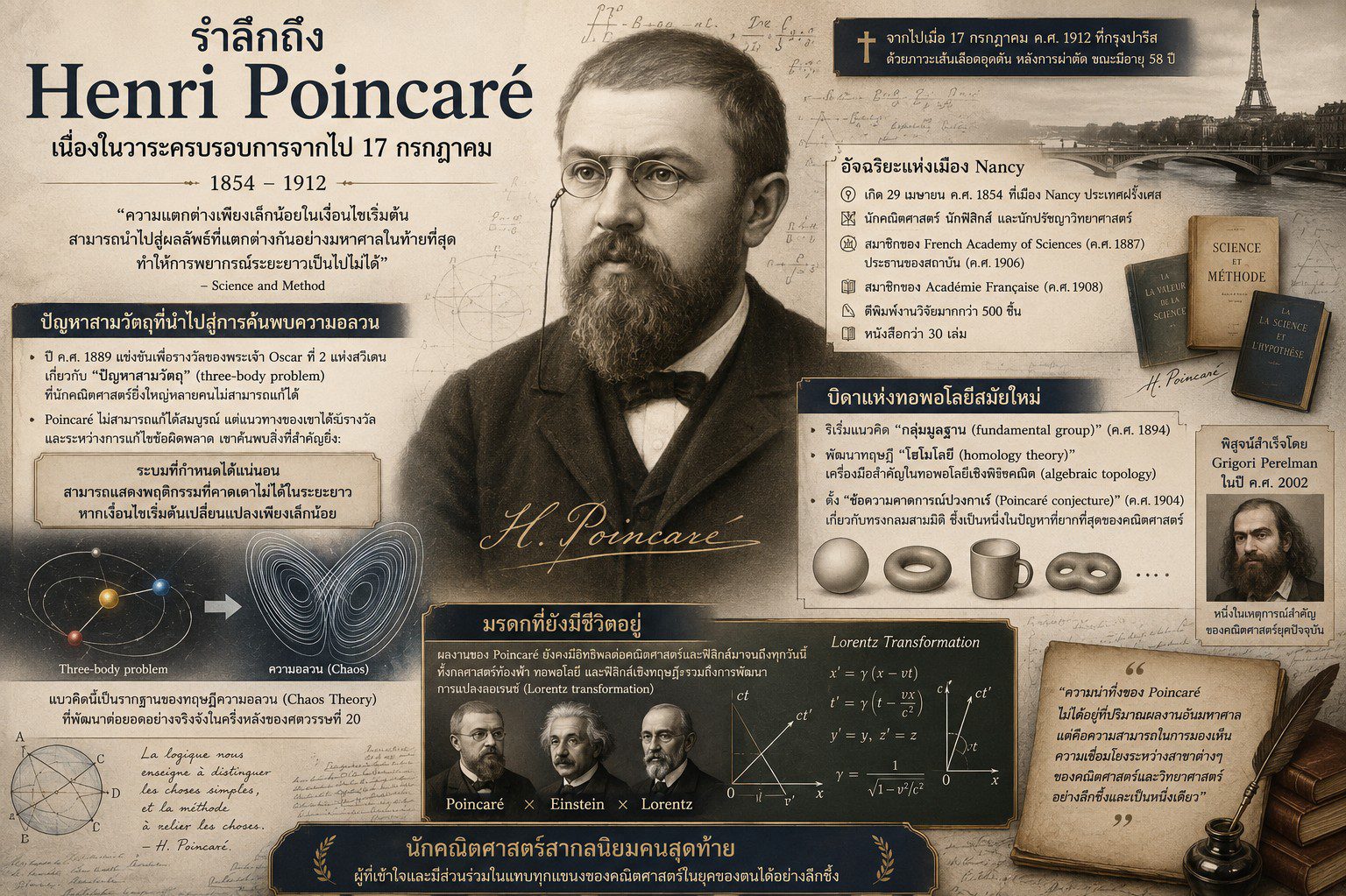
Henri Poincaré died on July 17, 1912, in Paris, at the age of 58, from an embolism that developed as a complication following surgery. His death was a major loss to the fields of mathematics and physics at the time, as he continued his research work until the final years of his life and remained one of the scholars who closely followed the development of contemporary theoretical physics throughout his career.
Although more than a century has passed, the name of Poincaré has never faded from the academic world. His legacy continues through numerous theorems, conjectures, and concepts that still bear his name and remain influential in mathematics and science to this day.
The Genius from the City of Nancy
Jules-Henri Poincaré was born on April 29, 1854, into a wealthy family in the city of Nancy, France. From an early age, he displayed exceptional talent in mathematics and science, along with a way of thinking that differed from many other mathematicians. Contemporary mathematician Gaston Darboux once described Poincaré as an “intuitive” thinker, because he often worked through mental visualization and conceptual insight rather than relying solely on step-by-step algebraic calculations.
Throughout his career, Poincaré was simultaneously a mathematician, physicist, and philosopher of science. He was elected as a member of the French Academy of Sciences in 1887 and later served as its president in 1906. In 1908, he was also elected to the Académie Française for his contributions through three books on philosophy and general science. Over the course of his lifetime, he published more than 500 research papers and over 30 books.
The Three-Body Problem That Led to the Discovery of Chaos
The Three-Body Problem That Led to the Discovery of Chaos One of the most important turning points in Poincaré’s life came in 1889, when King Oscar II of Sweden established a prize for anyone who could solve a problem concerning the stability of the solar system, originally posed by mathematician Karl Weierstrass. This challenge became known as the “three-body problem”, a problem that legendary mathematicians such as Euler, Lagrange, and Laplace had previously attempted to solve without success.
Poincaré was unable to solve the problem completely, but his analytical approach impressed the judges enough for him to receive the prize. Even more remarkable was that after submitting his work, he discovered an error in his analysis following questions raised by Swedish mathematician Lars Edvard Phragmén, forcing him to urgently revise his paper. It was during this revision process that Poincaré made a groundbreaking discovery: a deterministic system could exhibit long-term behavior that was unpredictable, even when its initial conditions changed by only a tiny amount. He described the complex trajectories of such systems as resembling “a tangled web of extraordinary complexity”, providing the first mathematical description of what is now known as chaos.
Later, in his book Science and Method, Poincaré explained this idea in a simple way: even a very small difference in the initial conditions of a system can eventually lead to enormously different outcomes, making long-term prediction impossible. This concept became one of the fundamental foundations of chaos theory, which was developed further in earnest during the second half of the 20th century, when computers allowed mathematicians to study these complex systems in far greater depth.
The Father of Modern Topology
Beyond his work in celestial mechanics, Poincaré is widely regarded as one of the founders of algebraic topology. He introduced the concept of the fundamental group in a paper published in 1894 and developed homology theory, a powerful tool for studying properties of shapes that remain unchanged under continuous deformation.
In 1904, he proposed what became known as the Poincaré conjecture, concerning the topological properties of three-dimensional spheres. It became one of the most difficult and significant problems in mathematics for nearly a century. The conjecture was finally proven in 2002 by Russian mathematician Grigori Perelman, marking one of the most important events in modern mathematical history.
A Living Legacy More Than a Century Later
Although Poincaré passed away more than 100 years ago, his work continues to have a profound influence on mathematics and physics to this day. His contributions remain fundamental in fields such as celestial mechanics, topology, and even relativistic physics, where he played a role in the development of the modern form of the Lorentz transformation alongside Albert Einstein and Hendrik Lorentz.
What makes Poincaré truly remarkable is not only the enormous volume of his work, but also his ability to recognize connections between different areas of mathematics and science that appeared unrelated at first glance. Whether in topology, celestial mechanics, or theoretical physics, he demonstrated a rare ability to move across disciplines and uncover deeper relationships between them. For this reason, he is regarded as one of the last great “universalist” mathematicians — a scholar who possessed the ability to understand and make profound contributions across nearly every major branch of mathematics of his time.
Each year, on the anniversary of his passing, it is an opportunity to remember a remarkable man who, although no longer with us, continues to illuminate the path for generations of scientists through the enduring power of his ideas.