Pierre Puiseux: The Astronomer Who Studied the Moon from a Family of Mathematicians
Before beginning this article, it is important to clarify one key fact: the inventor of the Puiseux series used in complex analysis was Victor Puiseux (1820–1883), not his son, Pierre Puiseux. Although they shared the same surname and came from the same mathematical family, they were different individuals. In this article, we will introduce Pierre Puiseux, a renowned astronomer in his own right, whose birthday falls on July 20.
The son of a legendary mathematician
Pierre Henri Puiseux was born on **20 July 1855** in **Paris, France**. He was the son of **Victor Puiseux**, a renowned astronomer and mathematician, a member of the **Academy of Sciences**, and the originator of the **Puiseux series**, and **Laure Louise Jeannet**. As a result, he was born into one of France's leading scientific and academic families.
In 1865, he began attending Saint-Louis High School, and in 1875, he enrolled at the École Normale Supérieure, where he earned a doctorate in mathematical sciences in 1879. Although he received intensive training in mathematics, Pierre's career path was primarily focused on astronomy.
The Moon Explorer of the Paris Observatory
Pierre Puiseux began working at the Paris Observatory in 1885 as an assistant astronomer before being promoted to a full astronomer in 1903. His principal research covered the aberration of light, asteroids, and lunar dynamics, the field to which he devoted the greatest part of his career.
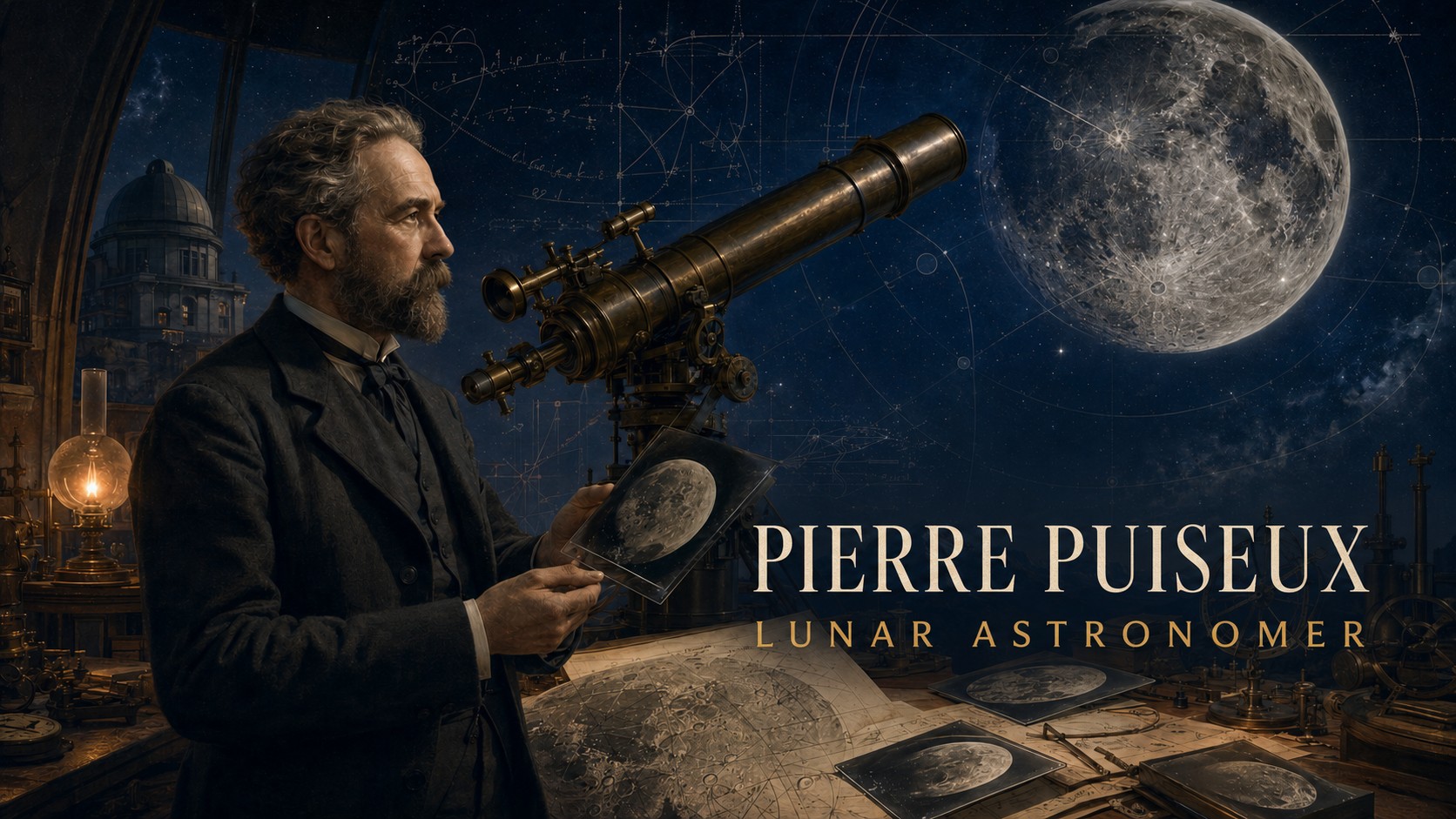
His most outstanding work was his series of studies on the Moon, covering its motion, surface, and internal structure. He collaborated with Maurice Loewy to produce detailed photographs of the lunar surface, resulting in one of the most accurate lunar maps of that era. His final research also addressed the Moon's libration around its own center of gravity.
Honors and Personal Life
Throughout his career, Puiseux received numerous academic honors, including the Valz Prize from the Academy of Sciences in 1892, the Lalande Prize from the French Astronomical Society in 1896, and the Janssen Prize from the Academy of Sciences in 1908. He was also appointed a Knight of the Legion of Honour in 1900 and served as President of the French Astronomical Society in 1911 before being elected to the Astronomy Section of the Academy of Sciences in 1912.
In addition to his academic work, Puiseux was also a renowned and passionate mountaineer. He achieved numerous first ascents in France, Switzerland, Sweden, and Italy, and regularly published articles on mountaineering. In his later years, he was honored with the title of Honorary President of the French Alpine Club.
An inheritance clearly separated from the father.
Pierre Puiseux died in 1928 after suffering from illness for many years. Although his name is often confused with that of his father, the creator of the Puiseux series in mathematics, Pierre's own contributions as an astronomer who pioneered the detailed study of the Moon are no less significant in their own right. The story of the Puiseux family is therefore an interesting example of a scientific family that passed down a passion for the computational sciences from one generation to the next, even as they pursued different fields of expertise.