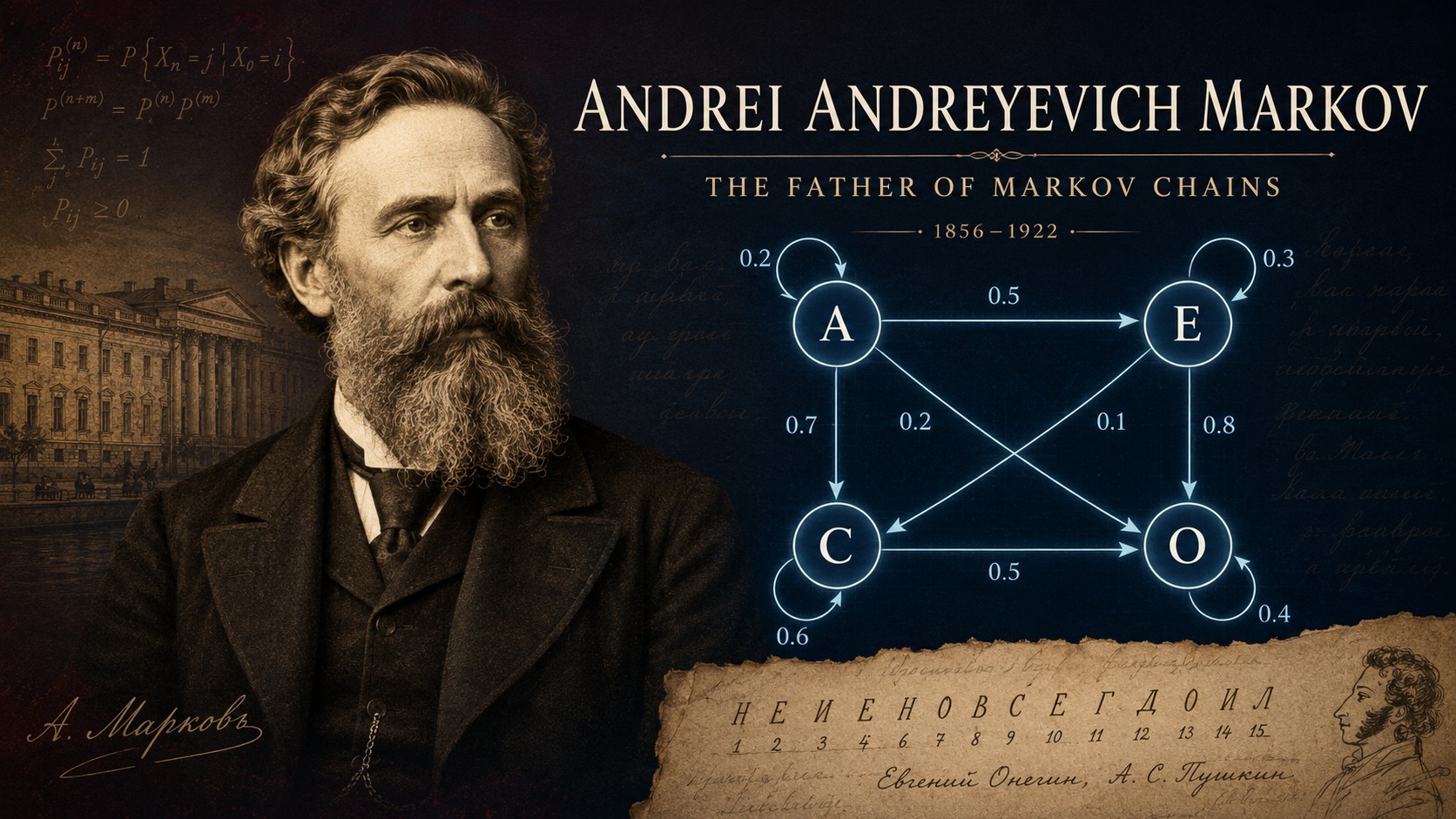
Remembering Andrei Andreyevich Markov, the creator of Markov Chains.
Andrei Andreyevich Markov was a Russian mathematician who pioneered the theory of stochastic processes and is credited with developing the concept of Markov chains, which have become fundamental tools widely used in modern statistics, artificial intelligence, and finance. On this occasion, we remember the life of this thinker, whose dedication to academic pursuits was never hindered by illness.
His final moments in Petrograd, July 20, 1922.
Andrei Markov died on July 20, 1922, in Petrograd (now St. Petersburg) after suffering from a serious illness for many months. His later life was filled with hardship, including food shortages due to the Russian Revolution and declining health, which eventually required eye surgery. Even in 1921, when his body was so weak he could barely stand, he persevered in lecturing on probability at the university.
This determination reflects Markov's character well, for even in 1917, during the early stages of the revolution, he requested the Academy of Sciences to send him to teach in a small rural Russian town without receiving any compensation, in order to help the area that lacked mathematics teachers.
The boy who used crutches became a leading mathematician.
Andrei Andreyevich Markov was born on June 14, 1856, in Ryazan, Russia. As a child, he had health problems that required him to use crutches until the age of 10. He was an unremarkable student in most subjects, except for mathematics, where he showed clear talent, even though some teachers considered him a rebel.
He entered St. Petersburg University in 1874 under the tutelage of Pafnuty Chebyshev, the great mathematician of the Russian School, and graduated with a bachelor's degree in 1878, a master's degree in 1880, and a doctorate in 1884. He was appointed professor at St. Petersburg University in 1886 and became a member of the Russian Academy of Sciences in 1896.
From number theory to the origin of Markov chains.
In the early stages of his career, Markov's research focused on number theory and analysis, particularly continued fractions, approximation theory, and convergence of series. He won a gold medal for solving a difficult problem of integrating differential equations using continued fractions as early as 1877 and also successfully proved the central limit theorem under more general conditions.
After 1900, Markov turned his serious attention to probability theory, applying the continued fraction method pioneered by his teacher, Chebyshev. He studied sequences of mutually dependent random variables to establish the most general possible limit laws for probability. This research was first published in 1906 when he was 50, marking the birth of what is now known as Markov chains. One of the most prominent examples of this research was his 1913 analysis of the distribution of vowels and consonants in the first 20,000 letters of Alexander Pushkin's novel Eugene Onegin, which is considered the first empirical application of Markov chains in history.
A pervasive legacy in the digital age.
The concept of Markov chains, pioneered by Markov, has extended its influence far beyond what he could have imagined in his time. Today, it has become a fundamental tool in a wide range of fields, including natural language processing, product recommendation systems, finance and risk assessment, genetics, and modern artificial intelligence that relies on creating probabilistic models of sequential events over time.
Each year on the anniversary of his death, the name of Andrei Andreyevich Markov continues to be mentioned as that of a mathematician who transformed the way humans understand randomness and uncertainty through a simple yet incredibly powerful framework, which remains a fundamental basis of modern computational science to this day.