Remembering Gottlob Frege, the father of modern symbolic logic
Gottlob Frege was a German mathematician and logician who pioneered modern symbolic logic and was one of the first people to try to show that mathematics is just an extension of logic (logicism). Although his work received little attention during his lifetime, he is now recognized as one of the greatest logicians of all time and the father of analytic philosophy. On this occasion, we want to look back and remember the life of this thinker.
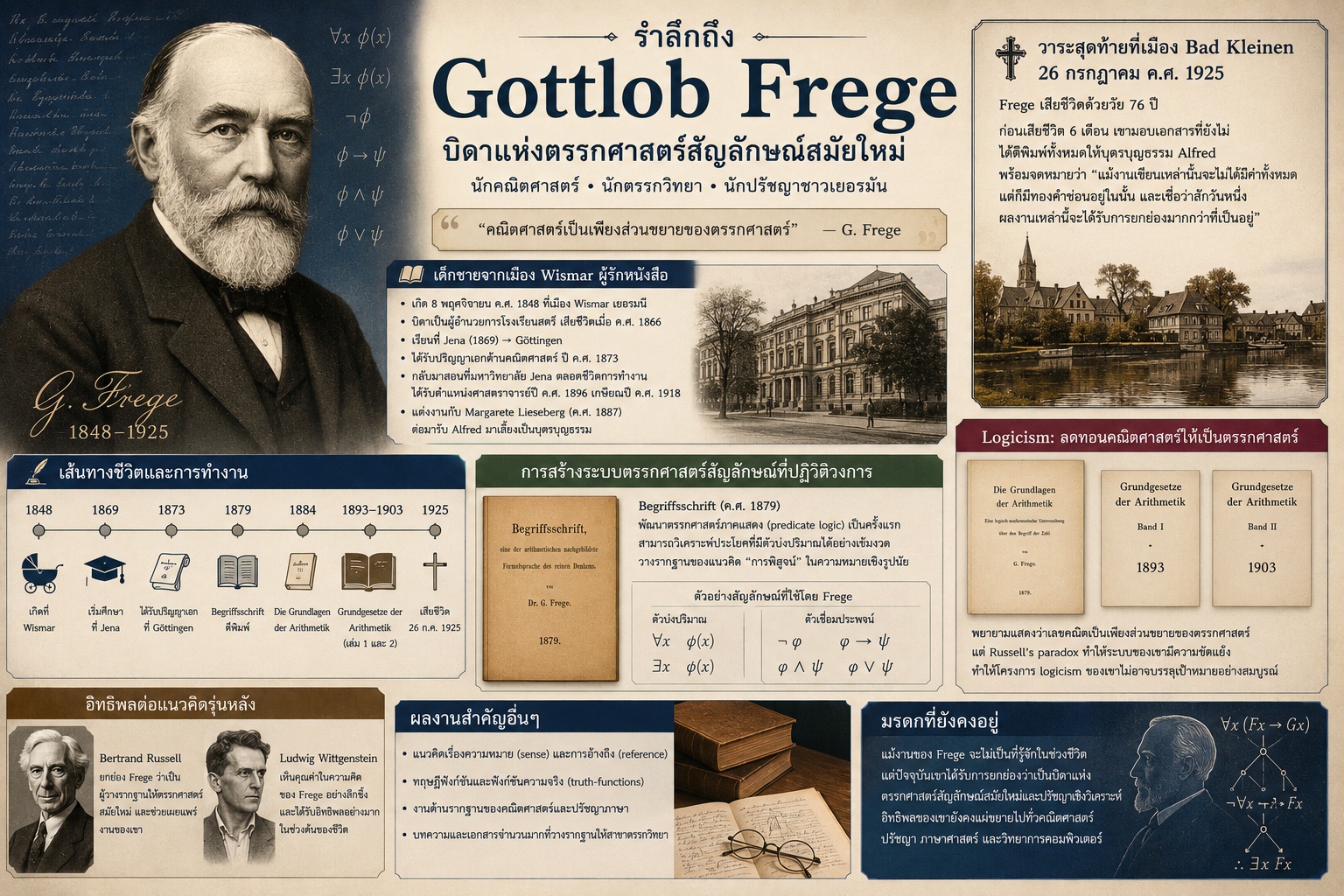
The final agenda in Bad Kleinen, July 26, 1925
Gottlob Frege passed away on July 26, 1925, in Bad Kleinen, near his hometown of Wismar, at the age of 76. Just six months before his death, he wrote a will leaving all his unpublished papers to Alfred, his adopted son, along with a letter stating that, although not all of the writings were valuable, there was hidden gold in them, and he believed that one day these works would be more appreciated than they were at that time. His passing went almost unnoticed by the world, but his prediction came true later, as Frege came to be recognized as one of the greatest logicians with a profound influence on philosophy.
A boy from the girls' school in Wismar
Friedrich Ludwig Gottlob Frege was born on November 8, 1848, in the town of Wismar, Germany. His father, Karl Alexander Frege, was a co-founder and the principal of the city’s girls' school. When his father passed away in 1866, his mother Auguste took over as principal, which allowed Frege to complete his secondary education smoothly. He started studying at the University of Jena in 1869, before moving to the University of Göttingen, where he earned a PhD in mathematics in 1873 with a thesis on projective geometry. He returned to teach at the University of Jena in the mathematics department and spent his entire career there, becoming a professor in 1896 and retiring in 1918.
He married Margarete Lieseberg in 1887. They had several children together, but they all died young. Later, the couple took in six-year-old Alfred as their adopted son, who later became an engineer and died in World War II in 1945.
Creating a game-changing symbolic logic system
The work that made Frege most famous was the publication of Begriffsschrift ("Concept Script") in 1879, which introduced a completely revolutionary new system of logic. He developed what is now called "predicate logic" for the first time, which could rigorously analyze sentences with quantifiers like "all" and "exists." It was a huge leap forward from the Aristotelian logic that had been used for over two thousand years.
This system also laid a solid foundation for the idea of “proof” in the formal sense that is still used today. Frege used this system to try to show that mathematical statements could be resolved through simpler logical and mathematical concepts.
Logicism: The effort to reduce mathematics to logic
Frege's biggest intellectual project was his attempt to show that all of mathematics, especially arithmetic, is just an extension of logic. This idea is known as logicism, and he developed it in detail in his work *Die Grundlagen der Arithmetik* (The Foundations of Arithmetic) in 1884 and *Grundgesetze der Arithmetik* (The Basic Laws of Arithmetic) published in two volumes in 1893 and 1903.
Sadly, before the second volume of *Grundgesetze* was published, Bertrand Russell, the British philosopher and mathematician, discovered a logical contradiction in Frege's system, known as Russell’s paradox, which involves sets that are members of themselves. Frege had to add a last-minute appendix to acknowledge this flaw. Even though he later tried to fix his system of truths, he never fully succeeded, which meant that his original logicism project couldn’t completely achieve its intended goals.
A Legacy Recognized After His Passing
Even during Frege's lifetime, his work barely received attention from the academic world. However, later thinkers like Bertrand Russell and Ludwig Wittgenstein deeply appreciated his work and helped push Frege's ideas into wider recognition. Today, he is celebrated as the father of analytic philosophy and modern symbolic logic, which have had a profound impact on the philosophy of language and the foundations of mathematics up to the present day. Every year on the anniversary of his passing, Gottlob Frege's name serves as a reminder that true intellectual value sometimes takes a long time to be properly recognized.