Remembering Oskar Morgenstern, co-creator of game theory with John von Neumann
Oskar Morgenstern was a German-American economist and mathematician who co-developed Game Theory with the great mathematician John von Neumann, making it one of the most influential tools for analysis in modern economics and mathematics. On this occasion, we’d like to take a moment to look back on the life of a thinker who connected economics with mathematical rigor in such a profound way.
Final agenda in Princeton on July 26, 1977
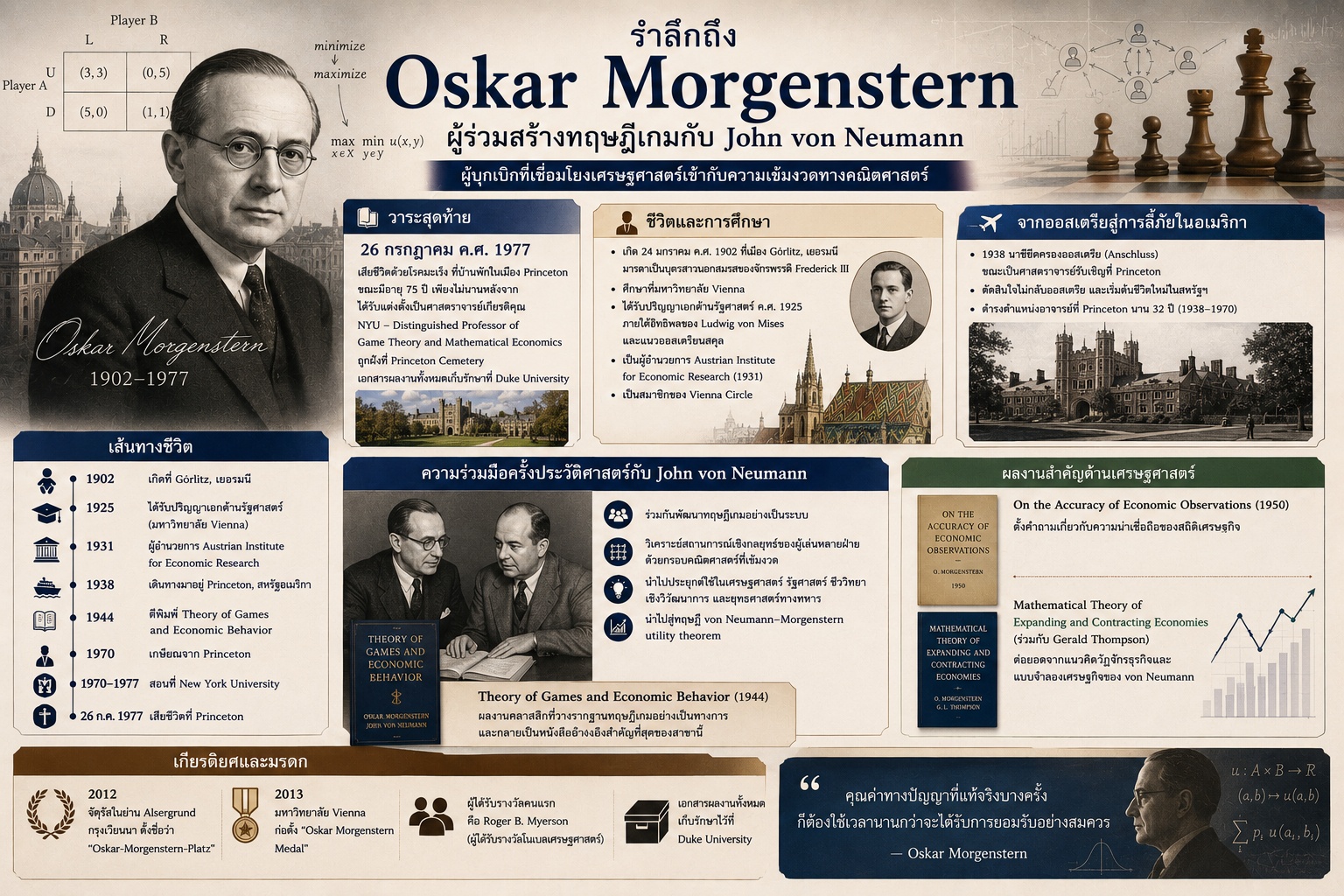
Oskar Morgenstern passed away from cancer on July 26, 1977, at his home in Princeton, New Jersey, at the age of 75, shortly after New York University had appointed him as a Distinguished Professor of Game Theory and Mathematical Economics. He was buried at Princeton Cemetery, and all of his work documents are kept at Duke University.
A son with royal blood from his mother
Oskar Morgenstern was born on January 24, 1902, in the town of Görlitz, Silesia, Germany. Interestingly, his mother was the illegitimate daughter of German Emperor Frederick III, which meant that Morgenstern had German royal blood by birth, even though he didn’t really talk much about it during his career.
He continued his studies at the University of Vienna and earned a PhD in Political Science in 1925, influenced by Ludwig von Mises, an Austrian School economist, and the ideas of Eugen Böhm-Bawerk. He began his career as a member of the Austrian economics institute, working with many famous economists, and served as the director of the Austrian Institute for Economic Research starting in 1931. He was also a member of the Wiener Kreis, or Vienna Circle, a group of thinkers that included famous philosophers and scientists like Karl Popper and Kurt Gödel.
From Austria to seeking asylum in America
A major turning point in Morgenstern's life happened in 1938 when Nazi Germany took over Austria (Anschluss). At that time, he was a visiting professor at Princeton University, so his colleagues suggested he stay in the United States instead of going back to Austria. He decided to start a new life in a new place and took a full-time faculty position at Princeton, where he stayed for 32 years until 1970.
A historic collaboration with John von Neumann
The thing that made Morgenstern's name most remembered in academic history is his collaboration with John von Neumann, the great mathematician at Princeton. Together, they systematically developed game theory, which von Neumann had previously sketched out back in 1928. But it was Morgenstern who saw the potential to apply this theory systematically to economic and business problems.
The joint work of the two of them is a book Theory of Games and Economic Behavior Published in 1944, which became a classic work that laid the foundation for the field of formal game theory, this book presents a rigorous mathematical framework for analyzing situations where multiple players have to make strategic decisions and the outcomes depend on everyone's choices. This theory became an important tool applied in economics, political science, evolutionary biology, and even military strategy. The work also led to the von Neumann–Morgenstern utility theorem, which is a key foundation of decision theory under uncertainty.
Other works in economics
Besides game theory, Morgenstern also made important contributions to the accuracy of economic data through his book *On the Accuracy of Economic Observations* in 1950, which raised challenging questions about the reliability of the economic statistics used at the time. He also collaborated with Gerald Thompson on *Mathematical Theory of Expanding and Contracting Economies*, which built on his interest in business cycles and von Neumann's model of economic growth.
After retiring from Princeton in 1970, he moved to teach at New York University until the end of his life, focusing on empirical studies of financial markets, particularly the dynamics of the New York Stock Exchange, reflecting his ongoing interest in applying economic theory to real-world problems.
A legacy that is still respected
In 2012, a square in the Alsergrund district of Vienna was named 'Oskar-Morgenstern-Platz' in his honor. It's the location of the Faculty of Economics and Mathematics at the University of Vienna. Then, in 2013, the same university established the Oskar Morgenstern Medal to award economists with outstanding achievements, with the first recipient being Roger B. Myerson, a Nobel Prize winner in Economics.
Every year on the anniversary of his passing, Oskar Morgenstern's name continues to be a reminder of the power of interdisciplinary collaboration, combining von Neumann's mathematical rigor with Morgenstern's deep economic insights, together creating analytical tools that forever changed the way both fields think.