Gerd Faltings: The Solver of the Mordell Conjecture Whom Andrew Wiles Had to Consult
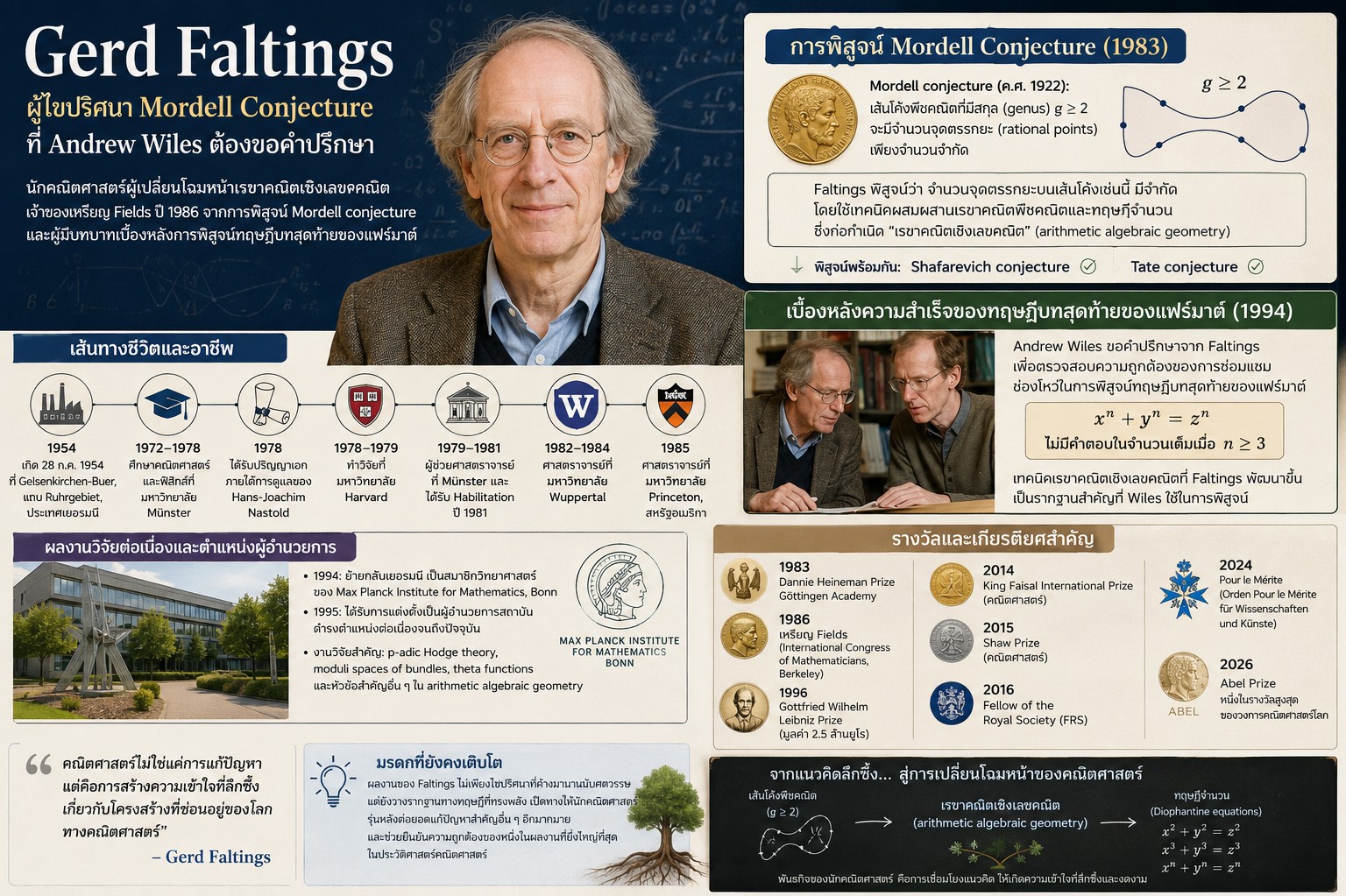
Among living mathematicians, Gerd Faltings is one of the most influential figures in shaping arithmetic algebraic geometry. He won the Fields Medal in 1986 for proving the Mordell conjecture and is an important behind-the-scenes figure that many might not know about, especially since Andrew Wiles consulted him before announcing his proof of Fermat's Last Theorem in 1994.
From the industrial city of Ruhr to the world of mathematics
Gerd Faltings was born on July 28, 1954, in Gelsenkirchen-Buer, an industrial city in the Ruhr area of Germany. He finished high school there in 1972 before studying mathematics and physics at the University of Münster from 1972 to 1978, earning his PhD in 1978 under the supervision of Hans-Joachim Nastold.
After graduating, he did research for a year at Harvard University before returning to Germany as an assistant professor at Münster and earned his Habilitation in 1981. He was a professor at Wuppertal University from 1982 to 1984 before moving to be a professor at Princeton University in the United States starting in 1985.
The proof of the Mordell Conjecture that caused a worldwide sensation
The work that brought Faltings the most fame happened in 1983, when he was able to prove the Mordell conjecture. This was a hypothesis proposed by Louis Mordell back in 1922, which states that algebraic curves with genus greater than or equal to two have only a limited number of rational points. This conjecture is deeply connected to fundamental problems in Diophantine number theory that mathematicians had been trying to solve for decades.
Faltings' most famous work came in 1983 when he succeeded in proving the Mordell conjecture. Faltings used techniques that deeply combined algebraic geometry with number theory, which is now known as arithmetic algebraic geometry. In the same proof, he also managed to prove other related conjectures, including those proposed by Shafarevich and Tate. This work caused a huge stir in the mathematics community, earning him the Dannie Heineman Prize from the Göttingen Academy of Sciences that same year and the Fields Medal at the international congress in Berkeley in 1986, which is the highest honor a young mathematician can receive. The conjecture, first proposed by Louis Mordell in 1922, states that algebraic curves of genus two or higher have only a finite number of rational points. This conjecture is deeply connected to fundamental problems in Diophantine number theory that mathematicians had been trying to solve for decades.
The behind-the-scenes role in proving Fermat's Last Theorem
One of the most interesting stories in Faltings' career happened in 1994, when Andrew Wiles was trying to fix a gap in his proof of Fermat’s Last Theorem that he had announced earlier. Wiles turned to Faltings for advice, as one of the most trusted experts in arithmetic geometry, to check the correctness of the fix that he ultimately succeeded in making.
This connection isn’t a coincidence, because the arithmetic geometry techniques that Faltings developed to prove the Mordell conjecture are part of the key technical foundation that Wiles used to build his own proof. The fact that Faltings was the one to verify one of the most important works in the history of mathematics really highlights his expertise and credibility in the field.
Ongoing research work and director position
In 1994, Faltings moved from Princeton to become a scientific member of the Max Planck Institute for Mathematics in Bonn, Germany, and became the director of the institute the following year, a position he held for many decades. His later research covered p-adic Hodge theory, moduli spaces of bundles, and theta functions, all of which further deepened his expertise in arithmetic geometry.
In 1996, he won the Gottfried Wilhelm Leibniz Prize, which is Germany's biggest research award, along with a research grant worth 2.5 million euros. He’s also received many other major awards, including the King Faisal International Prize in 2014, the Shaw Prize in 2015, and was elected as a foreign member of the Royal Society in 2016.
The latest honor and a legacy that continues to grow
Faltings' achievements continue to be widely recognized to this day. He received the Pour le Mérite award in 2024, and most recently, in 2026, he was honored with the prestigious Abel Prize, considered one of the highest awards in mathematics worldwide, comparable to a Nobel Prize. This solidifies his status as one of the most influential mathematicians of our time.
Faltings' work still serves as a key foundation for modern number theory and algebraic geometry. The techniques he developed not only solved long-standing puzzles that lasted decades but also opened the door for later mathematicians to build on them and tackle many other important problems, including helping confirm the correctness of one of the greatest achievements in the history of mathematics: the proof of Fermat's Last Theorem.