Remembering Gaspard Monge, the father of descriptive geometry
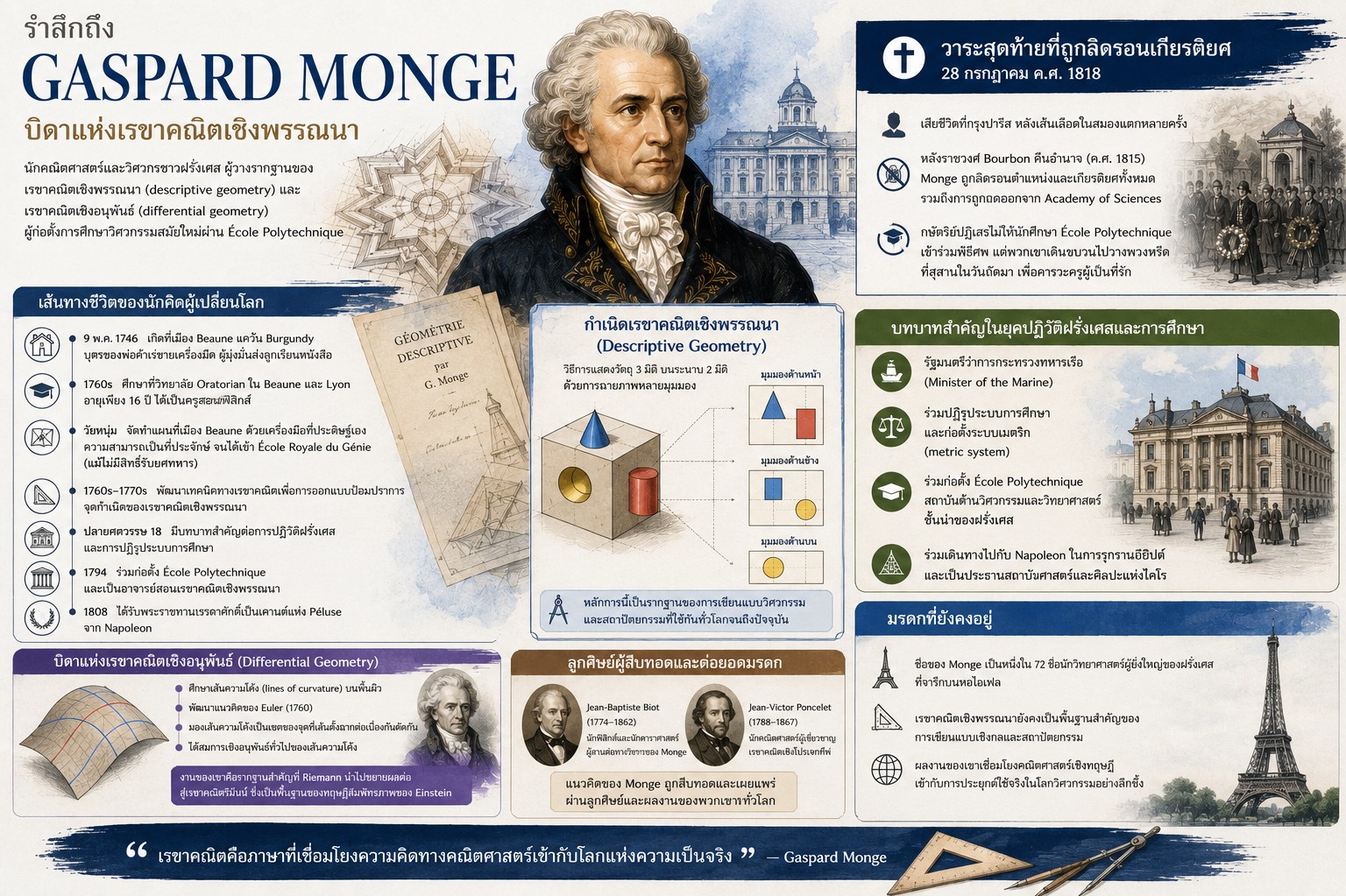
Gaspard Monge was a French mathematician who is acclaimed as the father of descriptive geometry and differential geometry, and he founded and taught at École Polytechnique, which became a key foundation for modern engineering drawing. On this occasion, let's take a moment to look back on the life of this thinker who went through both glory and downfall along with the French Revolution.
The final moment of stripped honor, July 28, 1818
Gaspard Monge passed away on July 28, 1818, in Paris after suffering several strokes. The final years of his life were full of physical and emotional pain. When the Bourbon monarchy was restored in France in 1815, Monge, who refused to change his anti-royalist political stance, was stripped of all his honors and positions, including being removed from the Academy of Sciences, which he had once been proud of.
Even though he was excluded from the royal court, when he passed away, many students from École Polytechnique requested permission to attend his funeral, but the king denied their request. However, the next day, those students marched to the cemetery to lay a wreath in honor of their beloved teacher themselves. It’s a clear reflection that, even though political power could take away his official honors, it couldn’t take away the respect of his true students.
The child of a traveling merchant who has a talent for exploration
Gaspard Monge was born on May 9, 1746, in the town of Beaune, Burgundy, France. His father was a traveling knife merchant who devoted everything to send his three sons to school. He was educated at the Oratorian colleges in Beaune and Lyon, and by the age of just 16, he was already teaching physics.
A major turning point happened when he went back to visit his hometown of Beaune and made a detailed map of the town using surveying methods and tools he invented himself. This map impressed a military officer so much that he recommended him to study at the École Royale du Génie in Mézières. Even though his social status meant he couldn’t hold a military rank, he was allowed to enroll in the surveying and drafting courses, even though he was told he had no right to handle problems that required advanced calculations.
The Origin of Descriptive Geometry
The start of the work that made Monge famous came when he was assigned to solve a military fortress design problem, which usually required complex and time-consuming algebraic calculations. But Monge developed a geometric method that could solve the same problem quickly and accurately. This method was so powerful that it was kept as a military secret for many years.
This technique itself was developed into descriptive geometry, which is a method of representing three-dimensional objects on a two-dimensional plane by projecting them from different viewpoints. This principle became a key foundation for engineering and architectural drawing used worldwide to this day. Even nowadays, descriptive geometry isn’t an actively researched field in mathematics anymore, but its basic principles are still a crucial part of mechanical and architectural drawing.
The founder of École Polytechnique and their role in the French Revolution
Monge played a very important role during the French Revolution. He served as the Minister of the Marine and took part in reforming the French education system, including helping to establish the metric system, which is used worldwide today. But his most significant contribution in education was being one of the founders and a key teacher at École Polytechnique, France's leading institution for engineering and science that remains prestigious to this day. He personally taught descriptive geometry there.
He also traveled with Napoleon Bonaparte during the invasion of Egypt and played an important role in the Egyptian Institute of Sciences and Arts, which was established during that campaign. Napoleon trusted him enough to make him the president of the institute. Later, in 1808, Napoleon appointed him as the Count of Péluse.
The key foundation of curvature theory that Riemann built upon
Besides descriptive geometry, Monge also made significant contributions to the theory of surface curvature by studying lines of curvature on surfaces. This built upon the work of Leonhard Euler, who first defined these lines back in 1760. Monge further developed the idea by looking at lines of curvature as sets of points on a surface where continuous normal lines intersect, and he derived the general differential equations for these lines. This work laid an important foundation for what we now call differential geometry, which Bernhard Riemann later expanded on in Riemannian geometry. These concepts became a key foundation that Albert Einstein used later to develop the theory of general relativity.
A Legacy That Remains a Fundamental Foundation
Even though Monge faced political decline later in life, his academic legacy remains significant. His name is one of the 72 great French scientists engraved on the Eiffel Tower, and many of his famous students, like Jean-Baptiste Biot and Jean-Victor Poncelet, continued to inherit and build on his intellectual legacy. Every year on the anniversary of his passing, Gaspard Monge's name still serves as a reminder of the power of geometric creativity that links theoretical mathematics to practical applications in engineering.