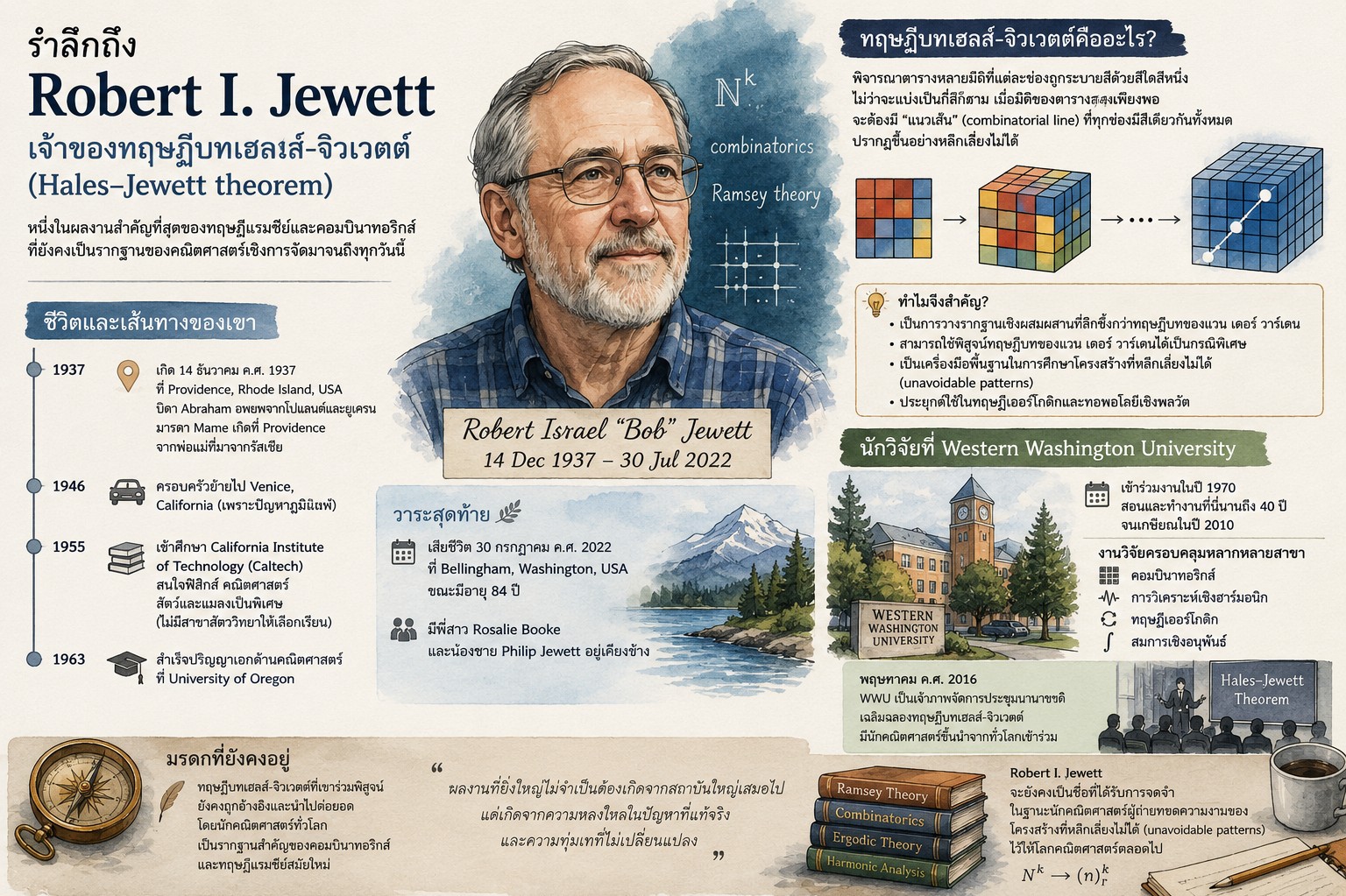
In memory of Robert I. Jewett, the owner of the Hales-Jewett theorem
Robert I. Jewett was an American mathematician, one of the co-creators of the Hales–Jewett theorem, an important work in the fields of combinatorics and Ramsey theory, which has become a fundamental tool in the field of combinatorial mathematics to this day. On this occasion, we would like to reflect on the life of a mathematician who lived and worked quietly at a small university in the state of Washington for as long as 40 years.
Final agenda in Bellingham July 30, 2022
Robert Israel “Bob” Jewett passed away on July 30, 2022, in Bellingham, Washington, at the age of 84, twelve years after he retired from his position as a mathematics professor at Western Washington University in 2010, the institution where he had taught for 40 years. He passed away with his sister Rosalie Booke and brother Philip Jewett by his side.
The boy who loved insects and animals more than math at first
Robert Israel Jewett was born on December 14, 1937, in Providence, Rhode Island. His father, Abraham, immigrated from Poland and Ukraine via Canada before settling in the United States. His mother, Mame, was born in Providence to parents who came from Russia. In 1946, the family moved to Venice, California, partly because of Bob's own allergy issues.
While studying at Venice High School, he was interested in both physics and mathematics, as well as animals and insects in particular. In 1955, he enrolled at the California Institute of Technology (Caltech), and since there was no zoology major available, he focused on physics and mathematics instead, before pursuing a doctoral degree at the University of Oregon and graduating in 1963.
Hales-Jewett Theorem: The Fundamental Basis of Ramsey Theory
The work that brought Jewett the most fame was co-proving the Hales–Jewett theorem together with Alfred W. Hales, which is one of the most fundamental results in Ramsey theory. This theorem concerns multi-dimensional grid-type games, such as tic-tac-toe, extended to increasingly higher dimensions, stating that when the dimension of the grid is high enough, no matter how the grid cells are divided into colors, there will inevitably be a line in a single color.
This theorem is extremely important because it lays a deeper combinatorial foundation than van der Waerden’s theorem, which is a classical theorem concerning arithmetic progressions in sets of integers. The Hales-Jewett theorem can be used to prove van der Waerden’s theorem as a special case, making it a fundamental tool in studying unavoidable patterns in combinatorial mathematics, and it has also been applied in ergodic theory and dynamical topology.
Multidisciplinary researchers at Western Washington University
Jewett joined Western Washington University in 1970 and worked there throughout the rest of his career, for up to 40 years. His research was not limited to combinatorics but also encompassed harmonic analysis, ergodic theory, and differential equations, demonstrating his broad mathematical interests.
Even though he works at a small university that emphasizes teaching over research, Jewett's work has received international recognition. In May 2016, Western Washington University hosted an international academic conference specifically to celebrate the Hales–Jewett theorem, which attracted leading mathematicians from around the world to attend.
The legacy that still remains a fundamental foundation of combinatorics
On the anniversary of his passing every year, the name of Robert I. Jewett remains a part of the fundamental foundations of modern Ramsey theory and combinatorics. The Hales–Jewett theorem that he co-proved continues to be cited and built upon by mathematicians around the world. It serves as evidence that valuable mathematical work does not necessarily have to occur only in large research institutions, but can flourish from dedication and passion for genuine problems, no matter where one works.