Hermann Brunn: From Convex Geometry to the Famous Borromean Rings
Hermann Brunn was a German mathematician who had significant work in two areas that seem completely different: convex geometry, through the famous Brunn–Minkowski inequality, and knot theory, through the concept of Brunnian links, well known in the example of the Borromean rings. Both of these works remain important fundamental tools in modern mathematics to this day.
From Rome to the city of Munich
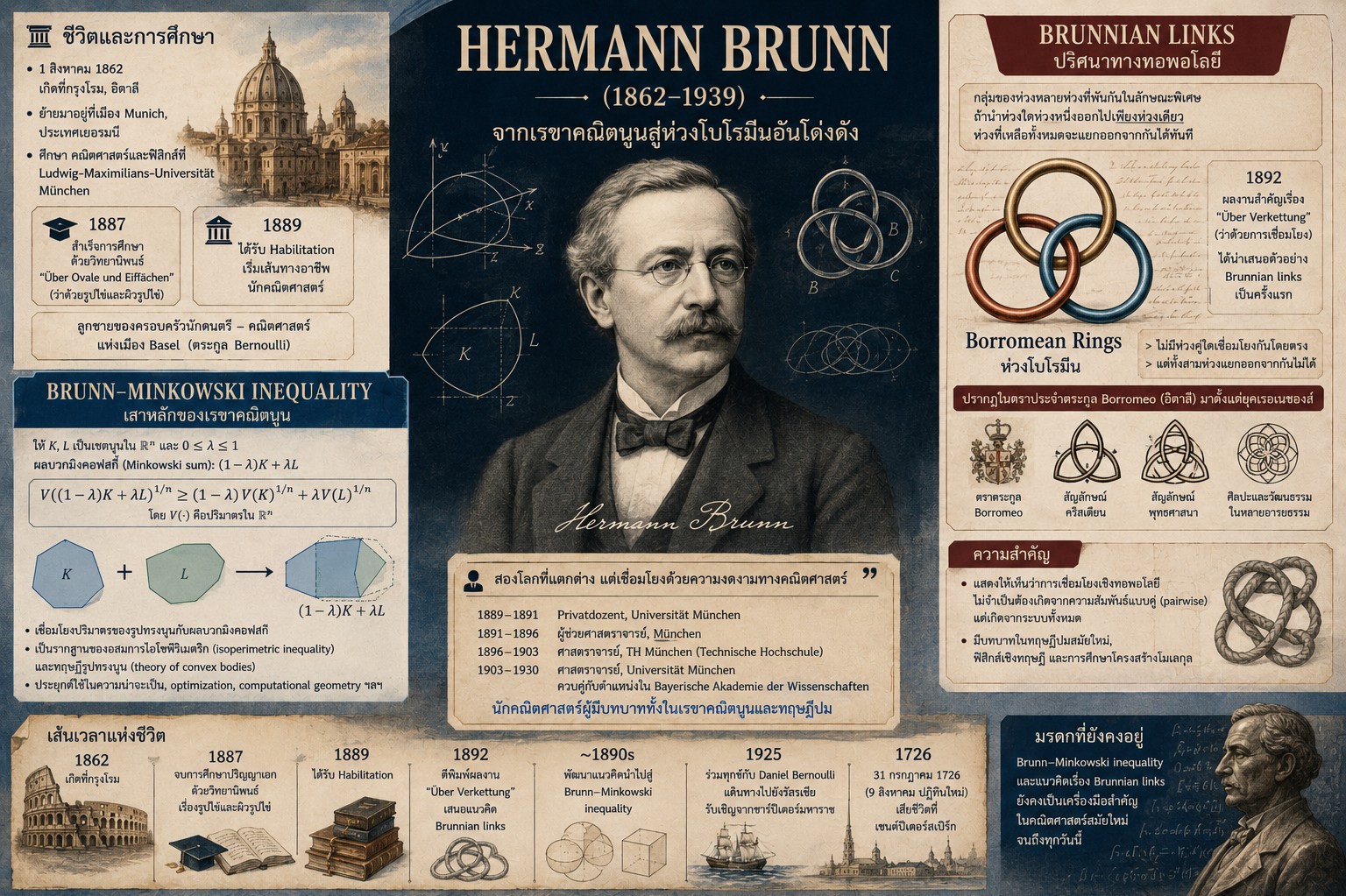
Hermann Brunn, or full name Karl Hermann Brunn, was born on August 1, 1862, in Rome, Italy, before his family moved to settle in Munich, Germany, which is where he grew up. He studied mathematics and physics at Ludwig-Maximilians-Universität München and graduated in 1887 with a thesis titled “Über Ovale und Eiflächen” (On Ovals and Egg-shaped Surfaces), which marked the beginning of his lifelong interest in convex shapes, before receiving his Habilitation in 1889.
Brunn–Minkowski Inequality: The Pillar of Convex Geometry
The work that brought Brunn the most fame was laying the groundwork for what later developed into the Brunn–Minkowski inequality, which is one of the most fundamental and powerful results in convex geometry. This inequality connects the volumes of two convex shapes with the volume of their Minkowski sum, providing an exact lower bound that became a key tool in analyzing the properties of convex shapes in various dimensions.
Brunn began developing this concept in his thesis on ovals and oval surfaces, before Hermann Minkowski, another famous mathematician, further developed it to be more complete and general at a later time, resulting in an inequality named after both of them. The Brunn–Minkowski inequality has a deep connection with the isoperimetric inequality, which is a classical problem studying the relationship between surface area and volume of shapes, and it is also an important foundation of modern convex body theory, which has wide applications in various fields, including probability theory, optimization, and computational geometry.
Brunnian Links: Topological puzzles hidden in intertwined loops
Apart from convex geometry, Brunn also made significant contributions to knot theory through his 1892 paper "Über Verkettung" (On Linking), which presented examples of what are now called Brunnian links—a group of multiple loops linked in a special way, such that all the loops are connected so that they cannot be separated, but if any one loop is removed, all the remaining loops can immediately separate freely.
The most famous example of Brunnian links is the Borromean rings, which consist of three interlocked rings in such a way that no pair of rings is directly linked, yet all three rings cannot be separated when combined. This symbol has a history that predates Brunn's work, appearing in the coat of arms of the Borromeo family in Italy since the Renaissance, and it has also appeared in various religious and cultural symbols around the world before that. However, Brunn was the first to study the topological structure of this phenomenon systematically in a mathematical way.
The concept of Brunnian links is extremely important in modern knot theory because it serves as an example showing that the properties of topological linking do not arise solely from pairwise relationships but can only emerge from the system as a whole. This concept has influenced the development of topological mathematics and theoretical physics in later times, as well as applications in studying entangled molecular structures in modern chemistry and molecular biology.
The heritage that connects two different branches
Hermann Brunn passed away on September 20, 1939, at the age of 77. An interesting aspect of his legacy is the two areas of work he left behind: convex geometry and knot theory. Although they seem to have no direct connection, both have become fundamental foundations of two separate fields in modern mathematics. The Brunn–Minkowski inequality remains an indispensable basic tool in convex geometry, while Brunnian links continue to be classic examples that knot theorists around the world reference when explaining complex systemic linking phenomena. Brunn's story is thus a testament to how a mathematician's creative thinking can take root in remarkably diverse directions.