Gregorio Ricci-Curbastro: The Overlooked Tool for Decades Before Einstein Discovered It Was the Key to the Universe
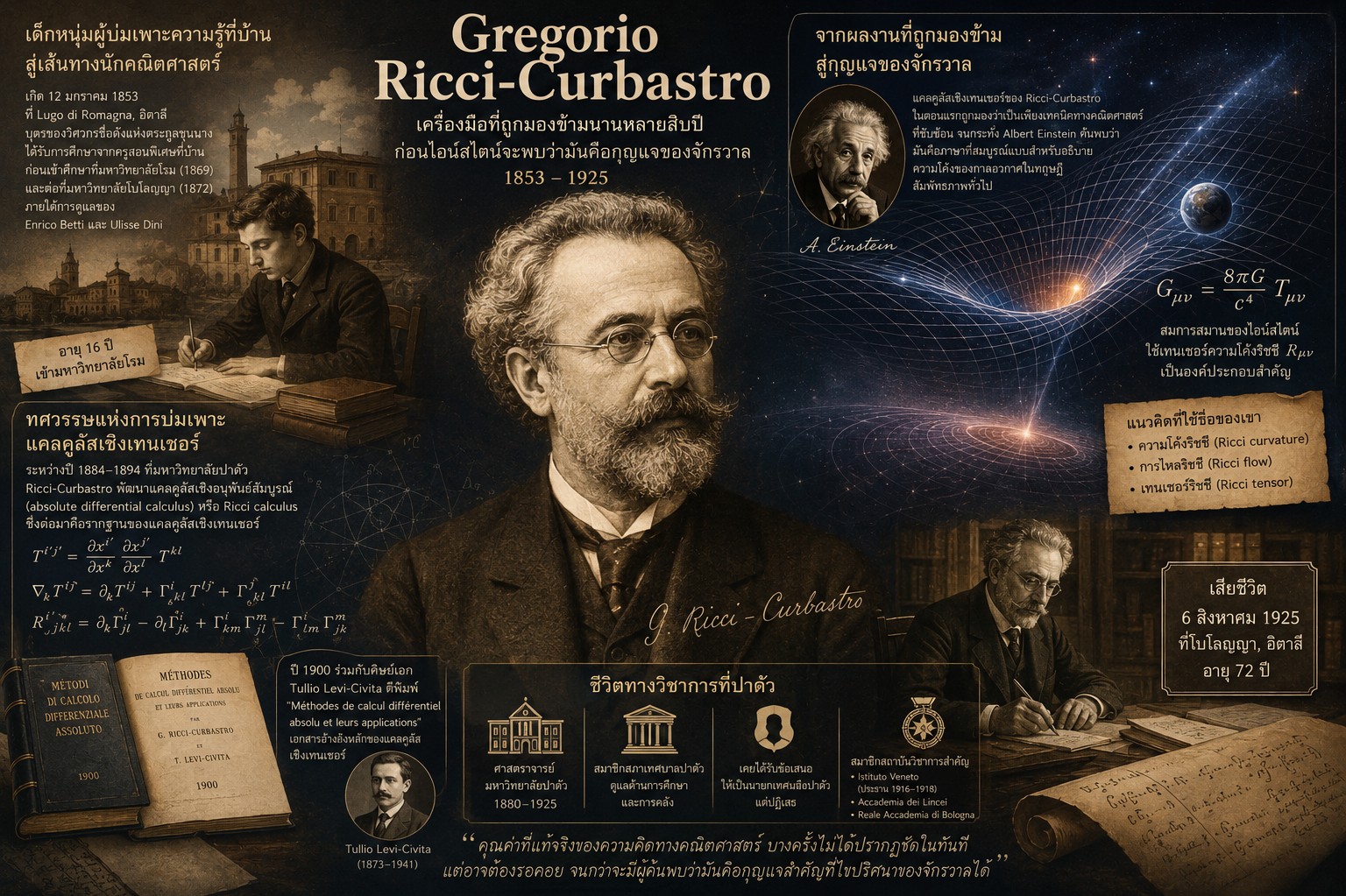
Few mathematical works have had to wait for several decades before the world recognized their true value. The story of Gregorio Ricci-Curbastro, an Italian mathematician, is one of the clearest examples. He spent more than a decade developing a mathematical tool that was initially regarded as merely a “technical achievement,” before Albert Einstein later discovered that this tool was an indispensable key to the creation of the theory of general relativity. Ricci-Curbastro died on August 6, 1925, in Bologna, Italy, at the age of 72.
Home Education in the Noble Family of Ravenna
Ricci-Curbastro was born on January 12, 1853, in Lugo di Romagna, into a prominent noble family of the Ravenna region. His father, Antonio Ricci-Curbastro, was a renowned engineer. Unlike most children of his time, Ricci-Curbastro and his brother did not attend school but instead received all of their primary and secondary education from private tutors at home. He entered the University of Rome in 1869 at the age of only 16, intending to study mathematics and philosophy, before transferring to the University of Bologna in 1872. He later graduated from the Scuola Normale Superiore di Pisa under the supervision of Enrico Betti and Ulisse Dini.
A Decade of Developing Tensor Calculus
Between 1884 and 1894, while serving as a professor at the University of Padua, Ricci-Curbastro devoted more than a decade to developing a mathematical system known as absolute differential calculus, later recognized as Ricci calculus, and now commonly referred to as tensor calculus. This system provided mathematical tools for handling complex quantities whose values remain unchanged regardless of the coordinate system from which they are viewed. It was particularly suited for describing the properties of surfaces and curved spaces in higher dimensions.
In 1900, he collaborated with his important student Tullio Levi-Civita to publish the work “Méthodes de calcul différentiel absolu et leurs applications,” which became a major reference document for tensor calculus. It was also the only time Ricci-Curbastro used the abbreviated name “Ricci” in a publication, causing citation confusion that continues to the present day.
From an Overlooked Work to the Foundation of the Theory of Relativity
Despite its depth and significance, Ricci-Curbastro’s tensor calculus initially received little attention from the mathematical community. It was regarded more as a highly complex mathematical technique rather than a profound innovation. It was not until Albert Einstein discovered that this tool was perfectly suited for what he was seeking—the mathematical language needed to describe the curvature of spacetime in the theory of general relativity—that its true importance was recognized. Tensor calculus then became an indispensable tool in modern physics and made Ricci-Curbastro’s name known worldwide, even though he did not live to see the extent to which Einstein would apply his work. Concepts such as Ricci curvature and Ricci flow, which bear his name, continue to serve as fundamental pillars of differential geometry to this day.
His Academic Life in Padua
Throughout his professional life, Ricci-Curbastro served as a professor at the University of Padua from 1880 until the end of his life in 1925. In addition to his research work, he served as a member of the Padua City Council, overseeing education and finance, and was once offered the position of Mayor of Padua, which he declined. He was honored as a member of several academic institutions, including the Istituto Veneto (where he served as president from 1916 to 1918), the Accademia dei Lincei, and the Reale Accademia di Bologna.
Gregorio Ricci-Curbastro died on August 6, 1925, in Bologna. His story serves as a reminder that the true value of some mathematical ideas may not be immediately apparent, but may require time until someone discovers that they are the key to unlocking the mysteries of the universe.