Cathleen Morawetz: The woman who used equations to explain why airplanes can fly safely
In an industry where women hardly had a place in the 20th century, Cathleen Synge Morawetz, a Canadian-American mathematician, not only overcame obstacles to become one of the leading experts in partial differential equations of her time but also rose to become the second female president in the 105-year history of the American Mathematical Society. She passed away on August 8, 2017, at her home in Greenwich Village, New York City, at the age of 94.
The daughter of a mathematician who grew up among numbers
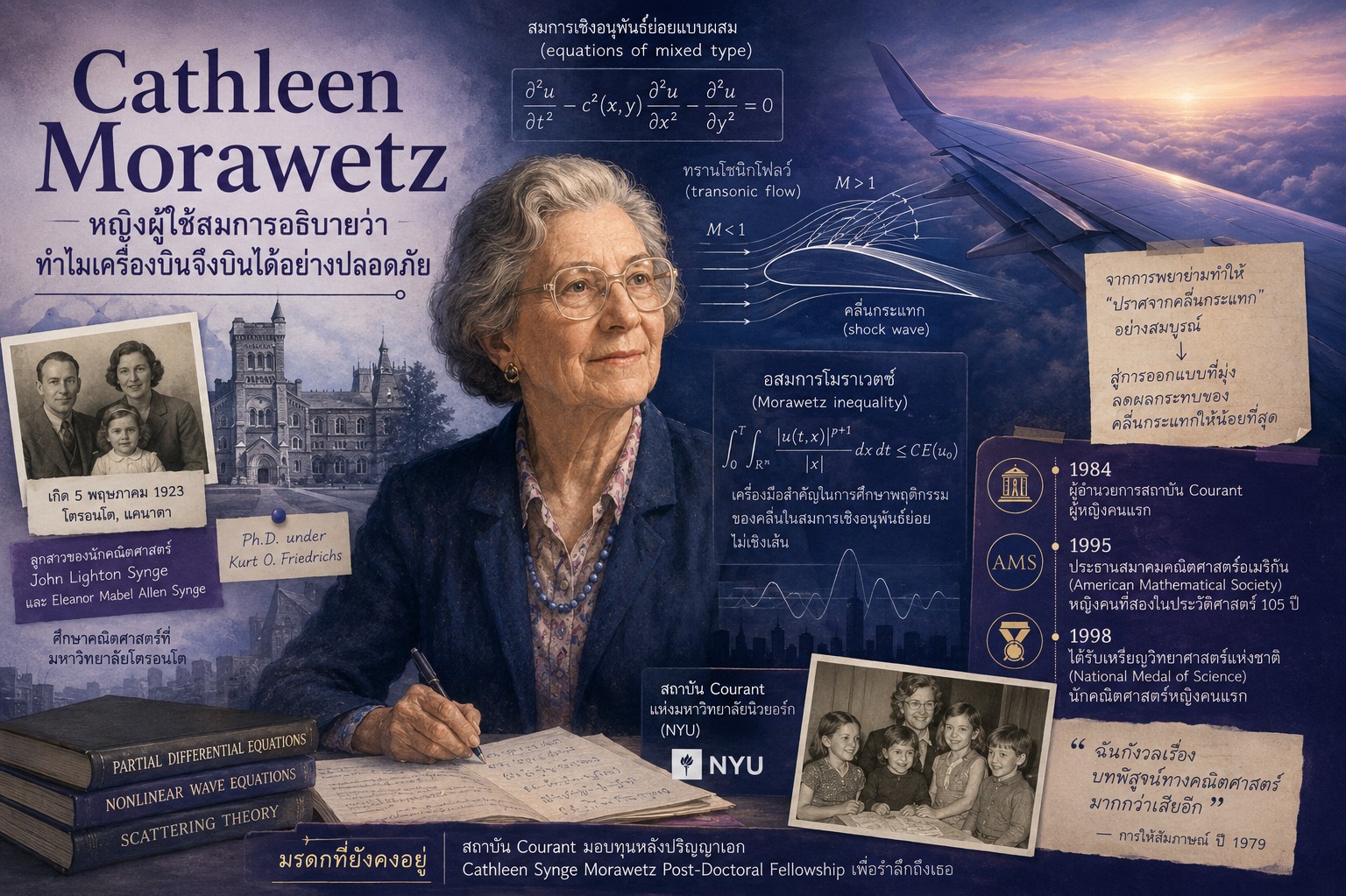
Morawetz was born on May 5, 1923, in Toronto, Canada, under the name Cathleen Synge. She was the daughter of John Lighton Synge, a renowned mathematician, and her mother, Eleanor Mabel Allen Synge, was also trained in mathematics. Both were Irish. When she was only two years old, her family moved back to Ireland when her father received a position as a professor of natural philosophy at the University of Dublin, before moving back to Toronto again when she was 7 years old. Morawetz received a scholarship and studied mathematics at the University of Toronto before moving to the United States to continue her studies and earn a Ph.D. under the supervision of Kurt Otto Friedrichs.
The equation that explains why airplane wings are safe
Morawetz's research focused on mixed-type partial differential equations related to transonic flow — situations where air flows over parts of an airplane wing at supersonic speeds, even though the airplane itself is flying at subsonic speeds. In three major research works in the late 1950s, she used functional analysis combined with clever new approximations to explain this phenomenon. This research transformed the understanding of aerospace engineers, from trying to design wings that were completely 'shock-free' to designing wings that minimized the effects of shock waves, an approach that is still used in the aviation industry today.
Later, in the 1970s, she turned to the study of scattering theory and nonlinear wave equations, and was the one who proved the inequality now known as the Morawetz inequality, which became an important tool in studying the behavior of waves in nonlinear partial differential equations.
The first female director and the first female president of AMS
Morawetz spent almost her entire working life at the Courant Institute of New York University (NYU), and in 1984 she was appointed director of the Courant Institute, making her the first woman to hold this position and also the first woman to hold an equivalent administrative position in the field of mathematical sciences across the United States. Later in 1995, she was elected president of the American Mathematical Society, becoming the second woman in the society's history to hold this position, and in 1998, she received the National Medal of Science for her pioneering work on partial differential equations and wave propagation, which was applied to aerodynamics, acoustics, and optics, becoming the first female mathematician to receive this honor.
Family life and the legacy left behind
Despite having a distinguished career, Morawetz also lived a full family life. She married chemist Herbert Morawetz in 1945 and had four children together. When asked in a 1979 interview whether she worried about her children while working, she jokingly replied that she was more concerned about mathematical proofs instead.
Cathleen Morawetz passed away peacefully at her home in New York City on August 8, 2017, leaving a legacy both as a mathematician who changed the way engineers design airplanes and as a pioneer for women in mathematics for generations to come. Today, the Courant Institute continues to award the Cathleen Synge Morawetz Post-Doctoral Fellowship in her memory.