Ralph Boas: A mathematician who believed that mathematics should be fun, and an editor who curated knowledge for the world
Ralph Boas: A mathematician who believed that mathematics should be fun, and an editor who curated knowledge for the world. When talking about mathematicians who influenced the field not only through their own research but also through their behind-the-scenes role in maintaining the quality of mathematical knowledge across the field, Ralph Philip Boas Jr. is one of the most prominent names. He was born on August 8, 1912, in Walla Walla, Washington, United States, and grew up to be both a leading mathematical analyst, a textbook author, and one of the most influential editors in the history of mathematical journals.
A child who graduated from high school at the age of 15
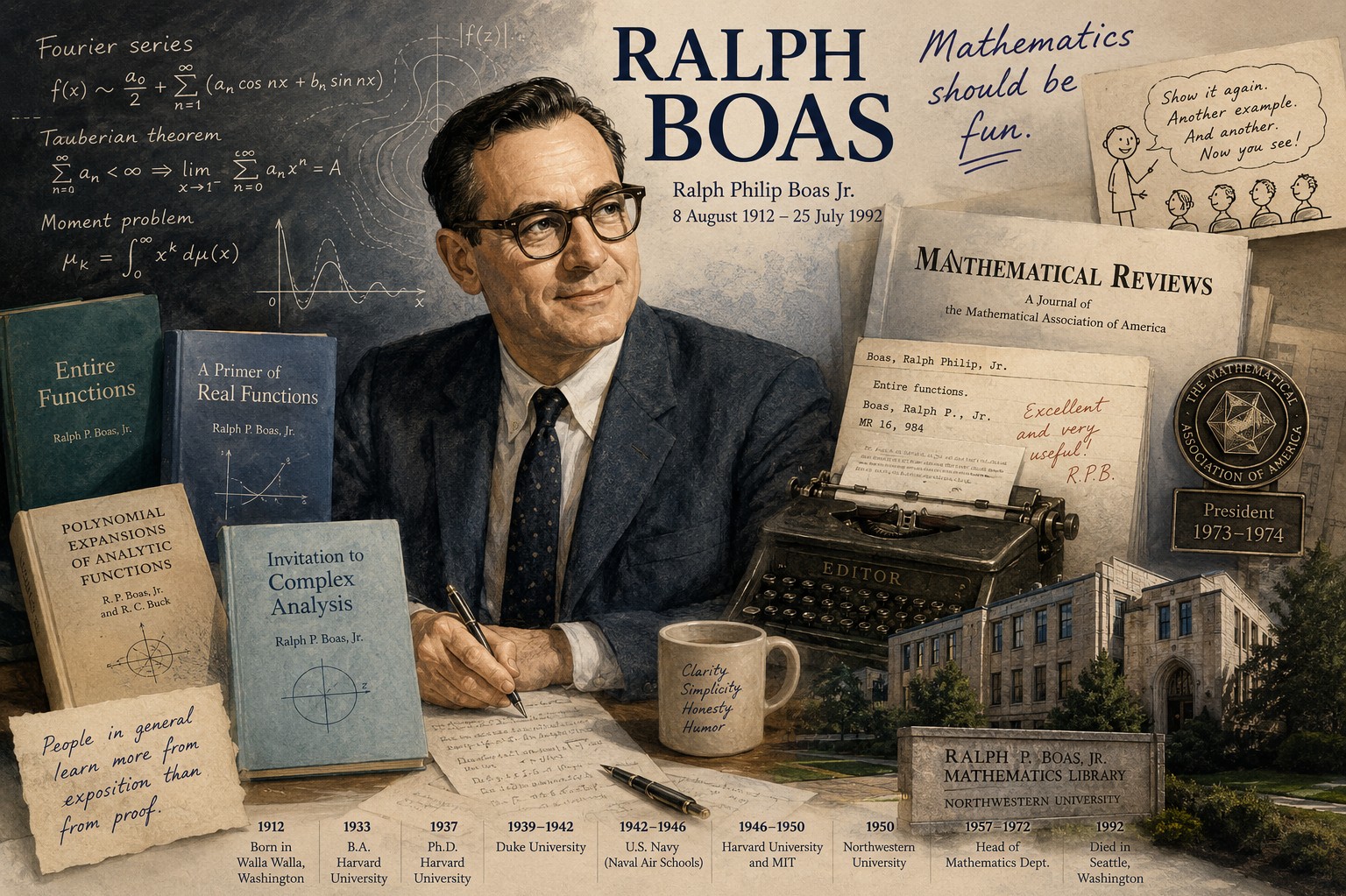
Boas was the son of a professor of English at Whitman College. His family moved frequently according to his father's career. He was homeschooled until the age of 8 before entering the formal school system in the 6th grade. With his outstanding intelligence, he graduated from high school at only 15 years old. After spending a year attending lectures at Mount Holyoke College, where his father taught, Boas then enrolled at Harvard University, initially intending to study chemistry to pursue medicine, but ultimately became fascinated with mathematics instead. He earned his bachelor's degree in 1933 and his doctorate in 1937 under the supervision of David Widder.
Expert in complex analysis and Fourier series
Boas's research focused on real and complex analysis, particularly Fourier series, moment problems, and Tauberian theorems. He published over 200 research papers throughout his career and is especially remembered for his clearly written textbooks, such as “Entire Functions” (1954) and “A Primer of Real Functions” (1960), which are still used in classrooms today. Additionally, he co-authored the book “Polynomial Expansions of Analytic Functions” with R. C. Buck and the introductory textbook for beginners, “Invitation to Complex Analysis,” in 1987.
After graduation, Boas received a two-year national research fellowship that took him to work with Salomon Bochner at Princeton, before teaching at Duke University from 1939 to 1942. He then moved to teach at the U.S. Navy Air School during the war, and later returned to Harvard and MIT, before being appointed as a professor at Northwestern University in 1950, where he served as the head of the mathematics department from 1957 to 1972.
Editor, the gatekeeper of global mathematics research quality
Apart from research and teaching, the role that made Boas's name known throughout the mathematics community was his position as editor of the journal Mathematical Reviews, a journal that collects and reviews new mathematical research from around the world. It is an important reference that every mathematician relies on to keep up with developments in various fields. He also served as president of the Mathematical Association of America during 1973-1974.
What made Boas beloved among his colleagues was not just his academic expertise, but the humor he consistently infused into his poetry, stories, and the reflections he left behind, such as the saying that ordinary people learn more from explanations than from proofs, or his humorous advice on teaching new concepts to children by using repeated examples instead of complex definitions.
Ralph Boas passed away on July 25, 1992, in Seattle, Washington, leaving a legacy as a researcher, textbook author, and guardian of the quality of mathematical knowledge that continues to influence the field to this day. Currently, the mathematics library at Northwestern University still bears his name in his honor.