Georg Pick: The formula owner that students around the world still use, but real life ended in a concentration camp
There are not many mathematical formulas that are simple enough to teach to school children, yet profound enough to still be referenced in advanced research — Pick's theorem is one such formula. The owner of this theorem, Georg Alexander Pick, an Austrian mathematician, was born on August 10, 1859, in Vienna, into a Jewish family. However, his life ended brutally in a Nazi concentration camp in 1942.
A prodigy who published research at the age of 17
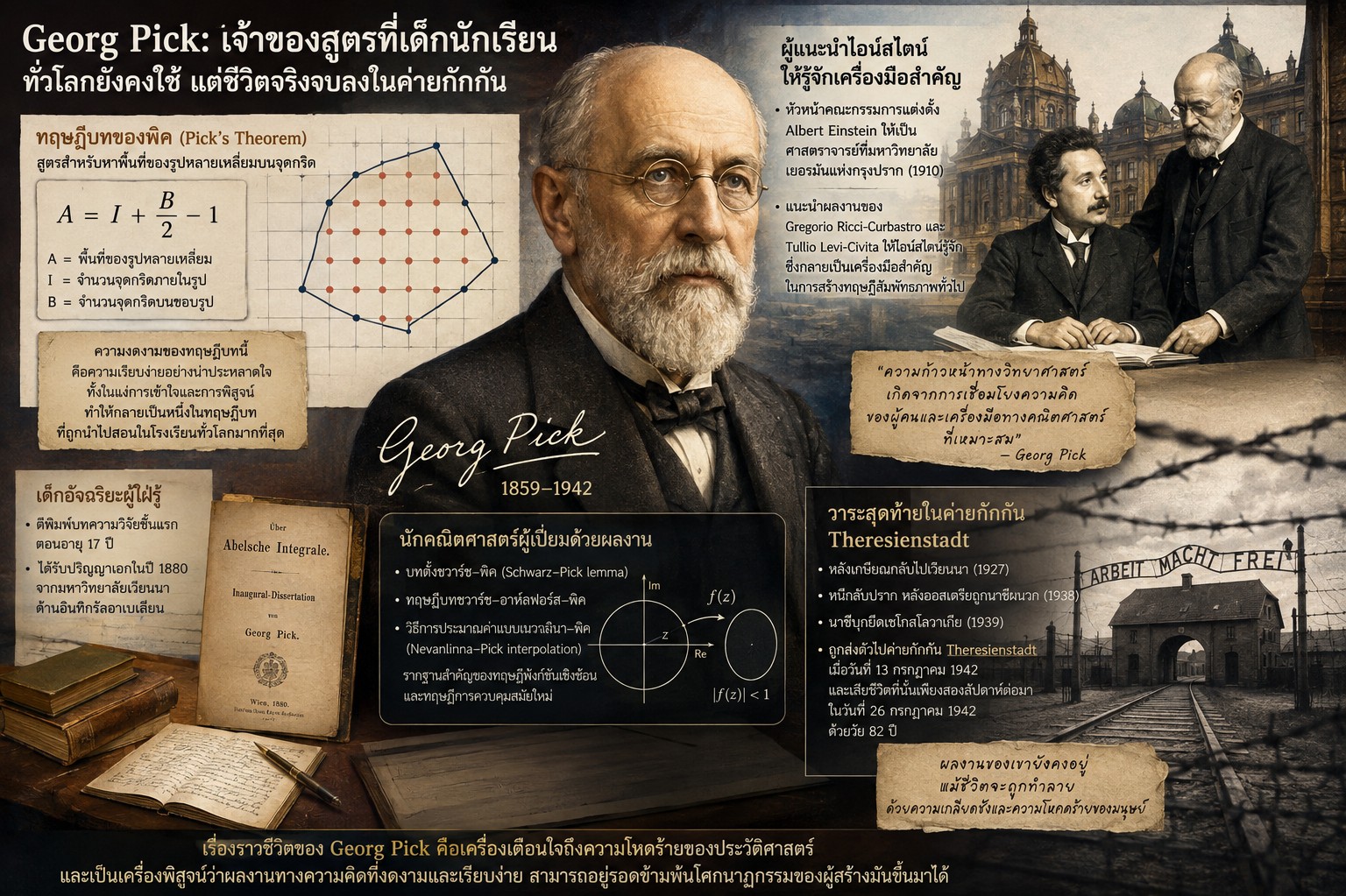
Pick received his early education from his father at home until the age of 11, before attending the Leopoldstädter Communal Gymnasium and passing the final secondary school examination in 1875, which qualified him to enter university immediately. He enrolled at the University of Vienna in the same year and published his first mathematical research paper at the age of only 17. He completed his undergraduate studies in 1879 in mathematics and physics and received a doctorate in 1880 with a thesis on Abelian integrals, under the supervision of Leo Königsberger and Emil Weyr.
A simple but powerful theorem
In 1899, Pick published the work that made his name most well-known, namely Pick’s theorem. It is a formula for calculating the area of a polygon whose vertices all lie on lattice points. According to this formula, the area of such a polygon is equal to the number of lattice points inside the polygon plus half the number of lattice points on the boundary, minus one. The beauty of this theorem lies in its surprisingly simple nature, both in terms of understanding and proving it, making it one of the most widely taught theorems in schools around the world. Although this work did not receive much attention initially, it became widely recognized again after Hugo Steinhaus included it in the 1969 edition of his book “Mathematical Snapshots.”
Apart from Pick's theorem, Pick also made significant contributions in the field of complex analysis, particularly the Schwarz–Pick lemma, which extends Schwarz's classical result to cover more general cases, and serves as an important foundation for other theorems and methods that later bear his name, such as the Schwarz–Ahlfors–Pick theorem and the Nevanlinna–Pick interpolation method, which are still widely used in complex function theory and modern control theory.
Who introduced Einstein to the Theory of Relativity Builder
Pick spent almost his entire working life at the German University of Prague, where he began working as an assistant to Ernst Mach in 1880. In 1910, he was the head of the committee that appointed Albert Einstein to the position of professor of mathematical physics at this university, and he was the one who introduced Einstein to the work of the Italian mathematicians Gregorio Ricci-Curbastro and Tullio Levi-Civita in the field of absolute differential calculus, which became a crucial tool that Einstein used to develop the general theory of relativity in 1915.
The final agenda in the Theresienstadt concentration camp
After retiring in 1927, Pick returned to live in Vienna, his hometown. But when Nazi Germany annexed Austria in March 1938, he had to flee back to Prague. However, in March 1939, the Nazis also invaded and occupied Czechoslovakia. Pick was sent to the Theresienstadt concentration camp on July 13, 1942, and died there just two weeks later, on July 26, 1942, at the age of 82.
The life story of Georg Pick is both a reminder of the cruelty of history and a testament that beautiful and simple intellectual works can survive beyond the tragedies of their creators. Today, Pick's theorem remains one of the first lessons that students around the world learn when they begin to experience the beauty of geometry.