Ivar Fredholm: The Pioneer of Integral Equation Theory from Sweden
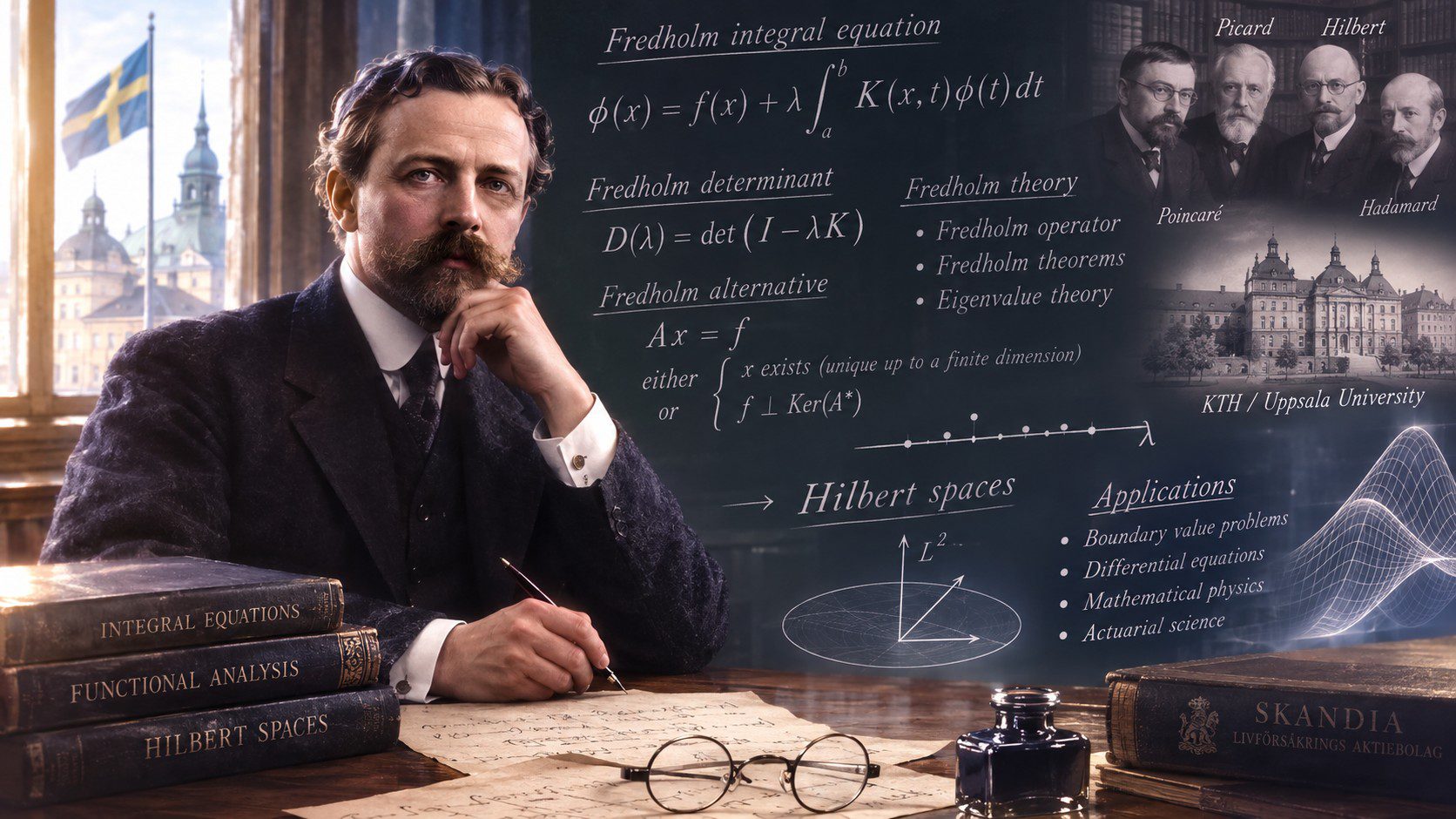
On August 17, 1927, in the town of Morby near Stockholm, Sweden, Erik Ivar Fredholm, a Swedish mathematician, passed away at the age of 61. He left behind the foundational work on the theory of integral equations, which paved the way for the development of modern functional analysis and was an important step that led to the theory of Hilbert spaces later on.
From outstanding student to mathematical physicist
Fredholm was born in the Clara district of Stockholm into a well-off merchant family. His father built wealth through the business of converting gas lamps into electric bulbs, so the family had enough resources to provide the best education for their son. Fredholm showed academic excellence at Beskowska School in Stockholm before continuing his studies at the Royal Institute of Technology (KTH) and Uppsala University in 1886. Initially, he was mainly interested in mathematical physics before turning to the serious study of integral equations after receiving his doctorate from Uppsala in 1898.
The theory that transformed the face of analytical mathematics
During the years 1900-1903, Fredholm proposed and analyzed a new type of integral equation, which later came to be known as Fredholm equations. This research included the construction of Fredholm determinants and the proof of Fredholm theorems, which became a crucial foundation of what is now called Fredholm theory. This important work partly took place while he was studying in Paris in 1899, alongside leading mathematicians such as Henri Poincaré, Émile Picard, and Jacques Hadamard, in the study of the Dirichlet problem.
Fredholm's work was quickly recognized in the international mathematics community when Erik Holmgren presented his theory at the University of Göttingen in 1901. David Hilbert immediately saw the importance of this theory, and during the first quarter of the 20th century, the theory of integral equations became a major research topic that attracted widespread attention. Hilbert built upon Fredholm's work by developing a complete eigenvalue theory for Fredholm integral equations, which led to the development of Hilbert space theory later on, becoming one of the most important foundations of modern functional analysis.
A mathematician associated with insurance work
Aside from theoretical research, Fredholm also worked as an actuary. He worked at the insurance company Skandia from 1904 until his death in 1927, applying his mathematical principles to calculate the buyback prices of insurance policies. In 1906, he was appointed as a professor of theoretical physics at Stockholm University, a position that demonstrated his expertise in both pure mathematics and applied physics.
A Living Legacy in Modern Mathematics
The concepts that bear Fredholm's name are still commonly found in advanced mathematical texts today, whether it is the Fredholm operator, the Fredholm alternative, or the Fredholm module used in modern noncommutative geometry. Fredholm's theory remains a fundamental tool that mathematicians and physicists around the world use to solve differential equations and boundary value problems up to the present day. It is a testament that deeply foundational work can truly exert influence across centuries.