Tom Apostol: A teacher who teaches calculus to students around the world
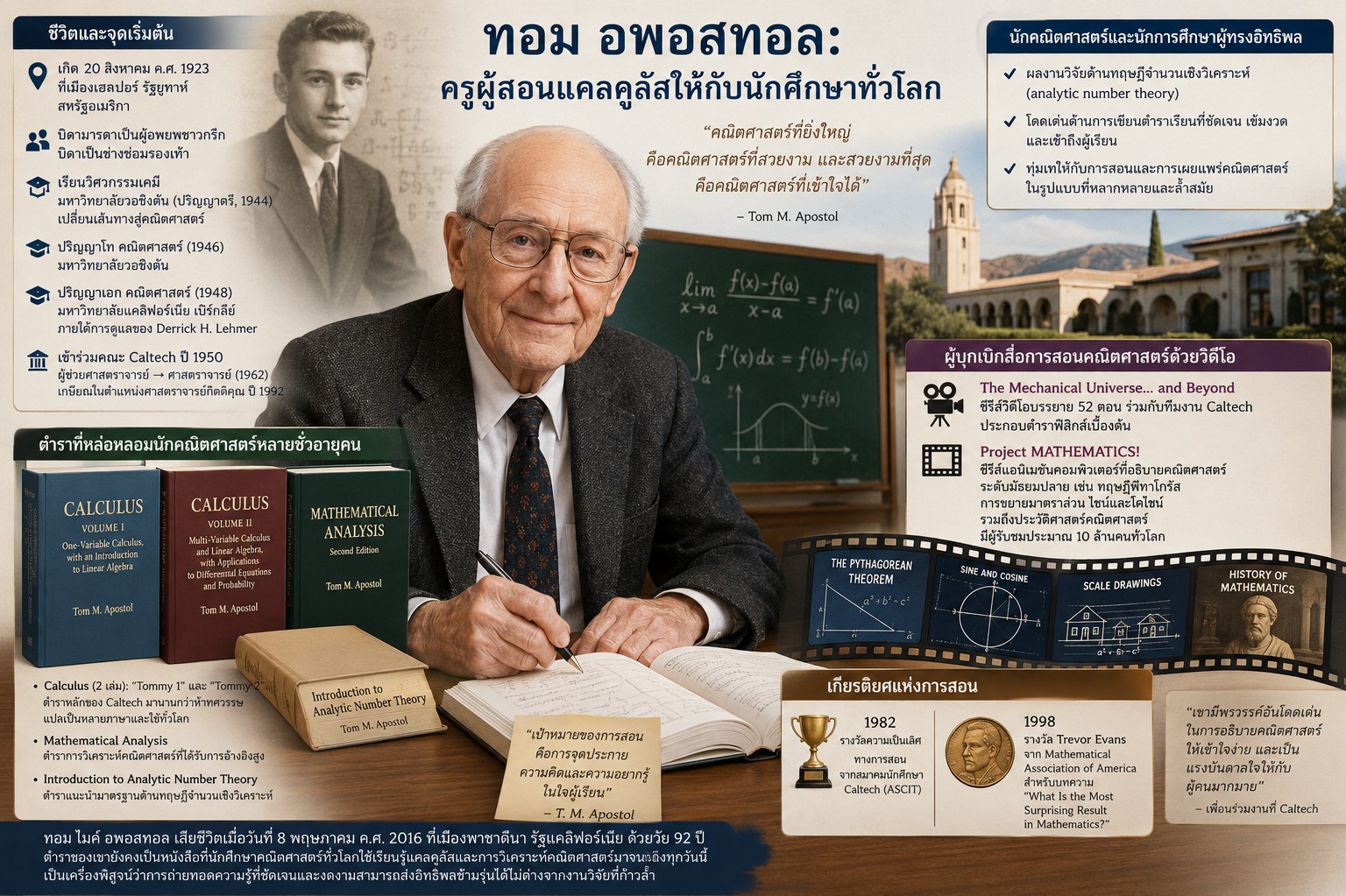
Tom Mike Apostol was born on August 20, 1923, in Helper, Utah, United States. His parents were Greek immigrants. His father, Emmanuil Apostolopoulos, came to the United States in 1916 to work in the mines, but due to claustrophobia, he turned to the profession of a shoemaker, which he had trained in Greece, instead, and established a stable livelihood in the town of Helper, which became the starting point for the Apostol family to settle in the United States.
The Path from Chemical Engineering to Mathematics
Apostol began his academic journey in chemical engineering, earning a bachelor's degree in this field from the University of Washington in 1944. However, his interests eventually shifted to mathematics. He received a master's degree in mathematics from the same university in 1946 before earning a Ph.D. in mathematics from the University of California, Berkeley in 1948 under the supervision of Derrick Henry Lehmer, a renowned number theorist. In 1950, Apostol joined the faculty at the California Institute of Technology (Caltech) as an assistant professor and gradually rose through the ranks to become a full professor in 1962, remaining at the institute for his entire career until retiring as a professor emeritus in 1992.
A textbook that has shaped generations of mathematicians
Although Apostol had valuable research in analytic number theory, what made his name known worldwide was his textbook writing, especially his two-volume Calculus textbooks, which Caltech students commonly refer to as 'Tommy 1' and 'Tommy 2.' This set of textbooks has been used to teach undergraduate calculus at Caltech for more than five decades and has been translated into Greek, Italian, and many other languages, becoming standard textbooks used by universities around the world.
In addition to his calculus textbook, Apostol also wrote the textbook Mathematical Analysis, which is one of the most popular and widely referenced textbooks in higher education for mathematical analysis, including the textbook Introduction to Analytic Number Theory In addition to his calculus textbook, Apostol also wrote the textbook Mathematical Analysis, which is one of the textbooks that remains a standard recommendation for beginners studying analytic number theory up to the present. His textbook stands out for its clarity in explanation, mathematical rigor, and presentation style that is accessible for students of mathematical analysis, making it one of the most popular and frequently cited textbooks at the higher education level, including textbooks
Pioneer of mathematics teaching media with videos
In addition to writing textbooks, Apostol was also a pioneer in advanced educational media in his time. He joined the team at Caltech to produce the 52-episode lecture video series “The Mechanical Universe… and Beyond,” which was used alongside the introductory physics textbook he co-authored. Later, he also became the creator, director, and executive producer of the series “Project MATHEMATICS!,” a computer-animated video series that won many awards, explaining fundamental high school mathematics topics such as the Pythagorean theorem, scale expansion, sine and cosine, as well as the history of mathematics. This video series has been watched by approximately 10 million people worldwide.
The Honor of Teaching
In 1982, Apostol received a teaching excellence award from the Caltech Student Association (ASCIT), and in 1998, the Mathematical Association of America (MAA) awarded the Trevor Evans Award to his article 'What Is the Most Surprising Result in Mathematics?' His colleagues at Caltech praised him for his outstanding talent in explaining mathematics in an understandable way and for inspiring many people.
Tom Apostol passed away on May 8, 2016, in Pasadena, California, at the age of 92. His textbooks remain books that mathematics students around the world use to learn calculus and mathematical analysis to this day. They are a testament to how clear and elegant knowledge transfer can influence generations, just as groundbreaking research does.