Simon Donaldson: Discoverer of the Wonders in Four-Dimensional Space
Simon Kirwan Donaldson was born on August 20, 1957, in Cambridge, England. He was the third of four children in a family surrounded by academics. His father was an engineer working in the physiology laboratory at the University of Cambridge, while his mother graduated in natural sciences from the same university. Donaldson's interest in mathematics in his youth began unexpectedly, stemming from a passion for sailing, which led to an interest in boat design, and ultimately brought him into the world of mathematics.
From an ordinary student to a researcher who transforms the face of technology
Even during his school years, Donaldson performed well in mathematics and physics, though not exceptionally outstanding. He graduated with a bachelor's degree from Pembroke College, University of Cambridge in 1979, before moving on to postgraduate studies at Worcester College, University of Oxford in 1980 under the supervision of Nigel Hitchin initially, and later under the supervision of Michael Atiyah, a legendary mathematician.
A discovery that shA discovery that shakes the field of topologyakes the field of topology
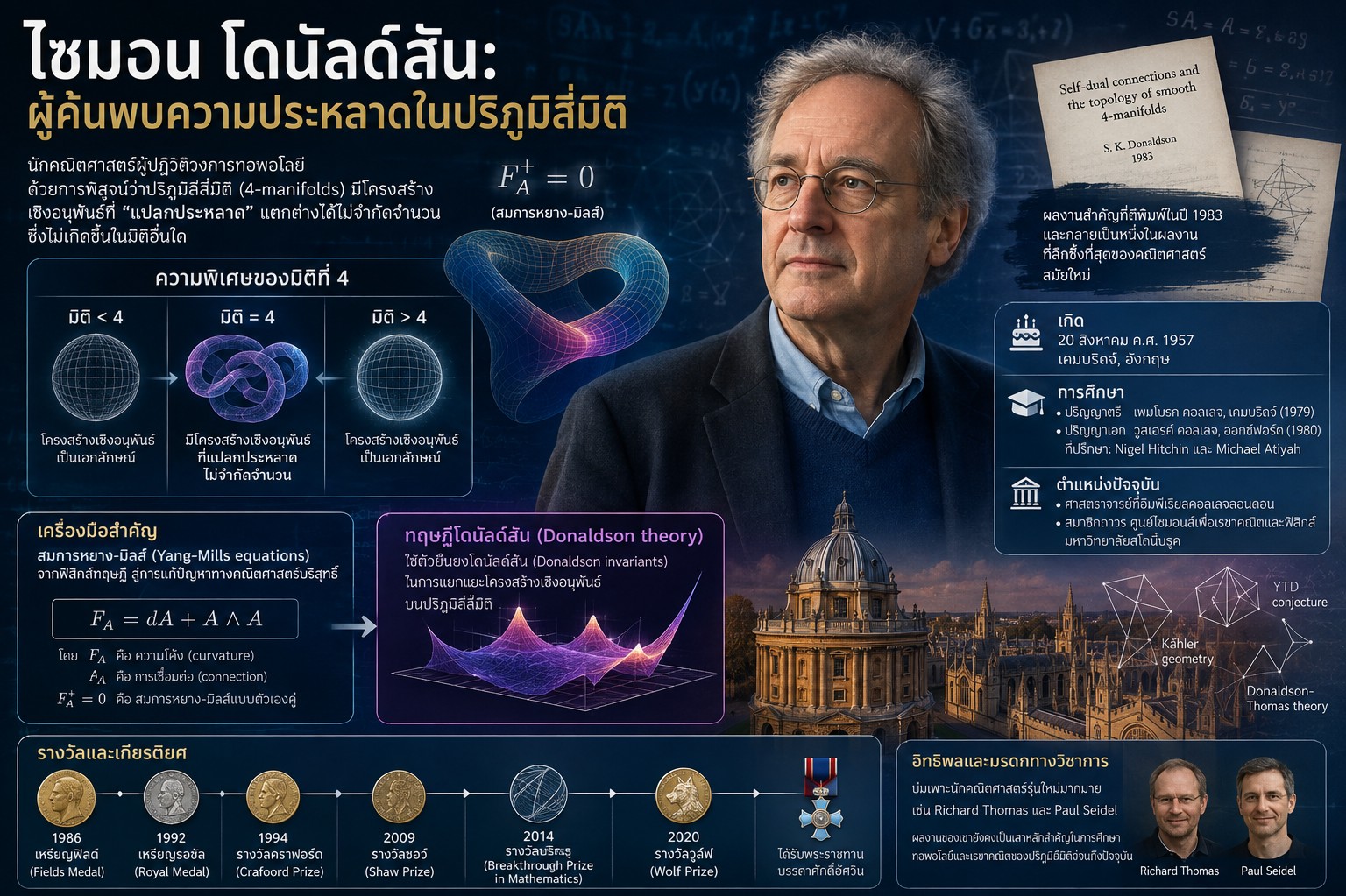
While still a PhD student in 1982, Donaldson produced work that immediately made his name famous throughout the mathematics community. He discovered that four-dimensional manifolds (4-manifolds) have "exotic" differential structures, completely different from all other dimensions. This discovery showed that four-dimensional Euclidean space (R⁴) can have an unlimited number of non-standard differential structures, a phenomenon that does not occur in any other dimension, whether lower or higher. This work was published in 1983 in the paper titled "Self-dual connections and the topology of smooth 4-manifolds" and became one of the most profound results in modern geometry and topology.
The key tool that Donaldson used in this discovery is the Yang-Mills equations borrowed from theoretical physics, which is a prominent example of how ideas from particle physics can be applied to solve fundamental problems in pure mathematics. This branch of research later developed into a field called Donaldson theory, which uses Donaldson invariants to distinguish different differential structures on four-dimensional manifolds.
Fields Medal and many honorary awards
In 1986, Donaldson received the Fields Medal for this revolutionary work, and throughout his subsequent career, he continued to receive numerous honors, including the Royal Medal in 1992, the Crafoord Prize in 1994, the Shaw Prize in 2009, the Breakthrough Prize in Mathematics in 2014, and the Wolf Prize in 2020. In addition, he was also knighted in 2012.
The work that extends into Kepler geometry
Apart from his work in four-dimensional topology, Donaldson has also made significant contributions to Kähler geometry and Donaldson-Thomas theory, as well as the Yau-Tian-Donaldson conjecture, which connects algebraic geometry with the existence of Kähler-Einstein metrics on Fano varieties. Throughout his career, he has worked at the University of Oxford, Stanford University, and currently holds a professorship at Imperial College London, in addition to being a permanent member of the Simons Center for Geometry and Physics at Stony Brook University.
Donaldson has mentored many young mathematicians who later made a name for themselves in their own fields, including Richard Thomas and Paul Seidel. His work remains a key pillar that mathematicians around the world use in the study of geometry and topology of low-dimensional spaces to this day. It is proof that four dimensions still remain a mysterious realm full of puzzles waiting to be discovered.