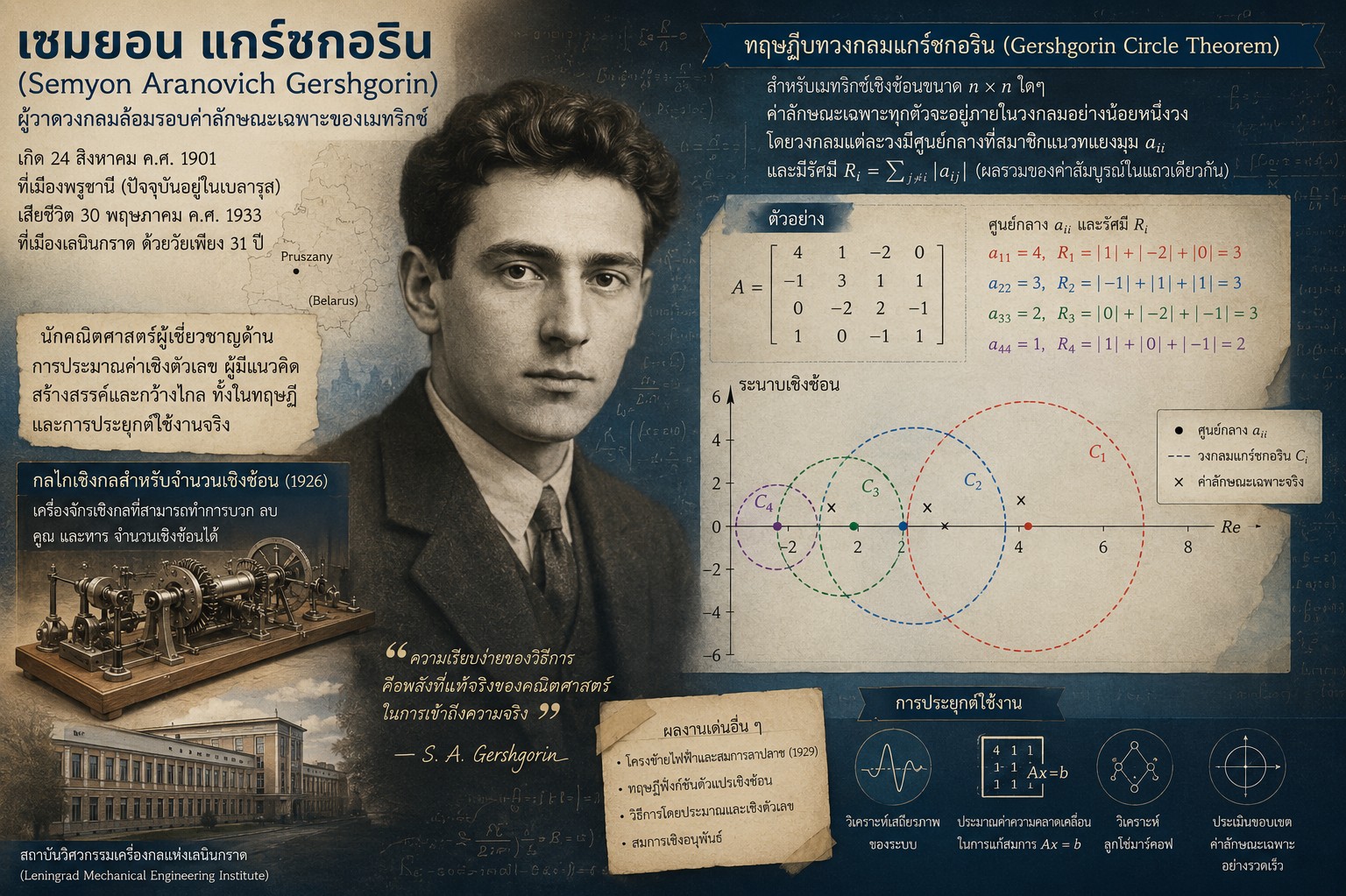
Semyon Gershgorin: The drawer of circles enclosing the eigenvalues of a matrix
Semyon Aronovich Gershgorin was born on August 24, 1901, in Pruzhany, which at that time was part of the Russian Empire (now in Belarus), into a Belarusian Jewish family. Although he lived only a short life of 31 years, Gershgorin left behind mathematical work that remains a fundamental tool in numerical linear algebra to this day.
A mathematician specializing in numerical approximation
Gershgorin began his studies at the Petrograd Technological Institute in 1923 and defended an outstanding thesis submitted to the Department of Mechanics. In 1930, he was appointed professor, and in the same year he was assigned to work at the Leningrad Mechanical Engineering Institute, which was the institute where he focused mainly on algebra, the theory of functions of a complex variable, approximate and numerical methods, and differential equations.
The most prominent feature of Gershgorin is his creative problem-solving approach, combined with energy and clarity in analysis. In his 1926 article 'Mechanisms for Constructing Functions of a Complex Variable,' he described mechanical devices capable of performing mathematical operations on complex numbers, including addition, subtraction, multiplication, and division, suggesting that such mechanisms could be assembled into larger devices for more complex functions. He also designed a device for generating ellipses, a replica of which is still displayed at the Deutsches Museum in Munich to this day. In 1929, he published work on electrical networks for finding approximate solutions to Laplace's differential equations, presenting a method for finding approximate solutions to partial differential equations through modeling based on a network of electrical components.
The circle theorem that has become a standard tool
The most famous work of Gershgorin is the Gershgorin Circle Theorem, which he published in 1931. This theorem provides a simple yet powerful method to estimate the locations of the eigenvalues of a square matrix without the need to calculate the actual eigenvalues at all.
The principle of the theorem is that for any n×n complex matrix, we can construct n circles on the complex plane, each with its center at a diagonal element of the matrix and a radius equal to the sum of the absolute values of the other elements in the same row. The theorem states that every eigenvalue of the matrix must lie within at least one of these circles. This tool has become widely used in numerical linear algebra because it provides bounds for eigenvalues quickly without complicated computations, which is extremely useful in analyzing system stability, estimating errors in solving the matrix equation Ax = b, and analyzing Markov chains.
Gershgorin circle theorem is still taught in numerical linear algebra courses worldwide to this day and serves as the starting point for the development of other related theorems, such as Brauer’s theorem, which uses Cassini ovals to provide more precise bounds.
A life that is short but valuable
Despite having outstanding work in the field of numerical approximation, Gershgorin suddenly passed away on May 30, 1933, in Leningrad at the age of only 31. His obituary stated that work requiring high concentration and stress had undermined his health, leading to an unexpected illness.
Gerschgorin's name appears in various transliteration forms, including Geršgorin, Gerschgorin, Gerszgorin, and from the Yiddish transliteration as Hirshhorn or Hirschhorn, which reflects the Ashkenazi Jewish linguistic roots of this surname. Although his life was too short, the circle theorem he left behind remains an indispensable tool for mathematicians, engineers, and computer scientists worldwide in analyzing matrices even today, almost a century after he discovered it.