Solomon Miclin: Pioneer of the Notation for the Integral Operator
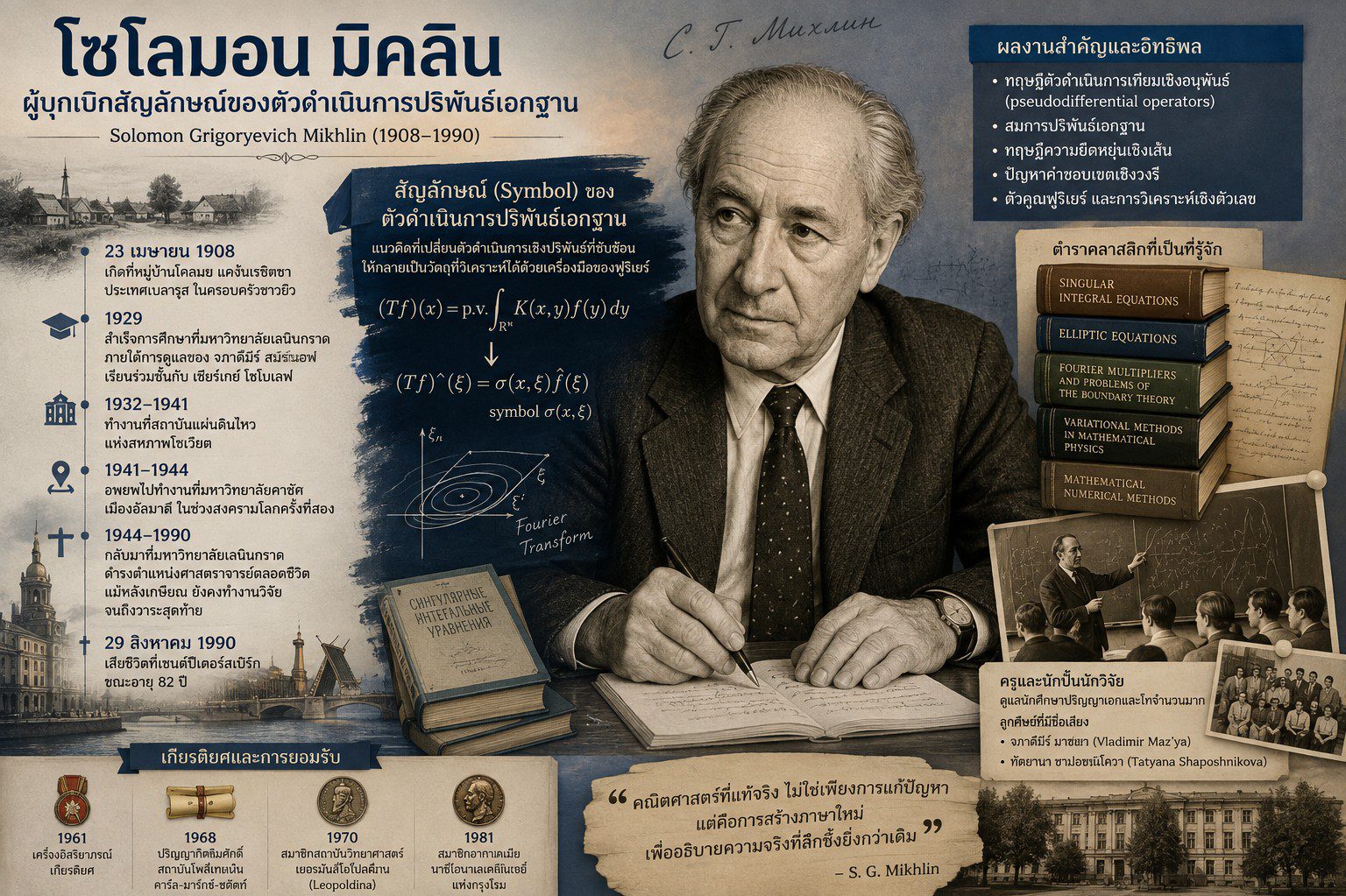
On August 29, 1990, in Saint Petersburg, Solomon Grigoryevich Mikhlin, a Soviet mathematician, passed away at the age of 82 due to a sudden stroke while traveling by public transport to buy medicine for his wife. Since he had no identification with him, it took some time to identify him, which is the reason why various sources record his date of death differently in some cases. He left behind work that laid a significant foundation for the modern theory of pseudodifferential operators.
From a small village in Belarus to the Soviet mathematics scene
Miklin was born on April 23, 1908, in the village of Kolmesh, Rechitsa region, Belarus, into a Jewish family of modest means. His real name was Salman Girshovich Miklin. He was the youngest of five siblings. There is conflicting information about his father's occupation; some sources state that he was a small trader, while others indicate that he was a melamed, or a religious teacher at a small Jewish school (kheder). Miklin studied at Leningrad University and graduated in 1929 under the supervision of Vladimir Smirnov, who was his master's thesis advisor on the topic of the convergence of double power series. Interestingly, he was in the same class as Sergei Sobolev, another famous mathematician.
Career path through times of turmoil
Miklin worked at the Earthquake Institute of the Soviet Union between 1932-1941. During World War II, he had to evacuate to work at Kazakh University in Almaty from 1941-1944 before returning to Leningrad University as a full professor in 1944, where he worked for the rest of his life. Even after retirement, he continued working as a senior researcher in his own laboratory until the end of his life. When the Department of Mathematics and Mechanics moved to the suburb of Peterhof in 1978, his seminar developed into greater specialization, becoming Miklin's Laboratory Seminar on Numerical Methods.
Pioneer of the symbol for the single integral operator
Miklin's most famous work was pioneering the concept of the "symbol" of a singular integral operator, a mathematical tool used to transform complex integral operators into a form that is easier to analyze. This discovery became a crucial foundation that led to the establishment and development of the theory of pseudodifferential operators, which is one of the most important tools in modern functional analysis and partial differential equations.
Miklin's research on singular integral equations is extremely important for the development of linear elasticity theory, elliptic boundary value problems, and Fourier multipliers analysis. In addition, he also made significant contributions in numerical analysis, a field he devoted himself to studying in the later part of his career.
Classic cookbook author and dedicated teacher
Miklin is widely known as the author of textbooks and academic papers that have become classics due to their clear and distinctive presentation style. His textbooks cover topics including elasticity theory, boundary value problems for ellipses, partial differential equations, Fourier transforms, and numerical mathematics, and they continue to be important references for later researchers to this day.
As a dedicated teacher, Miklyndu supervised many doctoral and master's students throughout his career. His notable students include Vladimir Maz’ya, who became both his student and close friend, and Tatyana Shaposhnikova, who was his direct doctoral student.
Honor and recognition at the international level
Throughout his career, Miklin received many honors, including the Order of the Badge of Honour in 1961, an honorary degree from the Karl Marx City Polytechnic Institute in 1968, membership in the German Leopoldina Academy of Sciences in 1970, and membership in the Accademia Nazionale dei Lincei in Rome in 1981, demonstrating international recognition of his work, even while working under the Soviet system, which often restricted contact with the Western academic world.
Miklin Eugenia's wife passed away just a few months after him. The academic legacy of Solomon Miklin, especially the notation for the integral operator he pioneered, remains an essential foundation that mathematical analysts around the world use every day to this day. It serves as proof that even during times of political and social difficulty, a resolute mathematical mind can still produce work that influences across borders and eras.