Olga Tausky-Todd: The Torchbearer of Matrix Theory
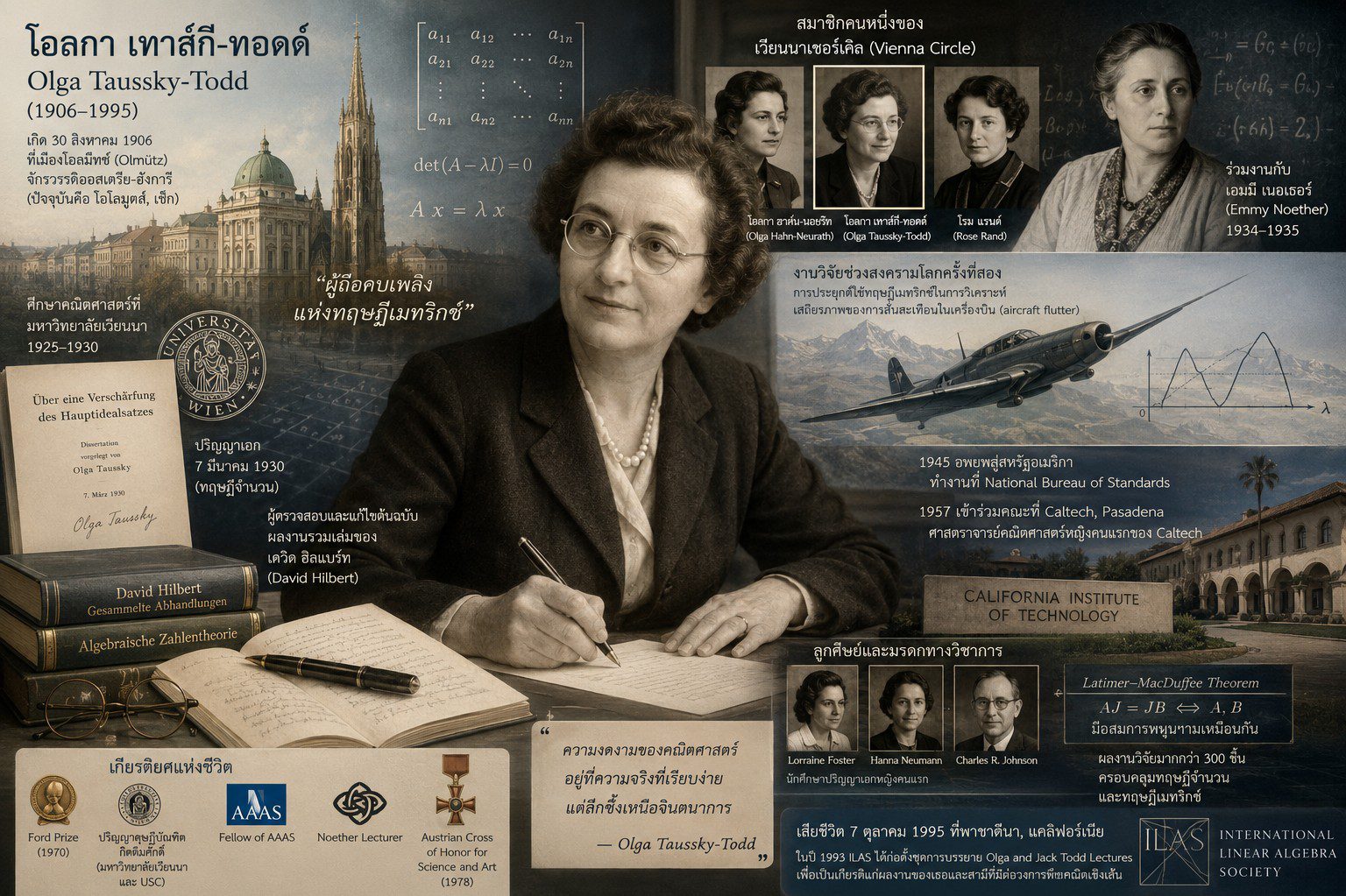
Olga Taussky-Todd was born on August 30, 1906, in Olomouc, Austria-Hungary (now Olomouc, Czech Republic) into a well-off and cultured Jewish family. She was the middle daughter of three children of Julius David Taussky, an industrial chemist, and Ida Pollak. When she was three years old, her family moved to Vienna, where she lived until the middle of World War I. Taussky-Todd later referred to herself as a 'torchbearer of matrix theory,' and her work truly played a key role in elevating matrix theory to an essential part of modern scientific studies.
From Vienna to the international academic circle
Tausig-Todd studied mathematics at the University of Vienna between 1925 and 1930 and defended her doctoral thesis on number theory, titled “Über eine Verschärfung des Hauptidealsatzes,” on March 7, 1930, under the supervision of Philipp Furtwängler. She was one of the first women to join the Vienna Circle, which was founded around Moritz Schlick, along with two other female mathematicians, Olga Hahn-Neurath and Rose Rand, and she also regularly attended Karl Menger's mathematics seminars.
After graduating, Tausek-Todd was assigned to help review and correct the manuscript of David Hilbert's collected works on algebraic number theory, which was extremely important because even Hilbert himself could no longer understand some parts of his own work. In 1934-35, she went to work with Emmy Noether, a great female mathematician, at Bryn Mawr College. Oswald Veblen, one of America's leading differential geometers, mentioned Tausek-Todd in 1935, after Noether passed away, saying that she had the potential to inherit this distinguished position.
Escaping the Nazis to career paths in England and America
When the Nazis occupied Austria and Germany, Tausky-Todd decided to leave Central Europe for good. She received a three-year science scholarship from Girton College, University of Cambridge in England, and met Jack Todd, a British mathematician, whom she married in 1938. During World War II, the couple moved around a lot, with Tausky-Todd working at the National Physical Laboratory. Her work there led her to apply matrix theory to analyze the stability of aircraft flutter, which was a major engineering problem at the time.
In 1945, the Todd family moved to the United States and worked at the National Bureau of Standards. Then, in 1957, the couple joined the faculty at the California Institute of Technology (Caltech) in Pasadena, where Tausky-Todd became Caltech's first female mathematics professor.
An academic legacy covering number theory and matrix theory
Throughout her career, Tausk-Todd published over 300 research papers, covering topics in algebraic number theory, integer matrices, and matrices in algebra and analysis. Her important works include the Latimer-MacDuffee theorem and research on class field theory. She was also the advisor for Caltech's first female PhD student, Lorraine Foster, and had many other notable students, including Hanna Neumann and Charles Royal Johnson.
The honor of a life dedicated to mathematics
Tausky-Todd received many honors throughout her career. She won the Ford Prize for her article on sums of squares published in the American Mathematical Monthly in 1970 and received honorary doctorates from the University of Vienna as well as from the University of Southern California in 1988. She was also a fellow of the American Association for the Advancement of Science (AAAS), a Noether Lecturer, and was awarded the Austrian Cross of Honor for Science and Art, First Class, in 1978. Even though she retired from teaching in 1977, she continued to stay in touch with other mathematicians about her work in matrix theory.
Olga Taussky-Todd passed away on October 7, 1995, in Pasadena, California, at the age of 89. In 1993, the International Linear Algebra Society set up a lecture series in honor of her and her husband's contributions to linear algebra. Taussky-Todd's academic legacy, both as a pioneer in numerical linear algebra and as a reviewer of Hilbert's original work, continues to be a major inspiration for female mathematicians around the world to this day.