Stefan Banach: Father of Modern Functional Analysis
Among the mathematicians of the 20th century, there is one name that is acclaimed as one of the most influential in modern mathematical analysis, and that is Stefan Banach, a legendary Polish mathematician who passed away on August 31, 1945, in the city of Lviv, which at that time was part of the Ukrainian Soviet Socialist Republic (currently in Ukraine).
An extraordinary early life
Banach was born on March 30, 1892, in Kraków, Poland (at that time under the Austro-Hungarian Empire). His childhood was quite complicated because his birth certificate listed his surname from his mother as 'Banach,' while his given name came from his father, Stefan Greczek. He never knew his own mother and was sent to be raised by a family in Kraków from a young age.
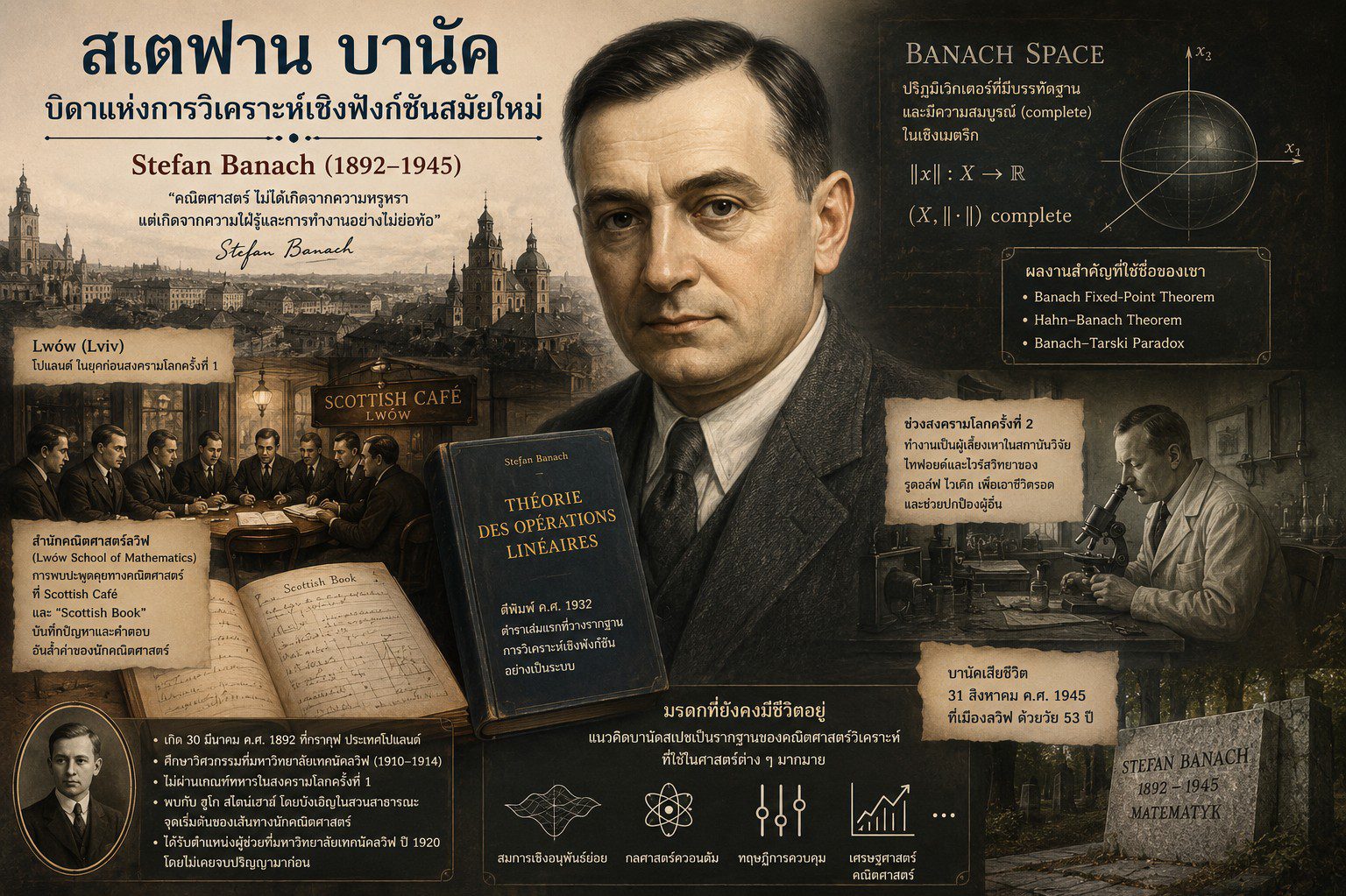
Banach studied at Lwów Technical University between 1910 and 1914 in engineering. During World War I, he did not meet the criteria to become a soldier due to poor eyesight, so he worked on road construction and taught at local schools, while researching mathematics in his spare time. A turning point occurred when the famous mathematician Hugo Steinhaus happened to hear Banach talking about mathematics in a public park and immediately recognized his remarkable talent. This event led to a significant academic collaboration, and in 1920 Banach was appointed as an assistant at Lwów Technical University, even though he had never officially completed a degree.
The establishment of the Lviv Mathematical Institute
Banach was one of the founders of the group that later came to be called the Lwów School of Mathematics, which was a group of world-famous mathematicians who gathered in the city of Lwów during the war period. This group became famous for meeting and discussing mathematics at the Scottish Café, where mathematical problems and the solutions discussed were recorded in a notebook known as the 'Scottish Book,' an important historical document in the field of mathematics.
Banach space and functional analysis
Banach's greatest achievement was laying the foundation for the field of modern functional analysis. He introduced the concept of normed linear spaces, which later came to be known as 'Banach spaces' in his honor. A Banach space is a vector space with a norm that is complete in the metric sense, which has become an indispensable fundamental structure in all modern mathematical analysis.
His most important published work is the book “Théorie des opérations linéaires” (Theory of Linear Operations) in 1932, which is the first textbook to systematically and comprehensively compile the theory of functional analysis. In addition, Banach had many other important works that still bear his name, such as the Banach fixed-point theorem, the Hahn–Banach theorem, and the famous Banach–Tarski paradox.
The war period and the later stage of life
When World War II broke out in 1939, the Soviet army occupied Lviv. Banach continued to work as the dean of the Faculty of Mathematics and Physics at the University of Lviv. But when Germany took over the city in 1941, all higher education institutions were closed to Poles. Banach had to make a living by working as a louse feeder at Rudolf Weigl's typhus and virology research institute, which, despite the risk of infection, helped protect him from being sent to work in Germany.
After the war ended, Banach planned to return to take up the position of mathematics professor at Jagiellonian University in Krakow. But before he could travel back, he was diagnosed with lung cancer and passed away on August 31, 1945, in Lviv at the age of 53.
The great inheritance
Stefan Banach is widely acclaimed as one of the most influential mathematicians of the 20th century. His concept of Banach spaces has become a fundamental foundation upon which all branches of mathematical analysis today rely, whether in partial differential equations, control theory, quantum mechanics, or even mathematical economics. His name continues to be mentioned in every functional analysis course worldwide to this day.