Henry Sheffer: The discoverer of the logical operator that can generate everything from a single one
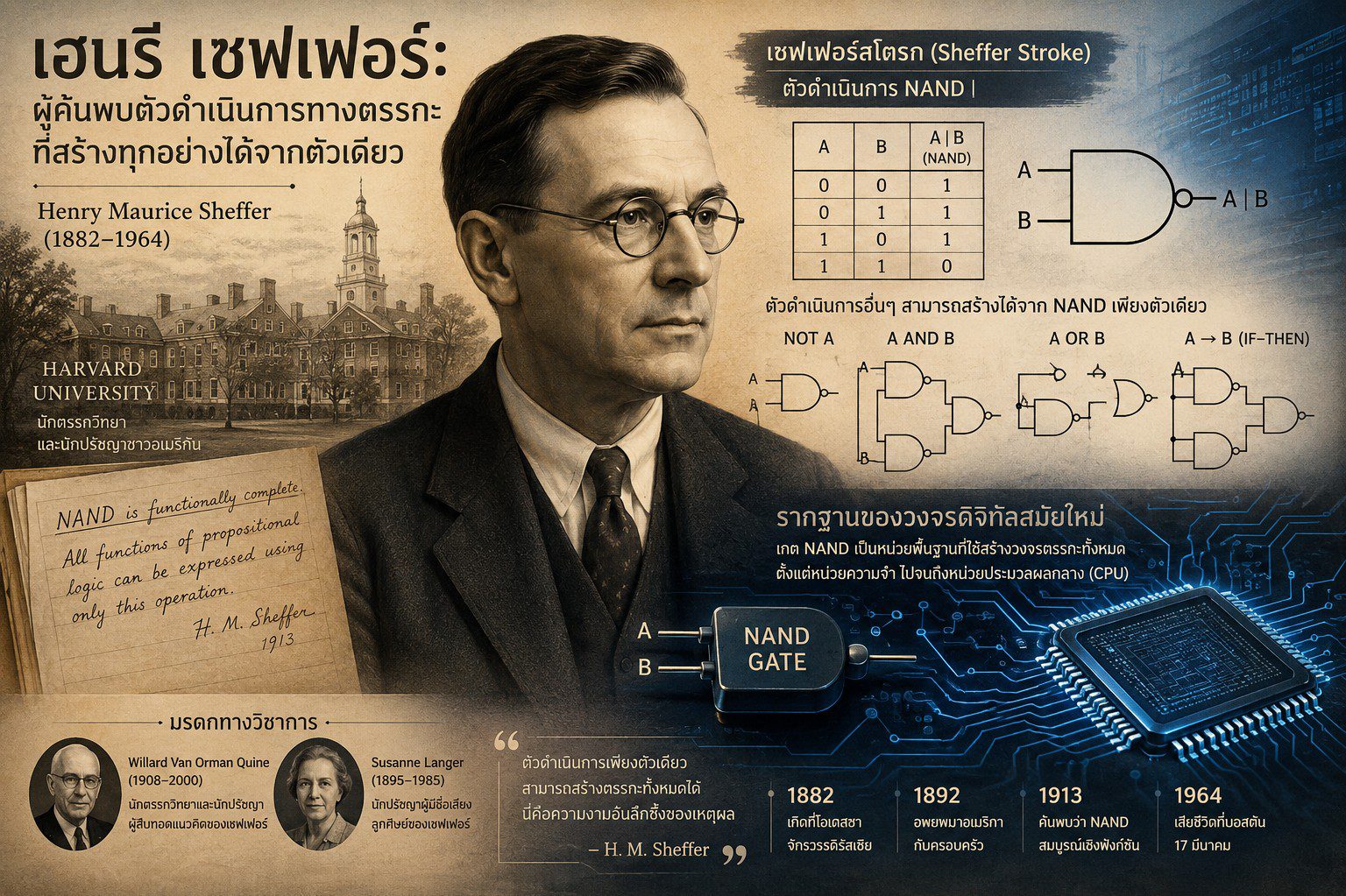
In the world of digital circuits and modern computer science, there is a logical concept that serves as a fundamental foundation, which the general public may not know the discoverer's name. That is Henry Maurice Sheffer, an American logician, born on September 1, 1882, in Odessa, Russian Empire (now in Ukraine).
Early life and immigration to America
Schaefer was born into a Jewish family of Polish descent who spoke Yiddish at home. When he was 10 years old, his family emigrated from Russia to the United States in 1892 and settled in Boston. Amid rising anti-Jewish sentiment in Eastern Europe at the time, Schaefer displayed outstanding academic abilities from a young age. He attended the prestigious Boston Latin School before continuing his studies at Harvard University, where he studied logic with the famous philosopher Josiah Royce. Schaefer earned his bachelor's degree in 1905, his master's degree in 1907, and his doctorate in philosophy under Royce's supervision in 1908.
After that, Schaeffer worked as a postdoctoral researcher at Harvard, and in 1916 he returned to join the Harvard philosophy faculty as a lecturer to help teach following Royce's death. He worked at Harvard continuously for 36 years and was promoted to professor in 1938.
The discovery of the Schaeffer-Stokes operator
The work that made Sheffer's name immortal in the field of logic is his discovery in 1913 that the NAND operator (also known as the 'Sheffer stroke' — Sheffer stroke symbol |) is a 'functionally complete' operator. That is, all other logical operators, whether AND, OR, NOT, or IF-THEN, can be constructed using only the NAND operator alone.
Although this discovery had previously been observed by Charles Sanders Peirce in 1880, Peirce's work was not published until 1933. Schaeffer is therefore considered the one who officially brought this idea to the attention of the field of logic. His work received high praise from Bertrand Russell, who widely applied the concept to improve his own logical system in the second edition of Principia Mathematica.
Importance to modern digital circuits and computers
The fact that a NAND operator can create all other logical operators makes it a fundamental foundation of digital circuit engineering. The NAND gate is the basic unit used to build all complex logic circuits, from computer memory to central processing units (CPUs). In practice, manufacturing NAND gates with semiconductor technology is easy and low-cost, allowing engineers to construct all complex circuits from just one type of NAND gate, a principle that is still used in computer chip design today.
Individual characteristics and academic heritage
Schafer is known as a scholar who published very few works. Despite having many pioneering ideas, he never formally published the details of his own methods, only describing them in teaching materials and short abstracts. However, his influence on the field of symbolic logic was transmitted through several famous students, including Willard Van Orman Quine, a legendary logician and philosopher, and Susanne Langer, a renowned philosopher.
Schäffer passed away on March 17, 1964, in Boston, Massachusetts, at the age of 81. Although his name may not be as widely known as other mathematicians, his work is an indispensable foundation of the entire modern computer industry.