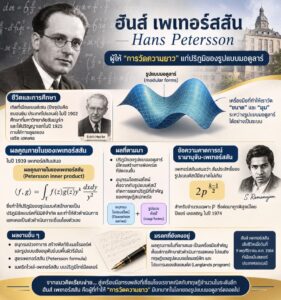
Hans Pettersson: The provider of 'length measurement' to the space of modular forms
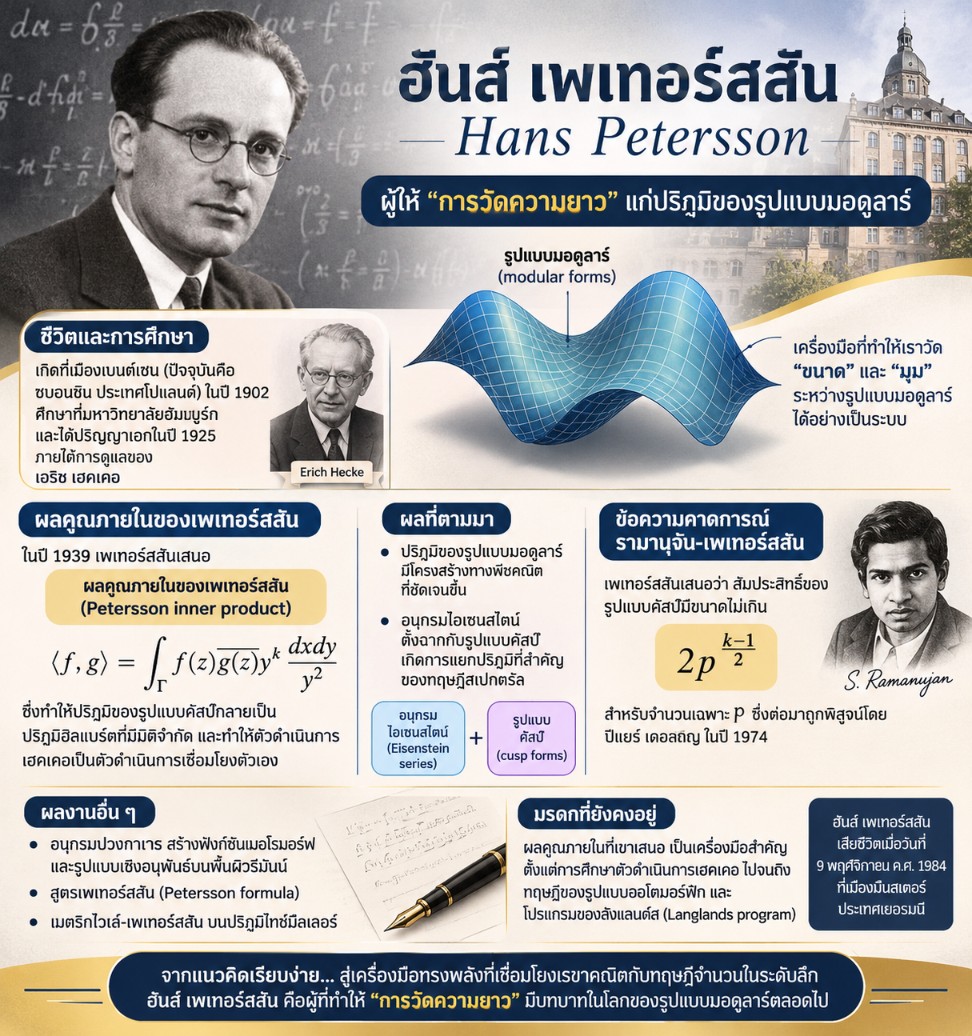
In modern number theory, one of the most frequently appearing objects is modular forms, which are highly symmetric complex functions. However, studying them systematically requires another tool that is simple yet powerful: a method for measuring the “size” and “angle” between modular forms. The person who provided that tool was Hans Petersson, a German mathematician who passed away on November 9, 1984, in Münster, Germany. He was born in the town of Bentschen, in the Province of Posen, which is now the town of Zbąszyń, Poland, in 1902 (sources cite different birth dates: June 26 or September 24).
Education under Hekke
Pettersson studied at the University of Hamburg, which was the center of German number theory at that time, and received his doctorate in 1925 under the supervision of Erich Hecke, who was one of the founders of modern modular form theory. Hecke developed the theory of cusp forms and Hecke operators, which were the foundations that Pettersson expanded upon.
Peterson's inner product
In 1939, Petersson introduced the concept that made his name appear in every textbook, namely the Petersson inner product, which is defined on the space of cusp forms by integrating the product of one form with the conjugate of another form, multiplied by a weight function, over a fundamental domain of the modular group in the upper half-plane, using the area measure corresponding to hyperbolic geometry.
The core of it is that, when defined on a cusp form, this integral converges absolutely and provides a positive-definite Hermitian form. That is, it is an actual inner product that turns the space of cusp forms into a finite-dimensional Hilbert space.
The consequence is something that number theorists use every day. The Hecke operator is a self-adjoint operator with respect to this inner product, which means that the space of cusp forms has an orthogonal basis consisting of functions that are simultaneous eigenvectors of all Hecke operators, and their Fourier coefficients are real numbers. In other words, the linear algebra of symmetric matrices that we are familiar with can be applied to the space of all modular forms.
In the space of all modular forms, the Eisenstein series, which is the most basic example of a non-cusp form, is orthogonal to the cusp forms, thus giving a decomposition of the space into two disjoint parts, which is fundamental to the spectral theory of automorphic forms.
Ramanujan-Petersson conjecture message
The name of Petersson also appears in a very famous conjecture. Srinivasa Ramanujan once conjectured about the size of the coefficients of a particular modular form (Ramanujan's tau function), and Petersson proposed a generalization to vector-valued cusp forms for the Hecke operators of all weights, stating that the coefficient at a prime number p has a size not exceeding two times p to the power of (k − 1)/2. This conjecture was proved by Pierre Deligne in 1974 as a consequence of the proof of the Weil conjectures, a work that earned Deligne the Fields Medal.
Other works
Petersson used the Poincaré series to construct all meromorphic functions and differential forms on compact Riemann surfaces completely in a series of articles, and the formulas related to the Fourier coefficients of such series are called the Petersson formulas, which later became an important tool in analytic number theory. In addition, his name also appears in the Weil–Petersson metric on Teichmüller space, which is constructed from the inner product in a similar way and serves as a tool in modern Riemann surface geometry.
Life and career in difficult times
Peterson taught in Hamburg since 1925. His career was affected by politics in Nazi Germany. According to documents studied by historians, he once consulted Hecke about a promotion, and Hecke recommended joining the Nazi Party's Sturmabteilung (SA). Several Hamburg professors, including Hecke, Blaschke, and Artin, submitted petitions for his promotion in 1934 and 1935. During the war, he worked at the German University in Prague and at the University of Strasbourg. His history during this period is complex and still a subject studied by historians of mathematics. After the war, Peterson was reappointed in Hamburg in March 1947 and later moved to the University of Münster, where he passed away.
He has two sons, one of whom is Holger Petersson, who is also a mathematician.
Inheritance
Hans Petersson passed away on November 9, 1984, in Münster. The inner product he proposed in 1939 is one of the quiet tools behind modern number theory, from the study of Hecke operators to the theory of automorphic forms and the Langlands program, which is a tool that provides “geometry” to spaces that were originally merely sets of functions.