Sigmund Janichevski: A topologist who planned to create a Polish mathematical nation before dying of the Spanish flu.
Today in the history of mathematics. | 12 กรกฎาคม ค.ศ. 1888
บทนำ: ประเทศที่ยังไม่มีอยู่บนแผนที่
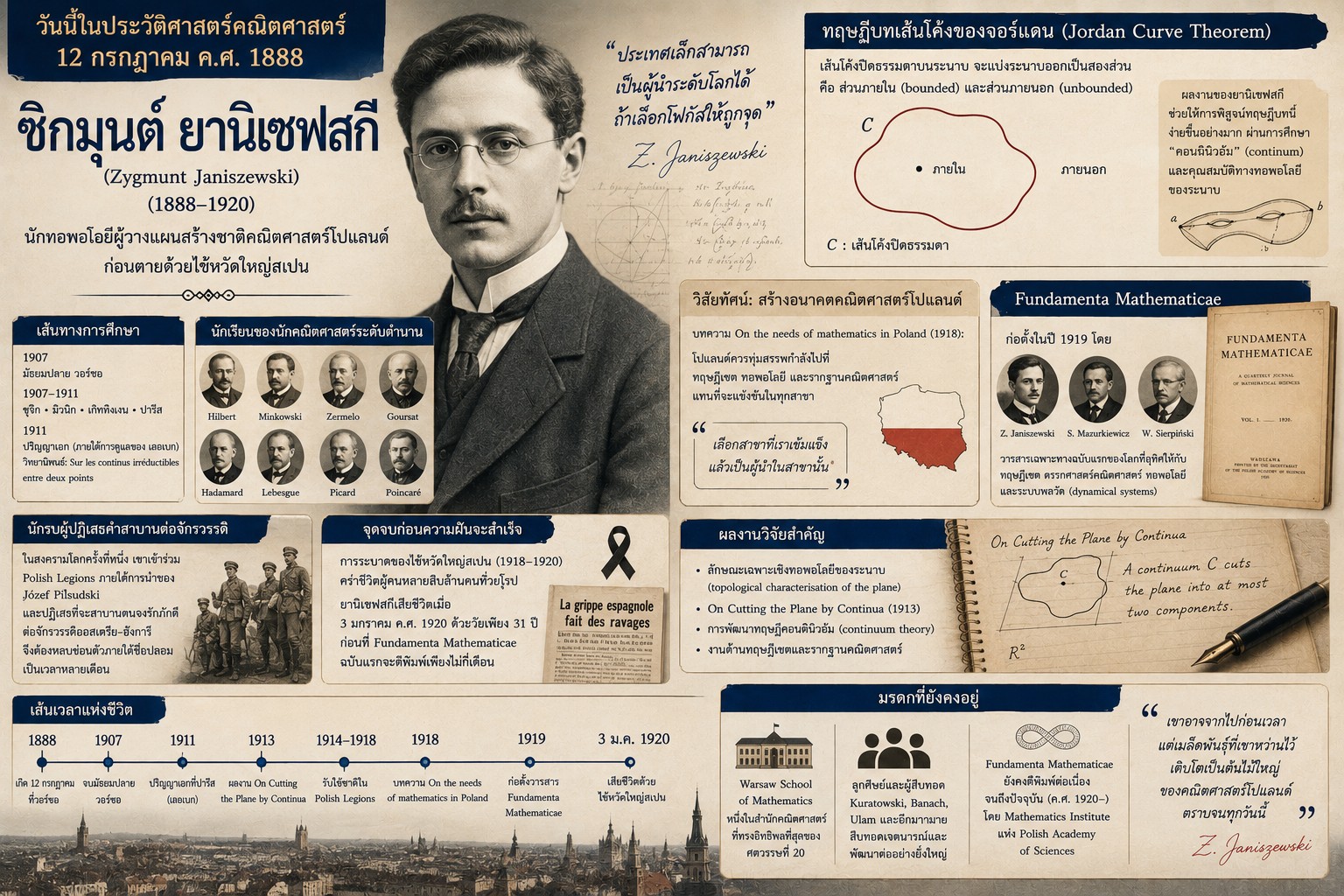
When Zygmunt Janiszewski graduated from high school in Warsaw in 1907, Poland didn't yet exist on the world map. For more than a century, Poland had been divided and occupied by Russia, Prussia, and Austria-Hungary. Polish students wishing to pursue advanced mathematics therefore had to travel abroad, and Janiszewski chose that path — studying in Zurich, Munich, Göttingen, and Paris.
He was born on July 12, 1888, in Warsaw, the son of Česław Janichevsky, a financier and director of the Société du Crédit Municipal in Warsaw, and Julia Sults-Høynitska.
A student of a legendary mathematician.
In Göttingen, Janichevsky studied with world-renowned mathematicians such as Hilbert, Minkowski, and Zermelo, while in Paris he studied with Goursat, Hadamard, Lebesgue, Picard, and Poincaré.
วิทยานิพนธ์ปริญญาเอกของเขาเรื่อง Sur les continus irréductibles entre deux points (Concerning the irreversible continuum between two points) It was completed in 1911 under the supervision of Lebec, and his thesis examination committee consisted of Poincaré, Lebec, and Fréchet — the most powerful committee possible in that era.
His most important contribution in this dissertation was the provision of the topological characterization of the plane, which greatly simplifies the proof of the Jordan Curve Theorem. This theorem states that:
A simple closed curve in a plane always divides the plane into two parts: an interior part with bounds and an exterior part without boundaries.
It sounds like an “obvious” thing, but rigorous proof is far more complex, as illustrated by Yanichevsky's 1913 work on… On Cutting the Plane by Continua This laid a crucial foundation for continuum theory, a part of point-set topology, which later developed.
Vision: To make Poland the leading nation in the field of mathematics.
What makes Yanichevsky special is not just his personal research, but his strategic vision, as stated in the article. On the needs of mathematics in Poland (1918) He proposed a bold idea: instead of Poland, having regained independence after World War I, trying to compete with mathematical powers like Germany or France in every field, it should focus its limited resources on areas where Polish mathematicians were already strong, namely set theory, topology, and mathematical foundations.
He proposed the establishment of the world's first specialized journal dedicated to a single field, and in 1919, together with Stefan Mazurkiewicz and Wacław Sierpiński, he founded the journal Fundamenta Mathematicae, a name suggested by Yanichevsky himself. This journal became a cornerstone of the Warsaw School of Mathematics, which later produced many world-class mathematicians such as Kuratowski, Banach, and Ulam.
A warrior who refused to swear allegiance to the empire.
Yanichevski was not just an ivory tower scholar. When World War I broke out, he joined the Polish Legions under the command of Józef Piłsudski and participated in operations around the Volyn region. When the Austrian army demanded an oath of allegiance, he refused along with other officers and had to go into hiding under a false name for several months.
The end before the dream comes true.
Sadly, Janishevsky did not live to see the success of the journal he founded. amidst the post-war turmoil and the Polish-Soviet War that followed. large outbreak of Spanish flu, which killed tens of millions of people across Europe Its effects progressively damaged his health, and he died on January 3, 1920, at the age of 31 — before the first issue of Fundamenta Mathematicae was published that same year.
A legacy that remains.
A century later, Fundamenta Mathematicae continues to be published by the Mathematics Institute of the Polish Academy of Sciences, covering set theory, mathematical logic, topology, and dynamical systems. Yanichevsky's idea that "small countries can become world leaders if they choose the right focus" has become a model studied by science policymakers in many countries to this day, and the Warsaw School of Mathematics, which he helped lay the foundation for, remains one of the most influential schools of mathematics of the 20th century.
Thought-provoking activities
- Explain in your own words what the Jordan Curve Theorem states and why this seemingly “common sense” object is so difficult to rigorously prove.
- Try drawing a simple, complex closed curve (not a circle or ellipse) on paper, and then test for yourself how a particular point lies “inside” or “outside” the curve without counting every intersection point.
- This study analyzes Janichevski's strategy for developing Polish mathematics (focusing on areas with competitive advantages) and discusses how this concept can be applied to the development of mathematical research in smaller Thai educational institutions.
- Research further who the important mathematicians were in the Warsaw School of Mathematics, which Yanichevsky helped found, and how their work has influenced modern mathematics.
References
- O’Connor, J. J., & Robertson, E. F. (2000). Zygmunt Janiszewski. MacTutor History of Mathematics Archive, University of St Andrews.
- Kuratowski, K. (1980). A Half Century of Polish Mathematics: Remembrances and Reflections. Pergamon Press.
- Derouiche, K. I. A. (2024). Zygmunt Janiszewski’s mathematical publications during his engagement in Poland’s struggle for national independence in World War I. arXiv preprint.
- Wikipedia contributors. (2024). Zygmunt Janiszewski. Wikipedia.
- Wikipedia contributors. (2026). Fundamenta Mathematicae. Wikipedia.
This series of articles, "Today in the History of Mathematics," presents mathematical stories connected to important dates on the calendar.