In Memory of Jacob Wolfowitz: The Man Who Proved the Limits of Error-Free Information Transmission
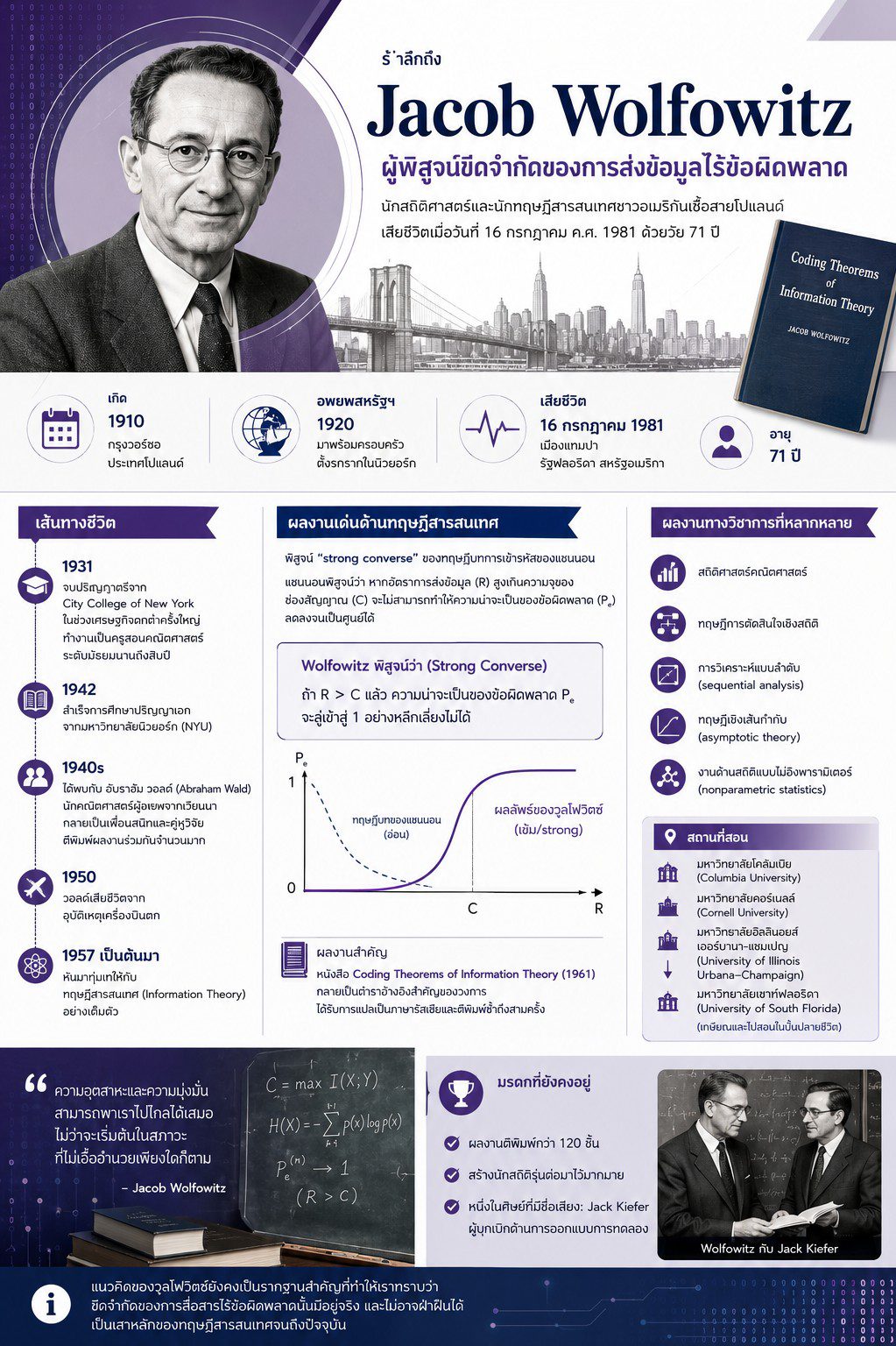
Today marks the anniversary of the death of Jacob Wolfowitz, a Polish-born American statistician and information theorist, who died of a heart attack in Tampa, Florida, on July 16, 1981, at the age of 71.
From a High School Teacher to a World-Class Mathematician
Wolfowitz was born in Warsaw, Poland, in 1910 and immigrated to the United States with his family in 1920. He earned his bachelor's degree from the City College of New York in 1931, right in the midst of the Great Depression. As a result, he spent the next ten years working as a high school mathematics teacher. During that time, he also pursued doctoral studies and eventually received his Ph.D. from New York University (NYU) in 1942.
The major turning point in his life came when he met Abraham Wald, a mathematician who had emigrated from Vienna. The two became close friends and research collaborators, publishing numerous papers together, particularly in the field of nonparametric statistics. In fact, the term “nonparametric” itself first appeared in a paper by Wolfowitz in 1942. This collaboration continued until Wald died in a plane crash in 1950.
Major Contributions to Information Theory
From 1957 onward, Wolfowitz devoted himself to Information Theory, a field pioneered by Claude Shannon. His most significant contribution was proving the **strong converse** of Shannon's coding theorem. Shannon had previously shown only that if the transmission rate exceeds the channel capacity, the probability of error can never be reduced to zero. Wolfowitz went further by proving that the probability of error inevitably converges to one. As a result, Shannon's original result came to be known as the **weak theorem** thereafter.
This work was compiled in the book Coding Theorems of Information Theory (1961), which became a major reference text in the field. It was translated into Russian and republished three times.
A diverse academic legacy
In addition to information theory, Wolfowitz made broad contributions to mathematical statistics, including statistical decision theory, sequential analysis, and asymptotic theory. He taught at Columbia University, Cornell University, and the University of Illinois Urbana–Champaign, respectively, before retiring and spending the later years of his career teaching at the University of South Florida.
Throughout his career, he published more than 120 scholarly works and mentored many members of the next generation of statisticians, including Jack Kiefer, a pioneer in the design of experiments. Wolfowitz's journey—from a high school classroom to the forefront of the global mathematics community—illustrates just how far perseverance can take a person, no matter how unfavorable the circumstances at the outset.