Krystyna Kuperberg: The Mathematician Who Solved the Seifert Conjecture, a Problem That Had Challenged the Mathematical Community for More Than 40 Years
Sometimes solving a great mathematical problem does not require an enormous amount of complex theory, but rather a sharp geometric insight, creativity, and a different way of looking at the problem. The story of Krystyna Kuperberg, a Polish-American mathematician, is a clear example of this. She was the person who solved the Seifert Conjecture, a problem that had remained unresolved in the fields of topology and dynamical systems for more than four decades.
From Tarnów to the World of Mathematics
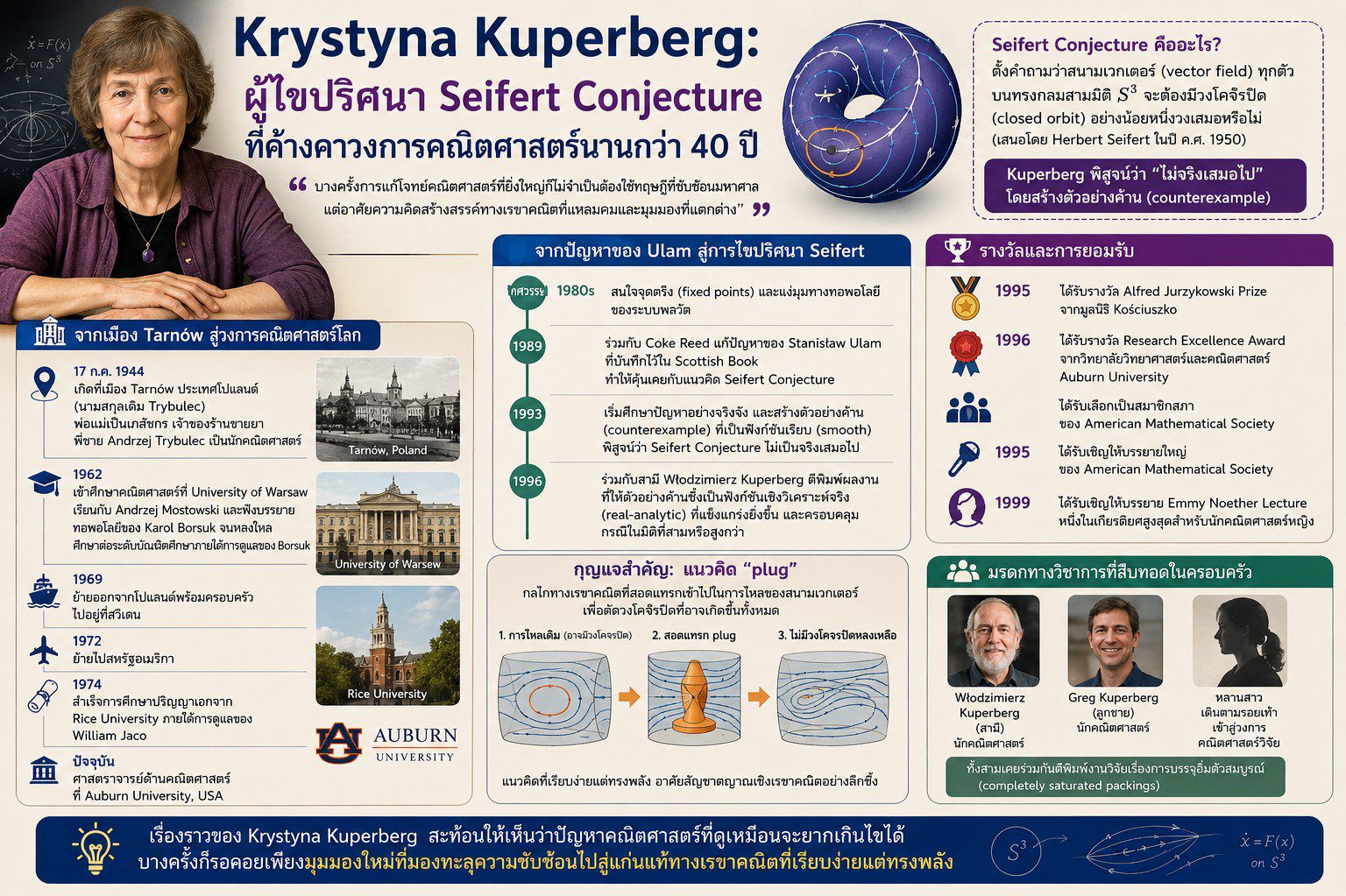
Krystyna Maria Kuperberg was born on July 17, 1944, in Poland, with the maiden name Trybulec. She grew up in the city of Tarnów, where her parents were pharmacists and owned a local pharmacy. Her older brother, Andrzej Trybulec, was also a mathematician. After completing high school in Gdańsk, she entered the University of Warsaw in 1962 to study mathematics. She took her first mathematics course with Andrzej Mostowski and later attended lectures on topology by Karol Borsuk. These lectures sparked her passion for the field, leading her to pursue graduate studies under Borsuk’s supervision.
In 1969, she left Poland with her family and moved to Sweden before relocating to the United States in 1972. She earned her Ph.D. from Rice University in 1974 under the supervision of William Jaco. She is currently a professor of mathematics at Auburn University in the United States.
From Ulam’s Problem to Solving the Seifert Conjecture
Kuperberg’s path toward solving the Seifert Conjecture began with her interest in fixed points and the topological aspects of dynamical systems during the 1980s. In 1989, she and Coke Reed solved a problem posed by Stanisław Ulam, which was recorded in the Scottish Book, a famous collection of mathematical problems created by the Polish mathematical community in Lwów. This achievement introduced her to the ideas behind the Seifert Conjecture, which asked whether every vector field on the three-dimensional sphere must always contain at least one closed orbit. The conjecture had been proposed by Herbert Seifert in 1950.
Kuperberg began studying this problem seriously in 1993 and successfully constructed a smooth counterexample, proving that Seifert’s conjecture was not always true. Later, in 1996, she and her husband Włodzimierz Kuperberg published an improved version of the work, presenting an even stronger counterexample involving a real-analytic function and extending the result to cases in three or higher dimensions.
The key feature of Kuperberg’s approach was the use of the “plug” concept, a geometric mechanism inserted into the flow of a vector field to eliminate all possible closed orbits. This method relied heavily on geometric intuition, reflecting her background in geometric topology developed through her training under Borsuk’s school in Warsaw.
Awards and Recognition
Her solution to the Seifert Conjecture generated significant excitement in the mathematical community. In 1995, she received the Alfred Jurzykowski Prize from the Kościuszko Foundation, and the following year she was awarded the Research Excellence Award from the College of Sciences and Mathematics at Auburn University. She was also elected to serve on the council of the American Mathematical Society. She was invited to deliver lectures at several major mathematical forums, including a major address at the American Mathematical Society in 1995 and the Emmy Noether Lecture in 1999, one of the highest honors recognizing outstanding women mathematicians.
An Academic Legacy Passed Down Through the Family
ne of the most fascinating aspects of Kuperberg’s story is that mathematics did not end with her alone. Her husband, Włodzimierz Kuperberg, and their son, Greg Kuperberg, are also mathematicians. The three of them have even co-authored research on completely saturated packings. Her granddaughter has also followed in the family’s footsteps and entered the field of mathematical research.
The story of Krystyna Kuperberg demonstrates that mathematical problems that appear impossible to solve may sometimes be waiting for a new perspective—one that looks beyond complexity and reveals a simple yet powerful geometric essence at the heart of the problem.