Giacinto Morera: The Engineer Who Provided a Key Criterion for Proving Holomorphic Functions
In complex analysis, proving that a function is holomorphic often requires simple and clear conditions that can be verified. One of the criteria that mathematicians have used to this day is Morera’s theorem, which is named after Giacinto Morera, an Italian mathematician and engineer.
From a Wealthy Merchant Family to the Academic World
Giacinto Morera was born on July 18, 1856, in the city of Novara, Italy. He was the son of Giacomo Morera, a wealthy merchant, and Vittoria Unico. His family's comfortable financial situation allowed him to fully devote himself to his studies after completing his laurea degree. Despite having a privileged family background, Morera was known as an exceptionally hardworking individual who continuously applied this dedication to his own research.
He graduated in engineering and mathematics from the University of Turin, where he studied under several renowned professors, including Enrico D’Ovidio, Angelo Genocchi, and Francesco Siacci. Morera regarded Siacci as not only an academic “teacher” but also a teacher of life. After that, he continued his studies at the University of Pavia under the guidance of Eugenio Beltrami and Felice Casorati, then went to the University of Pisa to study with Enrico Betti and Ulisse Dini, and finally traveled to Leipzig to study with Adolph Mayer and Felix Klein.
Career Path and Contributions in Mechanics
Morera was appointed professor of rational mechanics at the University of Genoa in 1886 and remained there for 14–15 years, serving as a lecturer, dean, and rector. He later moved to the University of Turin in 1901 to hold the same position, succeeding Vito Volterra.
Morera’s research focused on fundamental problems in mechanics, particularly the application of Pfaff’s method to systems of Jacobian partial differential equations and the problem of Lie transformations of the canonical equations of motion. Some historians of mathematics have noted that Morera may not have been a thinker who created entirely new theories, but he possessed exceptional analytical and critical abilities. This made him highly skilled at extending and refining existing theories, as well as solving complex and difficult problems that others were unable to solve.
Morera’s Theorem: The Converse Criterion of Cauchy’s Theorem
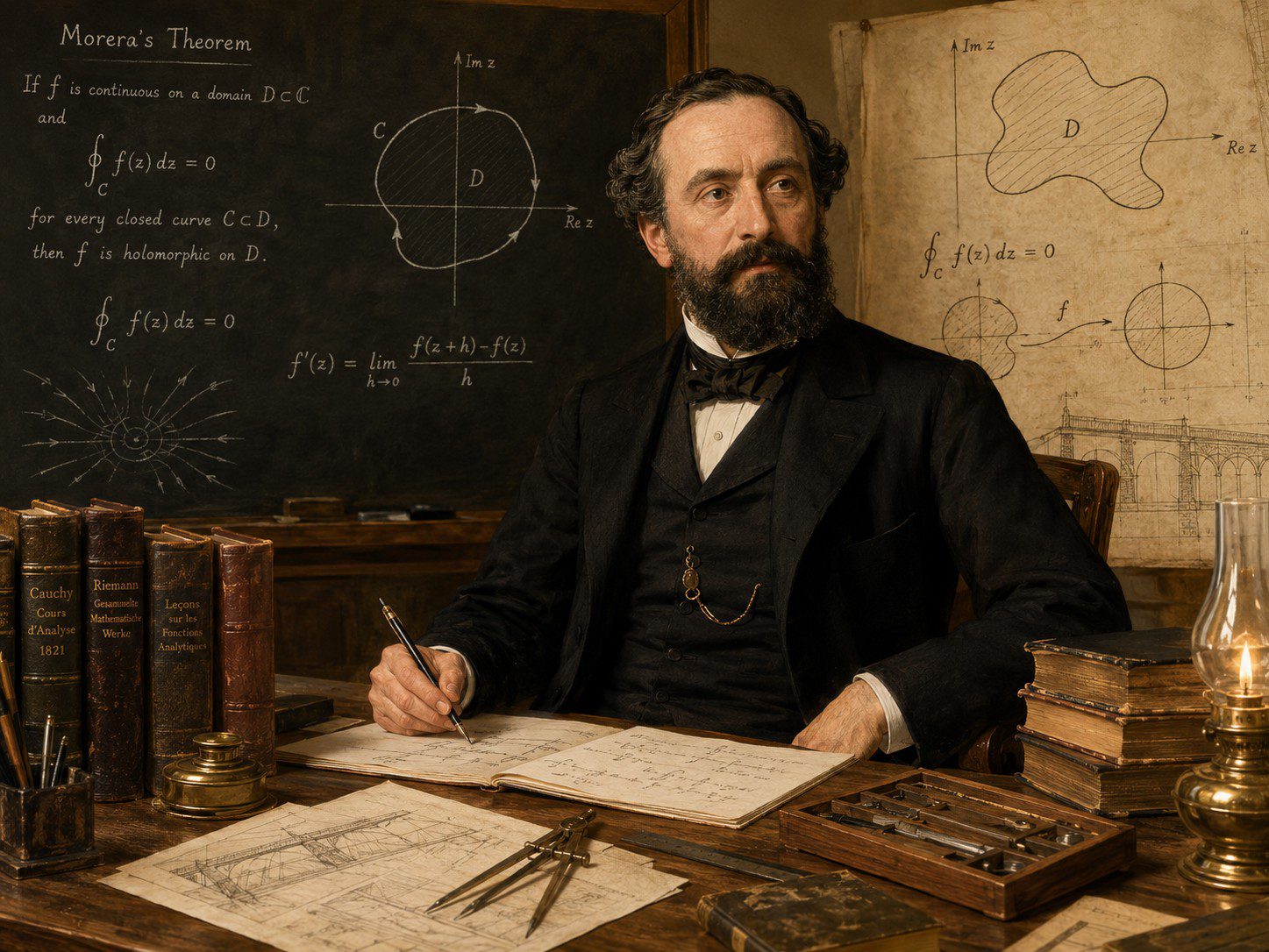
The work that made Morera’s name known throughout the mathematical community was the theorem he proposed concerning a sufficient condition for a function to be holomorphic. This theorem states that if a function is continuous on an open region in the complex plane and the integral of the function along any closed curve within that region is always zero, then the function must be holomorphic.
This theorem is considered the converse of Cauchy’s integral theorem and is of great practical importance because it provides a criterion that can be verified without directly requiring the calculation of a function’s derivative. This allows mathematicians to prove the holomorphicity of complex functions more conveniently, especially in cases where functions are defined through processes that make direct differentiation difficult, such as functions defined by limits of sequences of functions or by integrals.
In addition, Morera made important contributions to the theory of linear elasticity, including Morera stress functions, which are used to analyze internal stresses in materials, as well as work on harmonic functions applied to describing the gravitational field of an ellipsoid.
A Legacy Still Used to This Day
Giacinto Morera died in Turin in 1909. Throughout his life, he received numerous academic honors, including becoming a corresponding member of the Accademia Nazionale dei Lincei in 1896 and a full member in 1907, as well as a member of the Accademia delle Scienze di Torino. Although Morera was not a thinker who created many new theories, the single theorem that bears his name became a fundamental tool that mathematicians around the world continue to use in complex analysis to this day.