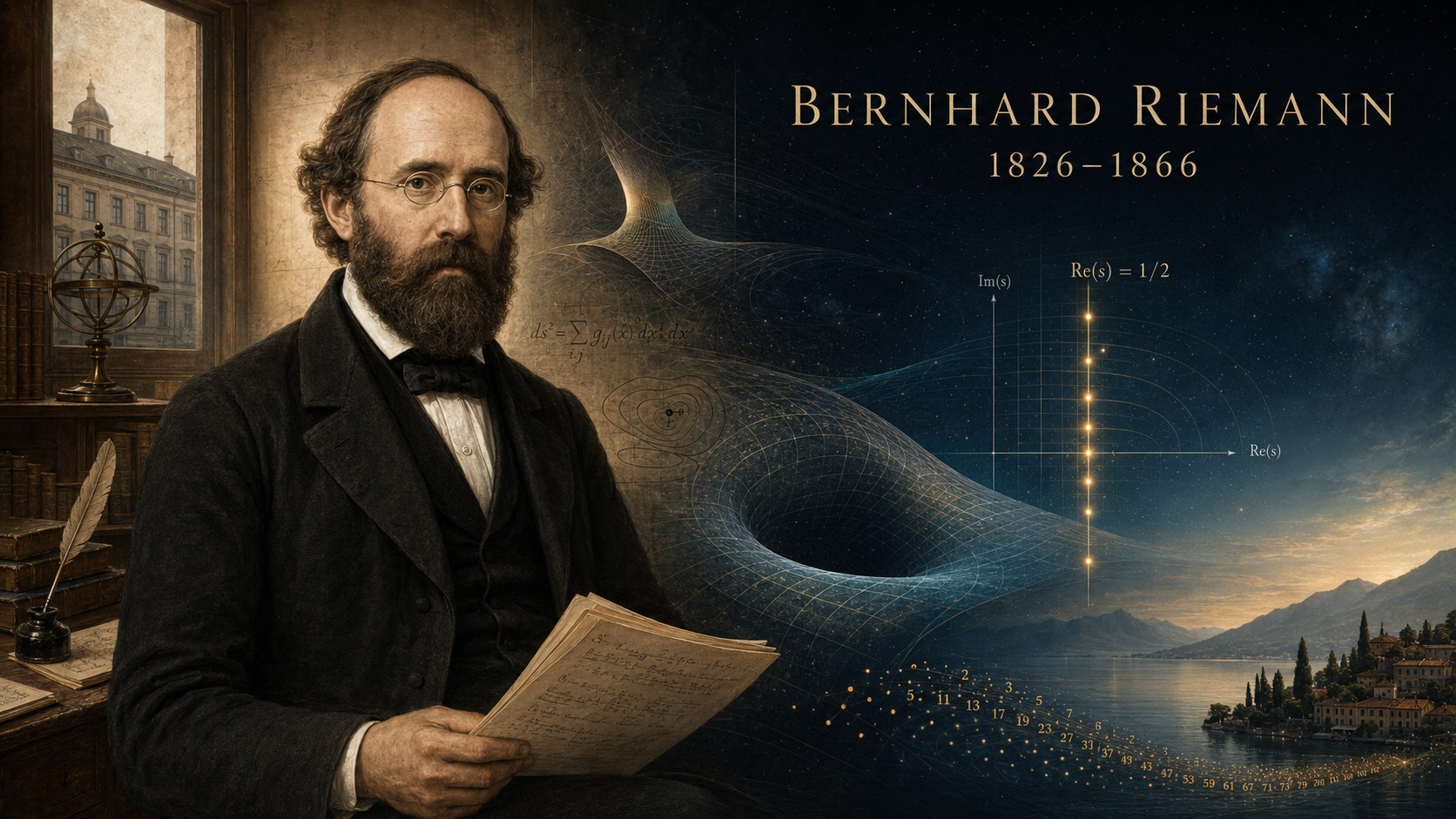
Remembering Bernhard Riemann, the father of Riemann geometry and the originator of the greatest assumption.
Bernhard Riemann was one of the greatest mathematicians of all time. He laid the foundation for Riemannian geometry, which Albert Einstein used as a crucial basis for his theory of general relativity, and is the originator of the Riemann hypothesis, one of the most profound mathematical problems that remains unproven to this day. On this occasion, we would like to reflect on the life of this genius.
His final moments at Lake Maggiore, July 20, 1866.
Bernhard Riemann passed away from tuberculosis on July 20, 1866, in Selasca, by Lake Maggiore, Italy, at the age of 39, with his wife Elise and three-year-old daughter Ida by his side. He had suffered from the disease since childhood, with his health severely deteriorating after a bad cold in 1862. His colleagues in Göttingen helped fund his recovery trip to Italy for a better climate, but the illness was incurable. The day before his death, he was still resting under a fig tree, delighting in the beautiful scenery before him, and passed away peacefully without any suffering.
Following his death, his close friend Richard Dedekind compiled Riemann's surviving works and published them in 1868, bringing his work to wider recognition. Sadly, some of his research was destroyed by those who did not appreciate its value shortly after his death.
A shy, talented child from a poor family.
Georg Friedrich Bernhard Riemann was born on September 17, 1826, in the village of Breselenz, Kingdom of Hanover, into a poor Lutheran priestly family. He was shy and withdrawn throughout his life, but possessed an exceptional gift for mathematics from a young age. His teachers noticed this talent and lent him advanced mathematical texts, including Adrien-Marie Legendre's number theory, which he finished reading within a week and memorized almost the entire book.
He entered the University of Göttingen in 1846, intending to study theology as his family wished. However, his professor, Carl Friedrich Gauss, recognizing his talent, encouraged him to study mathematics instead. He then transferred to the University of Berlin from 1847 to 1849 before returning to Göttingen to complete his doctoral dissertation under Gauss's supervision in 1851.
A work that revolutionized mathematics and physics.
Riemann pioneered the concept of Riemann surfaces in his doctoral dissertation, deeply linking topology to complex function theory. He was also the first to provide a rigorous definition of the integral, known as the Riemann integral, and made significant contributions to Fourier series.
His most influential work was his 1854 lecture on the foundations of geometry, which laid the groundwork for Riemannian geometry, expanding it to cover multi-dimensional curved spaces. This concept became an indispensable mathematical tool when Albert Einstein developed his theory of general relativity over half a century later. Additionally, in 1859, he proposed the Riemann Hypothesis regarding the positions of the zeros of the Riemann zeta function, which is linked to the distribution of prime numbers and remains one of the most difficult and important unsolved problems in mathematics today.
A legacy far greater than a short life.
Although Riemann lived only 39 years and his early work was not widely accepted due to his challenging writing style and limited number of students, his ideas had a profound influence on later mathematicians. Both Felix Klein and David Hilbert were inspired by his work, leading to Göttingen becoming a major center of mathematical research in the world, with Riemann playing a key role in laying the foundation.
Each year on the anniversary of his passing, Bernhard Riemann's name serves as a reminder of the power of mathematical creativity that could profoundly transform humanity's understanding of the nature of space, gravity, and time—even though it came from a shy young man with a short time on this earth.