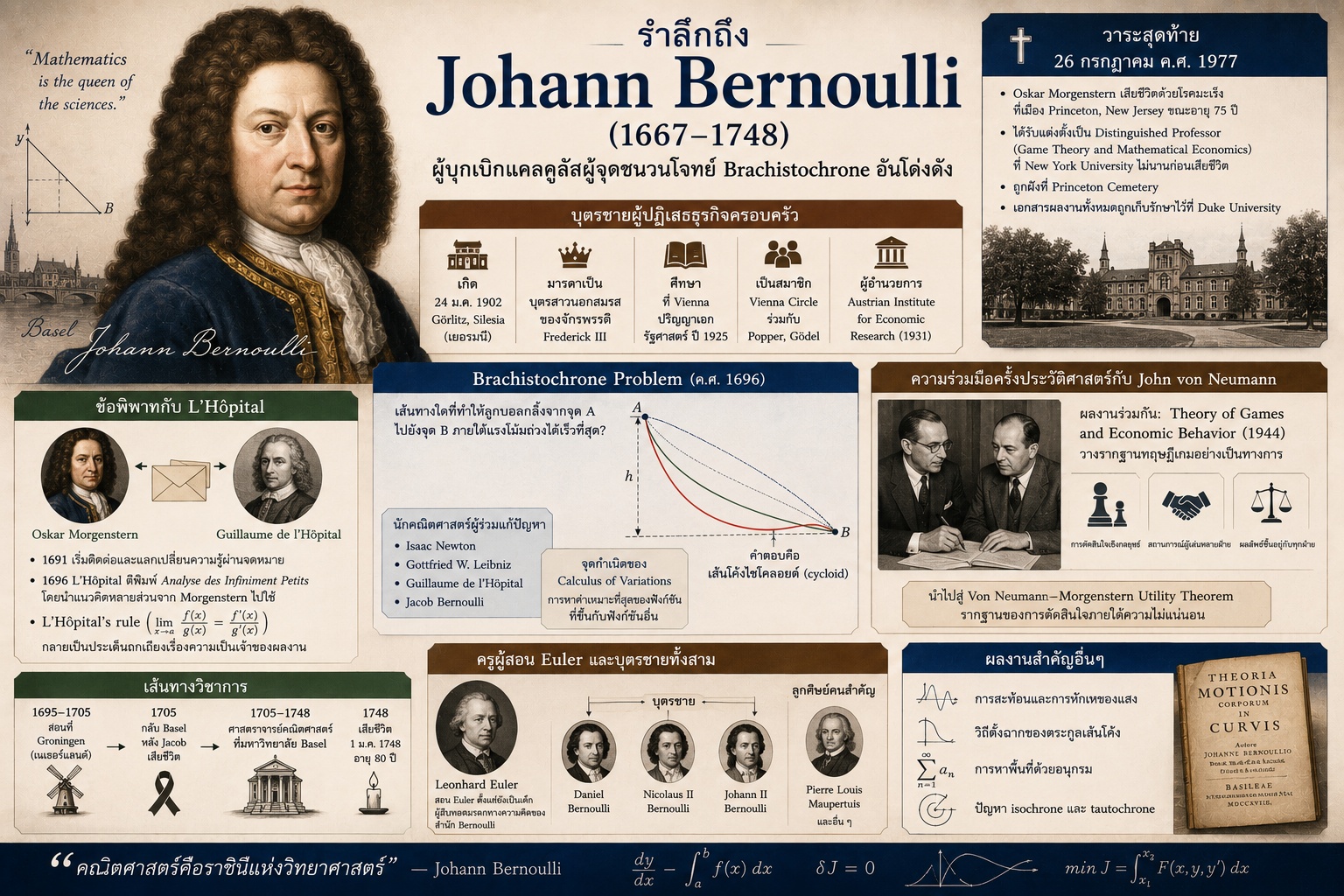
Johann Bernoulli: The calculus pioneer who sparked the famous Brachistochrone problem
Among the Bernoulli family members, the most influential mathematician in Europe, Johann Bernoulli, is considered one of the most important figures. He was one of the pioneers of early calculus alongside Gottfried Wilhelm Leibniz and sparked the field of calculus of variations through famous problems like the Brachistochrone problem. But his life was also full of conflicts and historical controversies, no less than his great achievements.
The tenth son who rejects the family business
Johann Bernoulli was born on July 27, 1667 (old calendar, or August 6 in the new calendar) in Basel, Switzerland. He was the tenth child of Nicolaus and Margaretha Bernoulli. His family came from Antwerp, Belgium, and had fled religious persecution from the Catholic side before settling in Basel. His father was a spice merchant and a local official who wanted his sons to carry on the family business, but Johann completely failed as an apprentice in trade.
In 1683, he was allowed to study at the University of Basel, where his brother Jacob Bernoulli, who was 12 years older than him, was already a professor of mathematics. Even though his father agreed for him to study medicine instead of going into the family business, Johann was deeply passionate about mathematics, strongly influenced by seeing his brother pursue a path in mathematics despite family objections. He earned his medical degree in 1694, but in the end, he devoted his whole life to the new branch of calculus that was revolutionizing the field of mathematics at the time.
The pioneer of calculus and the dispute with L’Hôpital
Johann learned Leibniz's calculus through his contact with his brother Jacob and became one of Leibniz's most active supporters in the dispute over who invented calculus with Isaac Newton. In 1691, during a trip to Paris, he met the French mathematician Guillaume de l’Hôpital, who persuaded Johann to teach him calculus in exchange for payment. They continued to correspond through letters afterward.
The major point of conflict came when l’Hôpital published the first textbook on differential calculus, called *Analyse des Infiniment Petits*, in 1696. Most of its content came from Johann’s notes and letters, but l’Hôpital claimed it as his own original work. One key part of this book was the rule for finding limits of functions in indeterminate forms, which is now known as L’Hôpital’s rule. Although l’Hôpital admitted in the preface that he had relied somewhat on the work of Leibniz and the Bernoulli brothers, he didn’t give clear enough credit, which has led to historical debates up to today about who really deserves the credit for inventing this rule. This tension ended their friendship on an awkward note.
Brachistochrone Problem: The Origin of the Calculus of Variations
One of the works that made Johann most famous was proposing the Brachistochrone problem in 1696, which asked what path would let a ball roll from one point to another under gravity the fastest. The problem seems simple but hides deep mathematical complexity, because the answer isn't the straight line you might expect, but a carefully calculated cycloid curve.
This problem challenged the leading mathematicians of the time to find a solution. Both Newton, Leibniz, l’Hôpital, and Jacob Bernoulli, his older brother, were all able to solve this problem in different ways. The process of solving this problem itself became the starting point for a new branch of mathematics called the calculus of variations, which studies how to find the optimal values of functions that depend on other functions, rather than just numerical variables. This field later became an essential tool in theoretical physics, engineering, and economics.
From Groningen to inheriting the position from his older brother
Johann taught at the University of Groningen in the Netherlands from 1695 to 1705, a period full of both academic and personal chaos, before returning to Basel after his brother Jacob passed away in 1705. He then took over his brother's position as a professor of mathematics, a role that cemented his status as one of Europe’s leading mathematicians.
It's interesting that the relationship between the two brothers wasn't very smooth. Even though Jacob initially taught Johann calculus, they later became fierce academic rivals, leading to several mathematical disputes between them. This also reflects Johann's conflicting personality, being both brilliant and having relationship issues with those around him.
Leonhard Euler's teacher
Apart from his own research, Johann Bernoulli also played a very important role as a teacher, especially in teaching Leonhard Euler, one of the greatest mathematicians in history, while he was still a young man. Later on, Euler became the full-fledged heir to the mathematical legacy of the Bernoulli family. In addition, he taught all three of his sons—Daniel, Nicolaus II, and Johann II Bernoulli—to become famous mathematicians, as well as many other notable students, such as Pierre Louis Maupertuis.
A Legacy That Remains a Fundamental Foundation
Johann Bernoulli passed away on January 1, 1748, in Basel at the age of 80. His work covered both the reflection and refraction of light, orthogonal trajectories of curve families, finding areas using series, and the isochrone and tautochrone problems. Even though his life was full of conflicts with l’Hôpital and his own brother, his mathematical contributions undeniably played a crucial role in the early development of calculus, from teaching problem-solving that led to the calculus of variations to passing on knowledge to the next generation of mathematicians like Euler. These achievements remain influential in mathematics to this day.