Remembering R. A. Fisher, the father of modern statistics
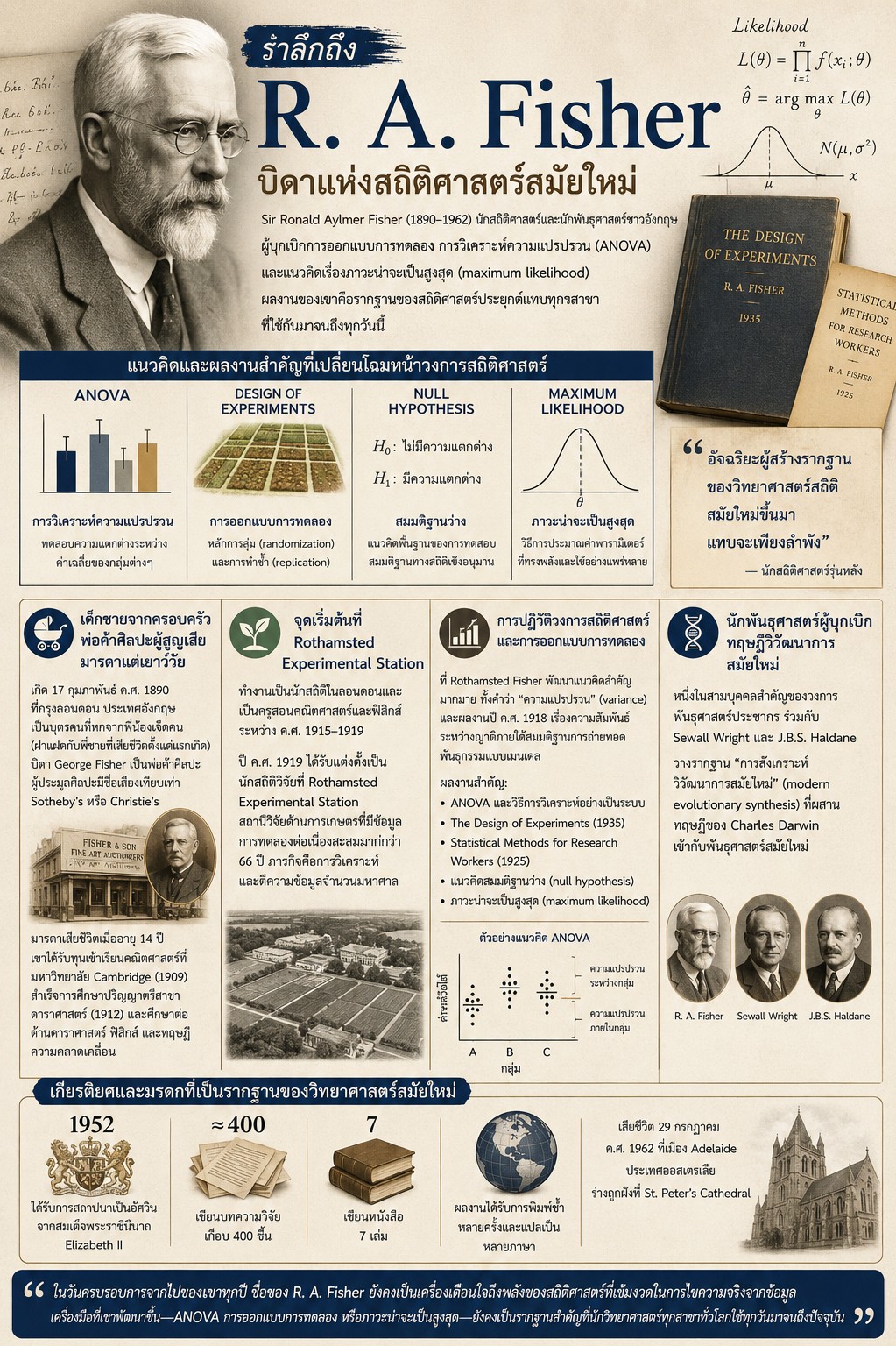
Sir Ronald Aylmer Fisher was an English statistician and geneticist who is celebrated as one of the fathers of modern statistics. He pioneered the design of experiments, analysis of variance (ANOVA), and the idea of maximum likelihood. His work became a key foundation for applied statistics in almost every field and is still used to this day. Today, we take a moment to look back and remember the life of this thinker who changed the way all of science analyzes data forever.
Final agenda in Adelaide on July 29, 1962
R. A. Fisher passed away from colon cancer on July 29, 1962, in Adelaide, Australia, at the age of 72, after undergoing surgery. In the later years of his life, after retiring from Cambridge University in 1957, he moved to work as a senior researcher at CSIRO in Adelaide, where he spent his final days. His body was buried at St. Peter’s Cathedral in Adelaide.
A boy from an art merchant family who lost his mother at a young age
Ronald Aylmer Fisher was born on February 17, 1890, in London, England. He was the sixth of seven children and was a twin with an older brother who died at birth. His father, George Fisher, was a highly successful art dealer, running a famous auction house comparable to Sotheby’s or Christie’s. Fisher’s childhood was filled with comfort and happiness, but when he was just 14, his mother passed away from peritonitis, marking a turning point that ended his luxurious childhood.
In 1909, he received a scholarship to study mathematics at Cambridge University and graduated with a bachelor's degree in astronomy in 1912. He then continued studying for another year, focusing on astronomy, physics, and the theory of errors. It was this interest in the theory of errors that later led him to explore statistical problems.
The starting point at Rothamsted Experimental Station
After graduating, Fisher worked as a statistician in London and taught math and physics at various schools between 1915 and 1919. The biggest turning point in his career came in 1919 when he was appointed a research statistician at Rothamsted Experimental Station in Hertfordshire, an agricultural research station with over 66 years of accumulated experimental data. His main job was to analyze and interpret this massive amount of data, which became a key starting point for the statistical innovations he developed later on.
The revolution in statistics and experimental design
At Rothamsted, Fisher developed several key ideas that forever changed the field of statistics. He was the one who coined the term 'variance' and was the first to develop a systematic method of analysis in his 1918 paper on the correlation between relatives under the assumption of Mendelian inheritance, which was work that linked genetics with statistics deeply for the first time.
His most important work was developing Analysis of Variance (ANOVA), a statistical tool used to test whether the differences between group means are statistically significant. He also pioneered the systematic design of experiments through his book *The Design of Experiments*, published in 1935, which established key principles of randomization and replication that remain the foundation of scientific experiments across all fields today. He also introduced the concept of the null hypothesis, which is widely used in inferential statistics.
Another important work is the concept of maximum likelihood, which is one of the most powerful and widely used methods for estimating statistical parameters today. The book *Statistical Methods for Research Workers* that he published in 1925 became a standard reference for scientists in many fields, was reprinted several times, and translated into multiple languages.
A geneticist who pioneered the modern theory of evolution
Besides his work in statistics, Fisher was also one of the three key figures in population genetics, along with Sewall Wright and J.B.S. Haldane. Together, they helped lay the foundation for what is called the 'modern evolutionary synthesis,' which perfectly blends Charles Darwin's theory of evolution with modern genetics.
Honors and legacy that are the foundation of modern science
Fisher was knighted by Queen Elizabeth II in 1952, becoming Sir Ronald Aylmer Fisher. Throughout his life, he wrote seven books and nearly 400 research papers. He is hailed by later statisticians as 'a genius who almost single-handedly laid the foundations of modern statistical science' and 'the single most important person in 20th-century statistics.'
Every year on the anniversary of his passing, R. A. Fisher's name continues to remind us of the power of rigorous statistics in uncovering the truth from data. The tools he developed—whether it's ANOVA, experimental design, or maximum likelihood—still form a key foundation that scientists in every field around the world use every day.