Remembering Walter Feit, who proved the odd order theorem and transformed group theory.
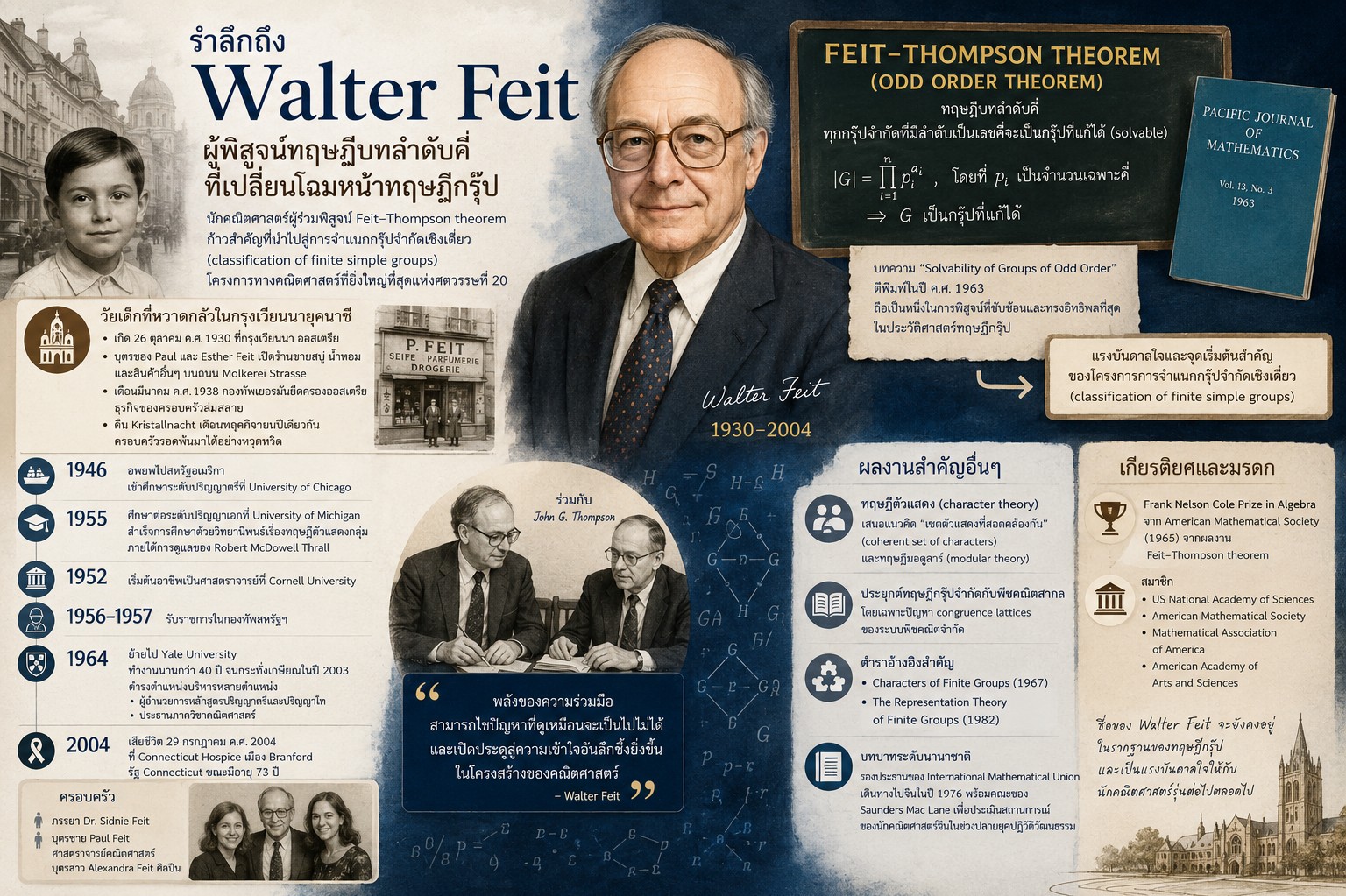
Walter Feit was an Austrian-American mathematician who co-proved the Feit–Thompson theorem, or the odd order theorem, in group theory, along with John G. Thompson. This was one of the most important steps leading to the classification of finite simple groups, one of the greatest mathematical projects of the 20th century. On this occasion, we take a moment to look back on the life of a mathematician who survived childhood fears and became one of the most influential algebraists of his time.
Final agenda in Branford on July 29, 2004
Walter Feit passed away after a long illness on July 29, 2004, at Connecticut Hospice in Branford, Connecticut, at the age of 73. This was less than a year after he retired from Yale University in October 2003, where over 80 colleagues and former students from around the world gathered for a special four-day academic conference, the “Conference on Groups, Representations and Galois Theory,” in his honor. He is survived by his wife Dr. Sidnie Feit, his son Paul, who is also a mathematics professor like his father, and his daughter Alexandra, an artist.
A childhood lived in fear in Nazi-era Vienna
Walter Feit was born on October 26, 1930, in Vienna, Austria, to Paul and Esther Feit, a Jewish family. His father ran a shop selling soap, perfume, and other goods on Molkerei Strasse, and the family lived in the apartment above the store. Their lives changed completely in March 1938 when the German army marched in and took over Austria. The family's business almost collapsed immediately, and on the terrifying night of Kristallnacht in November of that same year, his family narrowly escaped harm simply because his father happened not to open the shop that day.
In 1946, after the end of World War II, Feit immigrated to the United States and enrolled in an undergraduate program at the University of Chicago before pursuing a doctorate at the University of Michigan and graduating in 1955 with a dissertation on the theory of group characters under the supervision of Robert McDowell Thrall.
The academic journey from Cornell to Yale
Feit began his career as a professor at Cornell University in 1952 before moving to Yale University in 1964, an institution where he worked for as long as 40 years until his retirement. Between 1956 and 1957, he also served in the United States Army. Throughout his career at Yale, he also held several administrative positions, including director of the undergraduate and graduate programs and chair of the mathematics department.
Feit–Thompson Theorem: The most complex proof of that era
The work that brought Feit the most fame in the history of mathematics was his collaboration with John G. Thompson in proving Burnside's conjecture that every finite group of odd order must be a solvable group. This work was published in 1963 under the title 'Solvability of Groups of Odd Order,' which was so lengthy that it occupied an entire issue of the Pacific Journal of Mathematics and was widely acclaimed as the most influential article ever written in the field of finite group theory.
At the time of its publication, this proof was considered one of the most complex and difficult mathematical proofs ever. Both the length and the subtlety of the technical arguments used made this work not only answer a long-standing question but also inspire and provide new technical tools to the field of mathematics to a tremendous extent, becoming a significant starting point that propelled the project of classifying finite simple groups, which is one of the greatest and most complex mathematical projects in history, requiring the collaboration of hundreds of mathematicians over several decades to complete.
Other works in group theory and representation theory
Apart from the Feit–Thompson theorem, Feit also published nearly a hundred works in the field of finite group theory, character theory, particularly proposing the concept of a coherent set of characters, and modular theory. He also applied his deep knowledge of finite group theory to problems in universal algebra, especially the question of which lattices can occur as the congruence lattices of finite algebraic systems. His textbooks Characters of Finite Groups (1967) and The Representation Theory of Finite Groups (1982) remain important reference works in this field.
He also played an important role in the international mathematics community, serving as the vice president of the International Mathematical Union, and in 1976 he traveled to China with a delegation led by Saunders Mac Lane to assess the situation of Chinese mathematicians during the late Cultural Revolution, which was a time when the 'Gang of Four' still held power.
Honor and legacy that remain a fundamental foundation
Feit received the Frank Nelson Cole Prize in Algebra from the American Mathematical Society in 1965 for the Feit–Thompson theorem. In addition, he was a member of the US National Academy of Sciences, the American Mathematical Society, the Mathematical Association of America, and the American Academy of Arts and Sciences.
On the anniversary of his passing every year, the name Walter Feit remains a reminder of the power of academic collaboration that can solve seemingly impossible problems. The odd-order theorem that he co-proved with Thompson is not only a beautiful mathematical achievement in itself but also a significant step that led to one of the greatest accomplishments in the field of algebra in the 20th century.