In memory of Nicolaus (II) Bernoulli, the beloved son of Johann Bernoulli, who passed away prematurely
Nicolaus (II) Bernoulli was another mathematician from the famous Bernoulli family of Switzerland, who made significant contributions to the problem of trajectories and played an important role in the mathematical dispute between Isaac Newton and Gottfried Wilhelm Leibniz. On this occasion, we would like to recall the short life of the young mathematician whose bright future awaited him but ended abruptly at the age of only 31.
Final agenda in Saint Petersburg, July 31, 1726
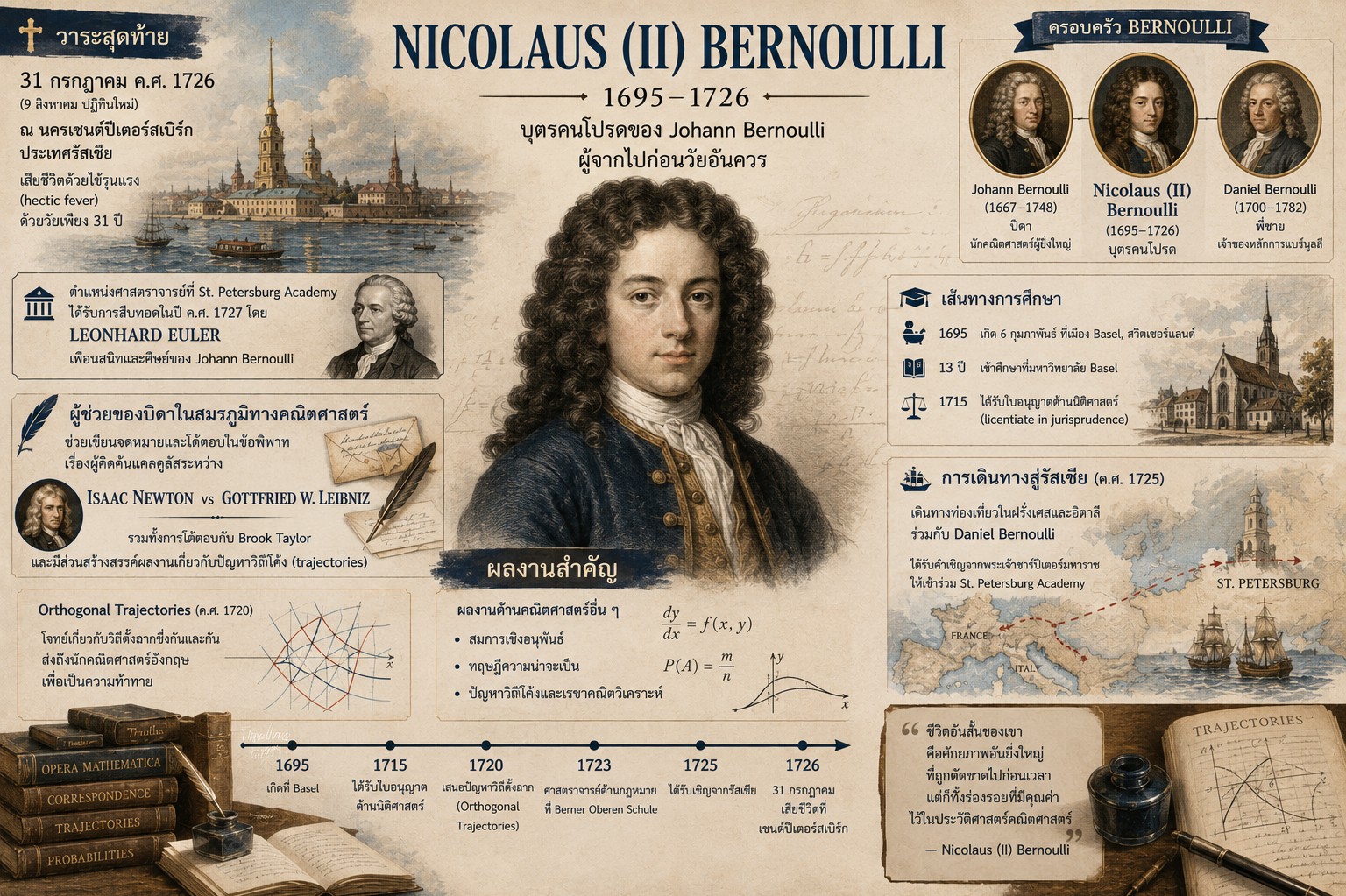
Nicolaus (II) Bernoulli died from a hectic fever on July 31, 1726 (old calendar, or August 9 in the new calendar) in Saint Petersburg, Russia, just eight months after he had traveled to take up a position at the St. Petersburg Academy, an institution newly established under the initiative of Tsar Peter the Great. His sudden departure at the young age of 31 caused great regret in the mathematical community of that era, as his talent indicated a future that could have been even more brilliant.
His professorship at the St. Petersburg Academy was succeeded in 1727 by none other than Leonhard Euler, one of the greatest mathematicians in history, who was a close friend and student of Johann Bernoulli, Nicolaus' father.
The favorite child who studies both mathematics and law
Nicolaus (II) Bernoulli was born on February 6, 1695, in Basel, Switzerland. He was the favorite child among the three sons of Johann Bernoulli, the great mathematician, and the brother of Daniel Bernoulli, the physicist known for the famous Bernoulli principle. He entered the University of Basel at the age of only 13, and, like many members of the Bernoulli family, he studied both mathematics and law simultaneously, receiving a licentiate in jurisprudence in 1715.
Father's assistant in the battlefield of mathematical disputes
One of Nicolaus (II)'s important roles was acting as an assistant to his father in academic communications, particularly in writing letters related to the dispute over the invention of calculus between Isaac Newton and Gottfried Wilhelm Leibniz, which was one of the most intense academic disputes in the history of mathematics. He not only helped write letters responding to the English mathematician Brook Taylor on behalf of his father, but also contributed to creating significant mathematical work on trajectory problems independently while supporting the mathematical arguments in this matter. In addition, he also played a role in another dispute directly between his father and Brook Taylor.
Orthogonal Trajectories: A Challenging Problem Sent to English Mathematicians
One of Nicolaus (II)'s most outstanding works occurred in 1720 when he posed a problem concerning reciprocal orthogonal trajectories, which is an analytical geometry problem that studies curves intersecting a family of other curves at right angles. This problem was specifically designed as a challenge to a group of English mathematicians who favored Newton's methods (English Newtonians), reflecting the intense academic competition between continental European and English mathematical schools at that time.
In addition, Nicolaus (II) also made contributions in the field of differential equations and probability theory, which is a field in which the Bernoulli family had played a significant and continuous role for several generations. Since 1723, he also held the position of professor of law at Berner Oberen Schule, demonstrating a versatile talent that combines both mathematics and law.
The journey to Saint Petersburg with my older brother
In the year 1725, while Nicolaus (II) was traveling in France and Italy with his brother Daniel Bernoulli, both of them received an invitation from Tsar Peter the Great of Russia to join the newly established St. Petersburg Academy, which was a great opportunity for the two young mathematicians. Unfortunately, fate took a turn; only eight months after starting work at the institution, Nicolaus (II) fell ill with a severe fever and died suddenly, leaving his brother Daniel to face a great loss in a land far from home.
A short but valuable legacy
Although the life of Nicolaus (II) Bernoulli lasted only 31 years, his work was a part that completed the grand picture of the Bernoulli family in laying the foundations of modern mathematics, both his role as an important assistant to his father in worldwide academic disputes and his work on curves, which demonstrated his true mathematical ability. On the anniversary of his passing each year, the name of Nicolaus (II) Bernoulli continues to be a reminder of the great potential that may have been cut short, yet still left valuable traces for the history of mathematics.