Remembering Ferdinand Georg Frobenius, who laid the foundation for finite group representation theory.
Ferdinand Georg Frobenius was a prominent German mathematician who played a key role in the development of group theory, particularly the concepts of abstract groups and the representation theory of finite groups. These concepts became fundamental foundations for applications in quantum physics and crystallography. On this occasion, we look back at the life of this versatile mathematician, specializing in fields ranging from elliptical functions to abstract algebra.
His final moments in Berlin, August 3, 1917.
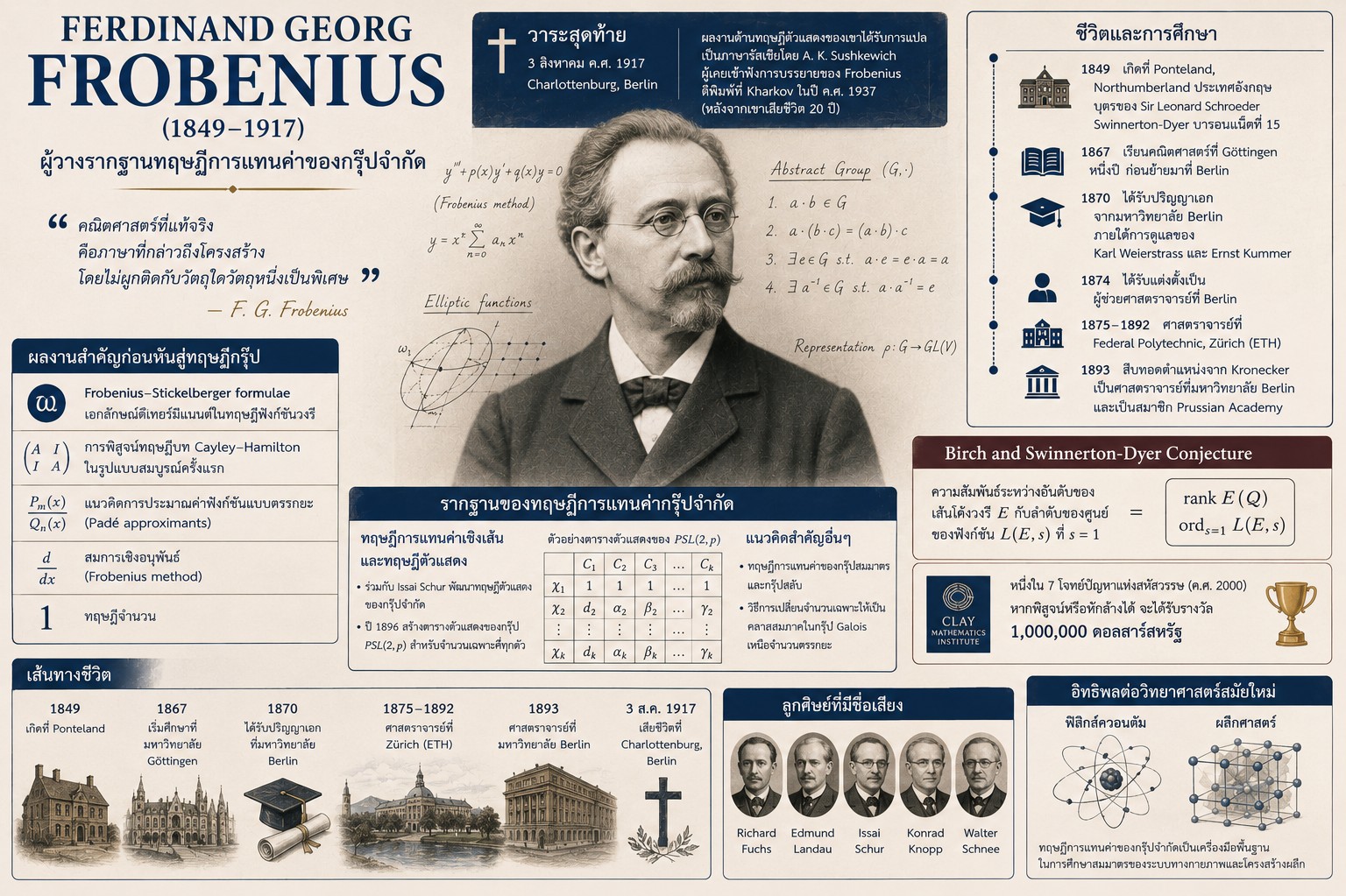
Ferdinand Georg Frobenius passed away on August 3, 1917, in Charlottenburg, a suburb of Berlin, at the age of 67. He departed during the middle of World War I, a challenging period for the German academic community as a whole. Interestingly, his seminal work on character theory continued to receive ongoing attention even after his passing. This is highlighted by the translation of his major work into Russian, complete with commentary by Anton K. Sushkewich, who had attended Frobenius's lectures between 1907 and 1911. This translation was published in Kharkov in 1937, fully 20 years after his death.
The talented son of a priest from Charlottenburg.
Ferdinand Georg Frobenius was born on October 26, 1849, in Charlottenburg, a suburb of Berlin, to Christian Ferdinand Frobenius, a Protestant parson, and Christine Elizabeth Friedrich. He entered the Joachimsthal Gymnasium at nearly eleven years of age and began his studies at the University of Göttingen for one year in 1867 before returning to continue his education at the University of Berlin. He received his doctorate in 1870 with a dissertation on the solution of differential equations under the supervision of the renowned mathematicians Karl Weierstrass and Ernst Kummer.
After graduating, he taught at several secondary schools, including the Joachimsthal Gymnasium and the Sophienrealschule, before being appointed an assistant professor at the University of Berlin in 1874 due to his outstanding publications.
From Zurich to the succession to Kronecker.
In 1875, Frobenius was appointed a full professor at the Federal Polytechnic in Zurich (now ETH Zurich), a position he held for 17 years, from 1875 to 1892. During this time, he married, started a family, and produced significant works in various fields of mathematics.
A crucial turning point occurred in late December 1891 when the great mathematician Leopold Kronecker of the University of Berlin died, leaving his professorship vacant. Weierstrass, firmly believing that Frobenius was the most suitable person to maintain Berlin's leadership in world mathematics, used his influence to secure the position for Frobenius in 1893. In the same year, he was also elected a member of the Prussian Academy of Sciences.
A diverse range of work before turning to group theory.
Before dedicating himself seriously to group theory in the second half of his career, Frobenius made significant contributions to various fields. In the theory of elliptic functions, he co-developed the Frobenius–Stickelberger formulae with Ludwig Stickelberger, which stands as an important determinantal identity in this field. Additionally, he provided the first complete proof of the Cayley-Hamilton theorem, a fundamental theorem in linear algebra, and was the first to introduce the concept of rational function approximation, now known as Padé approximants. He also contributed to differential equations through the Frobenius method, as well as to number theory.
The fundamental basis of finite group representation theory.
Frobenius's most memorable work in the history of mathematics is the foundation he laid for group theory, particularly the concept of abstract groups. He developed this by combining the results from algebraic equations, geometry, and number theory, leading to the study of groups in an abstract form that is not tied to any particular context.
His most important contribution to this field was laying the foundations of the representation theory of finite groups and character theory, which he developed jointly with his student, Issai Schur. In his first paper on characters in 1896, Frobenius constructed the character table of the group PSL(2,p) for all odd primes, which was a major pioneering work. Furthermore, he made fundamental contributions to the representation theory of symmetric groups and alternating groups, as well as introducing a method to turn prime numbers into conjugacy classes in Galois groups over rational numbers, which was a highly advanced concept.
This finite group substitution theory later became an indispensable fundamental tool in quantum physics, particularly in the analysis of symmetry of quantum mechanics systems, and in crystallography, where group theory is used to classify the symmetry structures of various crystals.
A legacy that connects pure mathematics with modern science.
Frobenius also served as a thesis advisor to several renowned mathematicians, including Richard Fuchs, Edmund Landau, Issai Schur, Konrad Knopp, and Walter Schnee, all of whom continued and expanded upon his intellectual legacy. Each year on the anniversary of his passing, the name Ferdinand Georg Frobenius serves as a reminder of the power of pure mathematics, which seemed highly abstract at the time of its creation, but which later became a fundamental tool that modern sciences such as quantum physics and crystallography rely on.