Commemorating Jerzy Neyman, a key architect of modern theoretical statistics.
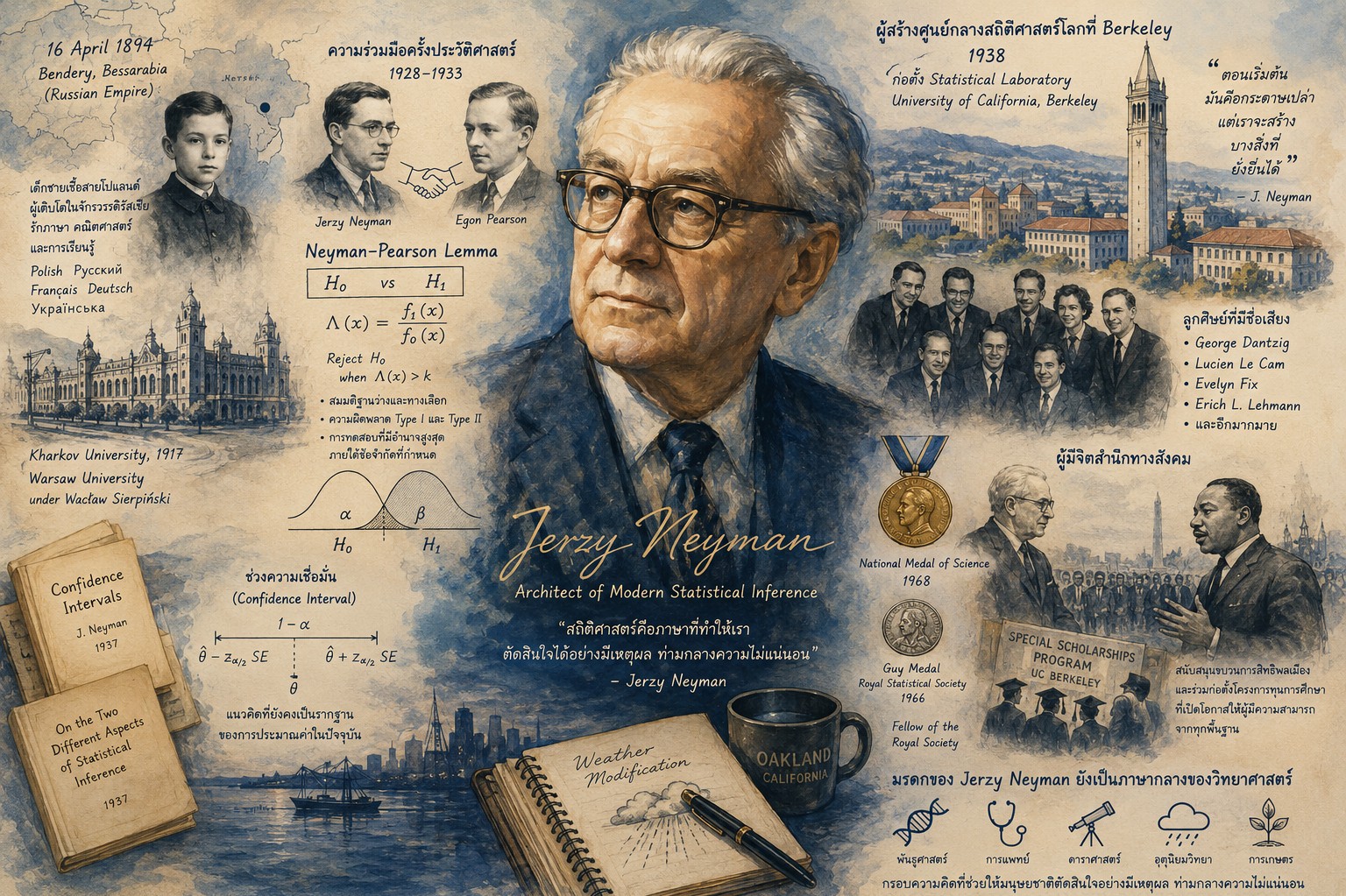
Jerzy Neyman was a Polish mathematician and statistician, widely regarded as one of the foremost architects of modern theoretical statistics. His work on hypothesis testing, developed jointly with Egon Pearson between 1928 and 1933, became a fundamental cornerstone of statistical science and remains in widespread use today. On this occasion, we commemorate the life of a scholar who worked tirelessly until his final days.
He passed away in Oakland on August 5, 1981.
Jerzy Neyman died of heart failure on August 5, 1981, in Oakland, California, at the age of 87. Just one month earlier, he had attended a conference on cancer research. He remained in relatively good health until two weeks before his death, and even on the day before he passed away, he was still working in the hospital on a book about weather modification. His unwavering dedication to research continued until the very end of his life.
His colleagues described him as “the last great pioneer of modern statistics,” and his passing marked the end of a defining chapter in the history of the field's development.
A Polish Boy Raised in the Russian Empire
Jerzy Spława-Neyman was born on April 16, 1894, in Bendery, Bessarabia Governorate, Russian Empire (now Tighina, Moldova). He was the second of four children born to Czesław Spława-Neyman, a judge, and Kazimiera Lutosławska. The family was of Polish descent and practiced Roman Catholicism, even though Poland had not yet regained its independence at the time of his birth. Because his father served as a judge, the family moved frequently in accordance with his judicial appointments, and Neyman spent his childhood in both Crimea and Ukraine.
Neyman began his formal education at the age of 10 in Simferopol, Crimea. Although he was slower than his classmates in learning Russian history and geography, he displayed exceptional talent for languages, becoming proficient in Polish, Russian, French, German, and Ukrainian. He graduated from the University of Kharkov in 1917 before continuing his studies at the University of Warsaw under the supervision of the renowned mathematician Wacław Sierpiński.
The Historic Collaboration with Egon Pearson
The most significant turning point in Neyman’s career came between 1928 and 1933, when he collaborated with Egon Pearson, the son of the renowned statistician Karl Pearson, to develop a systematic theoretical framework for hypothesis testing. Their joint work led to what is now known as the Neyman-Pearson lemma, a fundamental tool that established methods for designing the most powerful statistical tests under specified conditions.
The Neyman-Pearson framework for hypothesis testing completely transformed the way statisticians around the world analyze and make decisions from data. It introduced concepts such as the null hypothesis, alternative hypothesis, and the probabilities of Type I and Type II errors, which have become the standard language used by scientists across all fields to discuss statistical uncertainty to this day.
Additionally, Neyman pioneered the concept of confidence intervals, which he developed while still in Poland and presented at University College London in 1934, before formally publishing the work in 1937. This concept was initially somewhat confused with R. A. Fisher’s idea of fiducial intervals, but Fisher himself later helped to clarify the misunderstanding.
The Creator of a Global Center of Statistical Science at Berkeley
In 1938, Neyman immigrated to the United States and established the Statistical Laboratory within the Department of Mathematics at the University of California, Berkeley. At first, it was essentially a “blank sheet of paper,” with no systematic program in statistics before his arrival. Through his dedication and leadership, the laboratory grew into a world-renowned center for training leading statisticians and produced many distinguished Ph.D. students, including George Dantzig, Lucien Le Cam, Evelyn Fix, and Erich Leo Lehmann.
During World War II, he conducted military research, particularly on problems related to bomb targeting. In 1968, he was awarded the National Medal of Science in recognition of his contributions to establishing the foundations of modern statistics. He also received the Guy Medal from the Royal Statistical Society in 1966 and was elected a Fellow of the Royal Society.
A Scholar with a Strong Social Conscience
Beyond his academic work, Neyman also played an important role in the Civil Rights movement in the United States. He raised substantial funds in support of Martin Luther King Jr. and was instrumental in establishing the Special Scholarships program at Berkeley, which became the foundation for professional development programs and related senate committees that continue to operate today.
A Legacy That Remains the Common Language of Science
On the anniversary of his passing each year, the name of Jerzy Neyman continues to serve as a reminder of the power of rigorous statistical frameworks in helping humanity make rational decisions under uncertainty. His contributions to hypothesis testing and confidence intervals have become part of the common language used by scientists across all disciplines to communicate their research findings, whether in genetics, medical diagnosis, astronomy, meteorology, or agricultural experiments. This stands as a testament to the greatness of the intellectual framework he helped build throughout his lifelong career.