Pierre-Louis Lions: The revolutionary in the way of looking at solutions of equations that have no smooth solutions
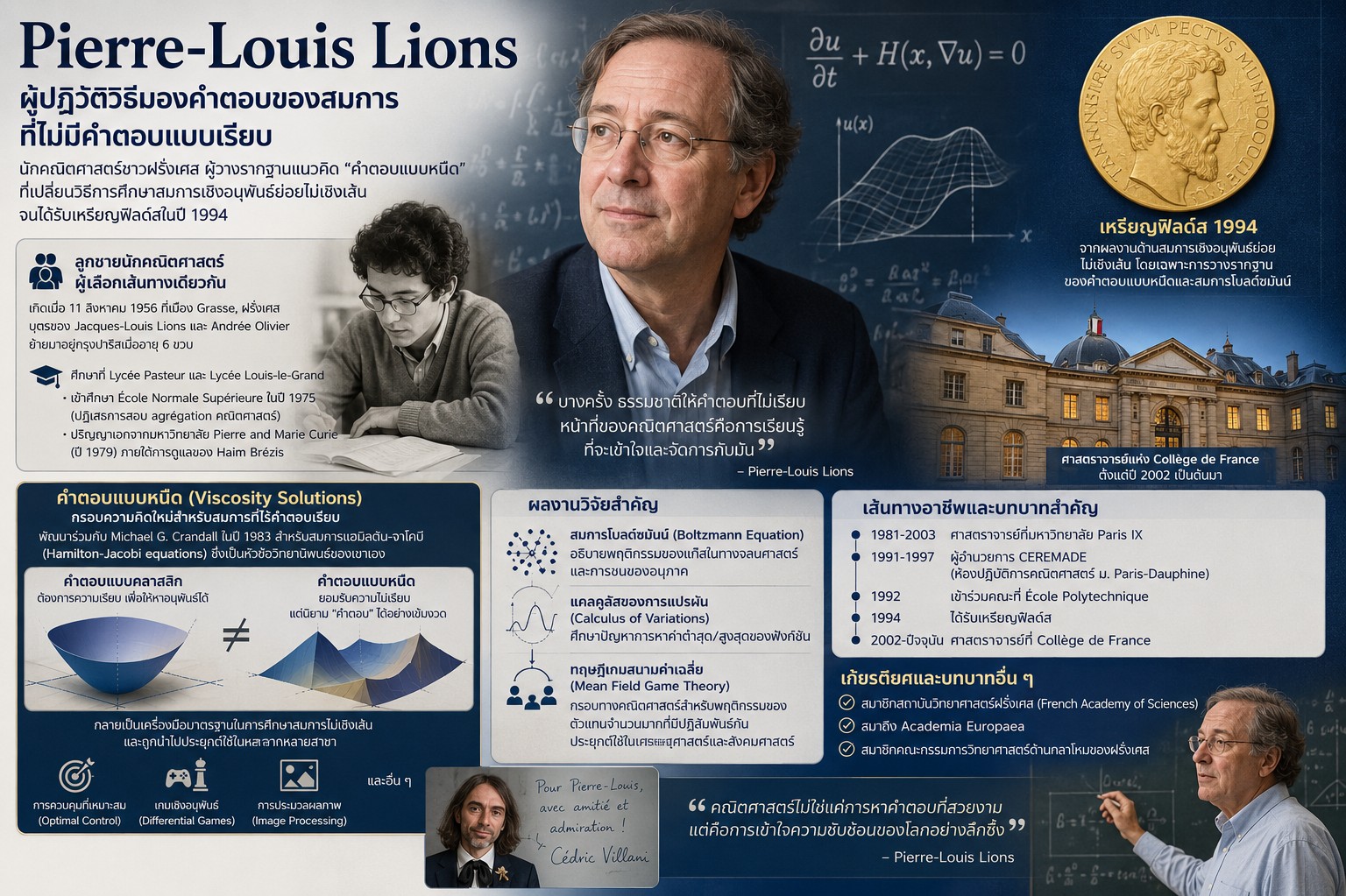
Finding solutions to nonlinear partial differential equations is one of the most challenging problems in modern mathematics because the solutions are often not as smooth and beautiful as mathematicians expect. Pierre-Louis Lions, a French mathematician, was born on August 11, 1956, in the city of Grasse, Alpes-Maritimes region, France, and grew up to become a revolutionary in the way mathematicians understand and handle these solutions, eventually receiving the Fields Medal in 1994.
The mathematician's son who chose the same path
Lions was the son of Jacques-Louis Lions, a renowned mathematician who later became the president of the International Mathematical Union, and Andrée Olivier. At the time of his birth, his father was still a professor at the University of Nancy, but when Pierre-Louis was six years old, the family moved to Paris when his father took a professorship there. He studied at Lycée Pasteur and Lycée Louis-le-Grand before entering the École Normale Supérieure in 1975, choosing to devote himself to research in applied mathematics instead of following the customary mathematics agrégation exam. He earned his doctorate from Pierre and Marie Curie University in 1979 under the supervision of Haïm Brézis.
Viscous solutions: A new framework for equations without smooth solutions
The work that brought Lions the most fame is the concept of viscosity solutions, which he developed together with Michael G. Crandall in 1983 for Hamilton-Jacobi equations, a topic from his own doctoral thesis. A major problem of many types of nonlinear partial differential equations is that solutions are often not smooth enough to have derivatives in the classical sense. The concept of viscosity solutions provided a new definition of 'solution' that is broader and rigorously covers these cases mathematically. It has become a standard tool used by mathematicians and engineers worldwide to study this type of equation up to the present, whether in optimal control problems, differential games, or image processing.
In addition, Lions also made significant contributions to the study of the Boltzmann equation, which describes the behavior of gases in kinetics, as well as to the calculus of variations. In the later stages of his career, he also played an important role in developing mean field game theory, a new mathematical framework for studying the behavior of large numbers of interacting agents, which has been widely applied in economics and social sciences.
Fields Medal and position at the French College
Lions received the Fields Medal in 1994 at the International Congress of Mathematicians in Zurich for his work on nonlinear partial differential equations, particularly for laying the theoretical foundations of viscous solutions and his work on the Boltzmann equation. At the time he received this award, he was affiliated with Paris-Dauphine University. Throughout his career, he served as a professor at Paris IX University from 1981 to 2003, joined the faculty at École Polytechnique in 1992, and since 2002 has held a professorship at the Collège de France, France's prestigious higher education institution.
Lions also played an important role outside the academic sphere, having served as the director of CEREMADE, the mathematics research laboratory at Paris-Dauphine University, between 1991-1997, and as a member of the French defense science committee. He was also elected as a member of the French Academy of Sciences and Academia Europaea. Currently, Lions remains one of the most influential mathematicians in the field of partial differential equations and has mentored many successful PhD students, including Cédric Villani, who later received the Fields Medal as well.