Gaston Darboux: A Geometer Who Connects Analysis with Geometric Shapes
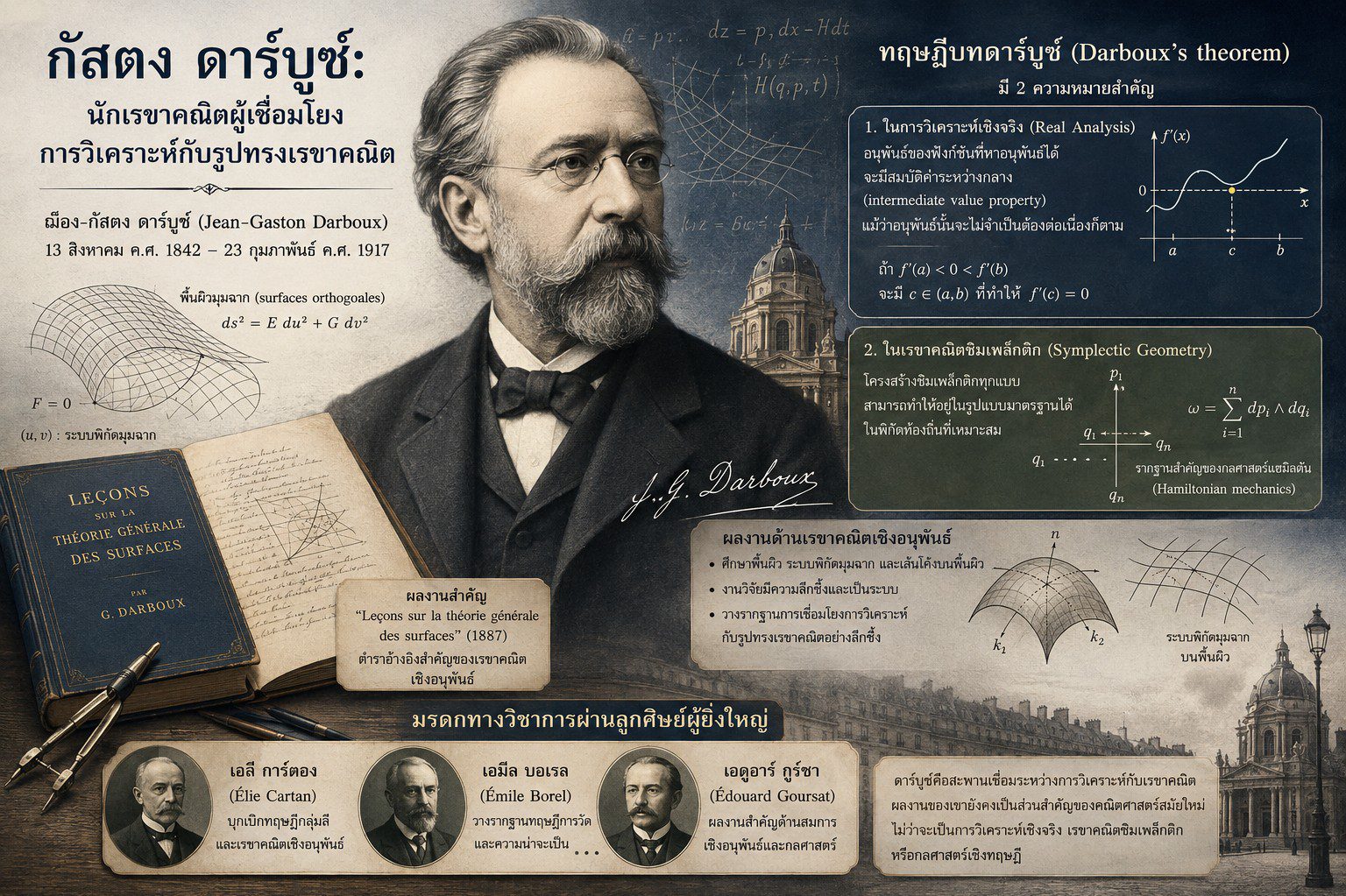
In the field of mathematics in the late 19th century, there was a French mathematician who played an important role both as a researcher and as a teacher who nurtured many new generations of mathematicians. That was Jean-Gaston Darboux, born on August 13, 1842, in the city of Nîmes in southern France. (A little tidbit: his birth certificate states that he was born at 1 a.m. on August 14, but Darboux himself always insisted that he was born at midnight on August 13 and chose to use this day as his official birthday, even on his own tomb.)
Early life and academic path
Darboux was born into a family of garment merchants. His father passed away when he was only 7 years old, so his mother had to take over the family business and made a great effort to ensure that her two children received a good education. Darboux showed talent in mathematics from a young age, and in 1861 he was able to pass the entrance exams for both the École Normale Supérieure and the École Polytechnique simultaneously, an achievement that brought him fame while still young. He chose to study at the École Normale Supérieure and later received a doctoral degree for his thesis on orthogonal surfaces (surfaces orthogonales) in 1866.
Darboux taught at several institutions before taking the position of professor at the Sorbonne from 1873 until his retirement, and he also served as an academic administrator with outstanding abilities.
Darboux Theorem: From Analysis to Geometry
The work that made Darboux's name best known is Darboux's theorem, which actually has two important meanings in mathematics.
The first meaning is in the field of real analysis. This theorem states that the derivative of a differentiable function has the intermediate value property, even though the derivative itself does not necessarily have to be continuous. It is a remarkable result because it shows that some types of discontinuous functions still exhibit a "regular" behavior in their own way.
Another meaning is in the field of symplectic geometry, which is an important foundation of Hamiltonian mechanics. This theorem states that every symplectic structure can be brought into a standard form in suitable local coordinates, which is an important result that allows the study of Hamiltonian dynamical systems in physics and mathematics to be conducted systematically.
Work in differential geometry
Apart from the theorem that bears his name, Darboux also made significant contributions to differential geometry, particularly the study of surfaces and orthogonal coordinate systems. His collected work 'Leçons sur la théorie générale des surfaces' is considered an important reference textbook in the field of differential geometry of that era and is still cited in academic circles today.
Academic heritage through students
One thing that made Darboux widely influential in the French mathematical community was his role as an academic advisor. His students included several legendary mathematicians, such as Élie Cartan, a pioneer of Lie group theory; Émile Borel, who laid the foundations of measure theory; and Édouard Goursat, all of whom later became major pillars of French mathematics.
Darbois died on February 23, 1917, in Paris, but his works and ideas remain an important part of advanced mathematics curricula worldwide to this day, whether in real analysis, symplectic geometry, or theoretical mechanics.