Henri Cartan: The Legend of the Bourbaki Group and Algebraic Topology
Among French mathematicians of the 20th century, there is one name that stands out particularly, both as a pioneering researcher and as a co-founder of a group of mathematicians who had a profound influence on the world of mathematics. That is Henri Cartan, who passed away on August 13, 2008, in Paris at the age of 104.
Early life and family of the mathematician
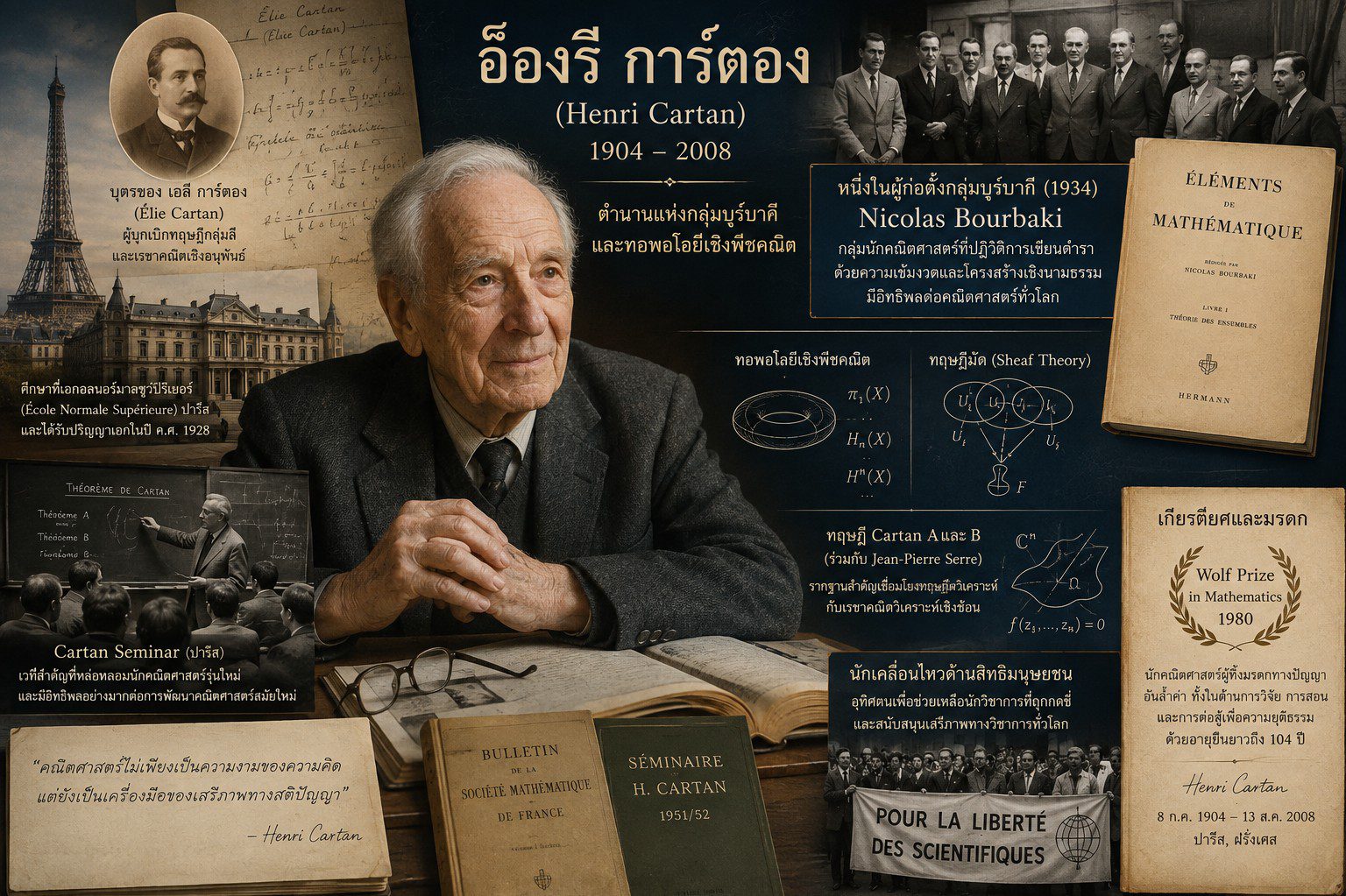
Henri Cartan was born on July 8, 1904, in Nancy, France. He was the son of Élie Cartan, a great mathematician of that era, a pioneer of Lie group theory and differential geometry. Growing up in a family of legendary mathematicians contributed to Henri's interest in mathematics from an early age. He studied at the École Normale Supérieure in Paris and received his doctorate in 1928.
One of the founders of the Bourbaki group
In 1934, Carton was one of the founding members of the Bourbaki group (Nicolas Bourbaki), a group of young French mathematicians who came together under the collective pseudonym “Nicolas Bourbaki” to write a new series of mathematics textbooks that laid the foundation for modern mathematics in a rigorous and systematic way, from algebra and analysis to topology. The Bourbaki group had a tremendous influence on the style of writing and teaching mathematics worldwide in the mid-20th century, emphasizing logical rigor and abstract structural principles.
Work in algebraic topology and functions of complex variables
Cartan had significant research achievements in many fields, especially in algebraic topology, where he helped develop theories linking algebraic structures with the topological properties of spaces. The seminar (Cartan seminar) that he held in Paris during the 1940s-1950s became an important platform that nurtured many young mathematicians and had a great influence on the development of sheaf theory.
Another field in which Cartan played an important role is several complex variables. He co-developed the key concepts known as 'Cartan’s theorems A and B' together with Jean-Pierre Serre, which are fundamental results that link the theory of analytic sheaves with complex analytic geometry.
Role in human rights and politics
Apart from his academic work, Carton is also widely known as a human rights activist. He devoted himself greatly to helping mathematicians and academics who were politically oppressed in many countries, especially during the Cold War. He played a key role in international human rights organizations that supported scholars who were imprisoned or had their academic freedom restricted for political reasons.
Academic heritage
Carton received numerous awards and honors throughout his career, including the Wolf Prize in Mathematics in 1980. He passed away at the age of 104, leaving behind an academic legacy encompassing algebraic topology, complex variable functions, and the foundations of modern mathematics through the Bourbaki group, which continues to influence mathematics education worldwide to this day.