Viggo Brun: The finder of the secrets of twin prime numbers.
On August 15, 1978, in Derobac, Norway, the Norwegian mathematician and number theorist Viggo Brun died at the age of 92. He left behind mathematical techniques that remain vital in the study of twin primes, one of the most challenging problems in number theory to this day.
The route from Lier to Göttingen
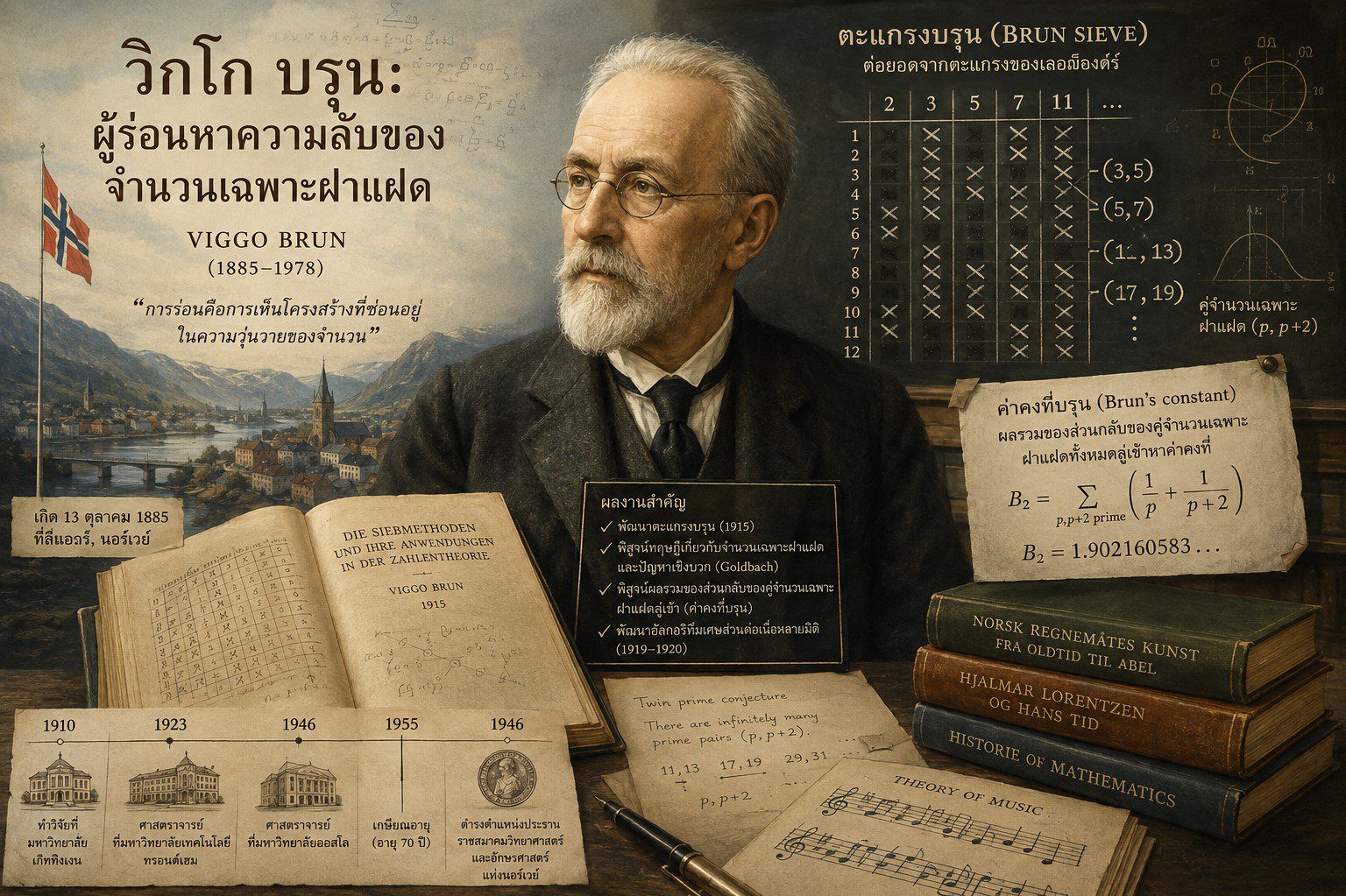
Brun was born on October 13, 1885, in Lier, Buskerud, Norway. He studied at the University of Oslo before traveling to Germany to conduct research at the University of Göttingen in 1910. At that time, Göttingen was considered one of the world's most vibrant centers of mathematics. Afterward, he returned to Thailand to take a professorship at the Trondheim Technological University in 1923 and later moved to the University of Oslo in 1946 before retiring in 1955 at the age of 70.
Brun's Sieve: A new tool for an old problem.
In 1915, Brun developed a new method building upon Legendre's Sieve of Eratosthenes. This method later became known as the "Brun sieve" and became a fundamental technique of sieve theory in analytical number theory. The Brun sieve is a powerful tool for dealing with additive problems, such as Goldbach's conjecture and the twin prime conjecture.
Using this technique, Brun was able to prove several remarkable results. He showed that there exist infinitely many integers n such that both n and n+2 have no more than nine prime factors, and that every large even number can be written as the sum of two numbers, each having no more than nine prime factors. These results were considered important steps that paved the way for a deeper understanding of the distribution of prime numbers.
Bruner constant: When an unlikely sum converges to true.
One of Brun’s most famous achievements is proving that the sum of the reciprocals of all twin primes converges to a specific constant, now known as Brun’s constant. The fascination of this result lies in its contrast with the case of all primes, where the sum of the reciprocals of all prime numbers diverges infinitely. However, when restricted only to twin prime pairs, the sum yields a finite value. This discovery was a major breakthrough that allowed mathematicians to understand the nature of twin primes more deeply, and it remains a vital inspiration for research on the twin prime conjecture, which remains unproven to this day.
A mathematician with an interest in music and history.
In addition to his research on sieve theory, Brun developed the multi-dimensional continued fraction algorithm during 1919-1920 and applied it to interesting problems in music theory. He also authored works on the history of mathematics, including a book on the art of computation in Norway from ancient times to the time of Abel, and in 1946 he served as president (praeses) of the Royal Norwegian Society of Science and Letters.
Viggo Brund lived to the age of 92, and even after his passing, the Bruns Grate and the constant bearing his name remain vital tools used by number theorists worldwide to unravel the mysteries of the distribution of prime numbers.