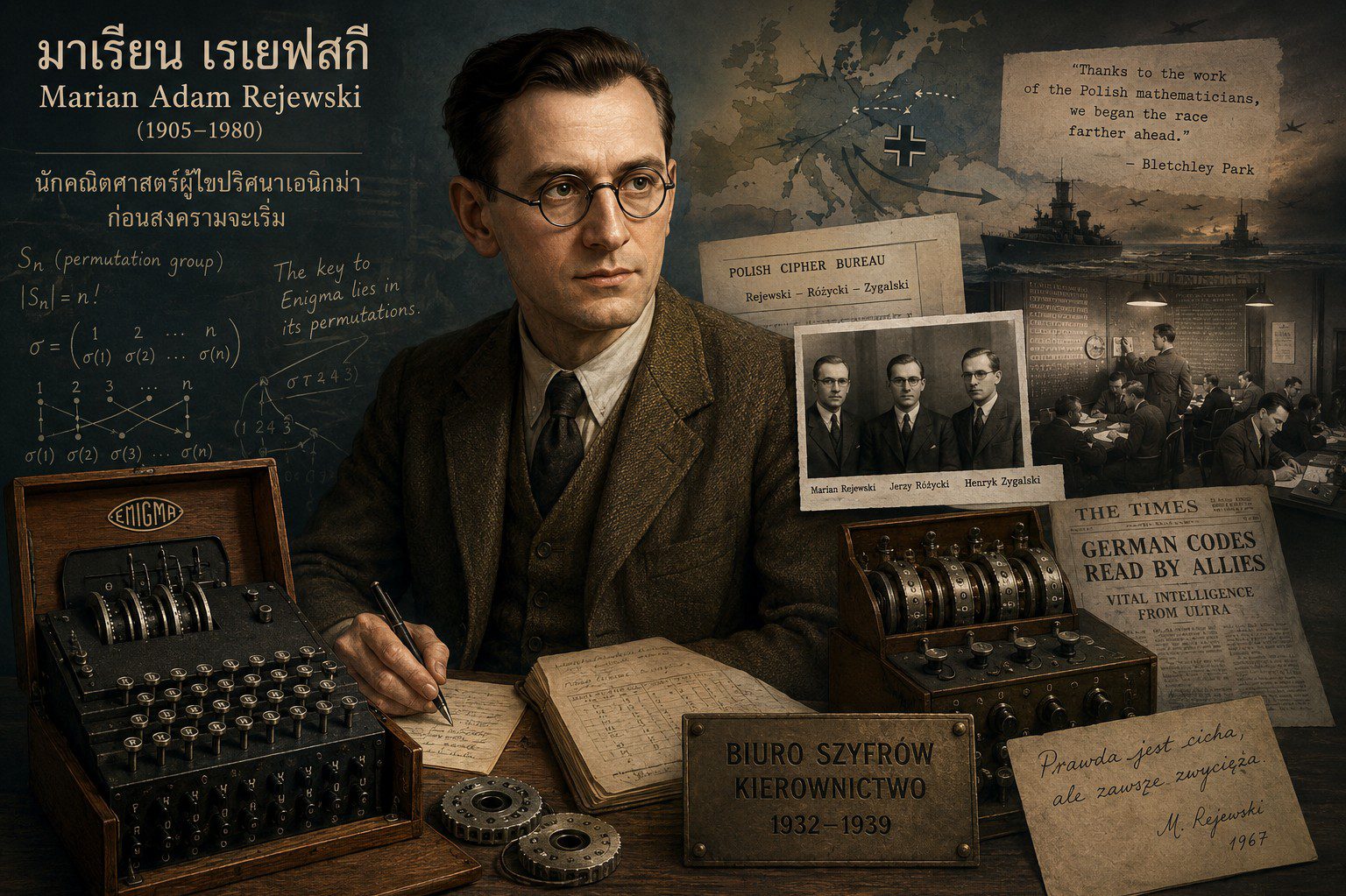
Marian Reyevsky: The mathematician who solved the Enigma puzzle before the war began.
Marian Adam Rejewski was born on August 16, 1905, in Bromberg (now Bydgoszcz, Poland), which was then under Prussian rule. His life story is one of the most powerful examples of how pure mathematics can change the course of world history, as his discoveries in 1932 may have been a key factor in giving the Allies an advantage in World War II.
From mathematician to cryptographer.
Reyewski studied mathematics at the University of Poznań, and after completing his master's degree in 1929, he traveled to Göttingen, Germany, to further his studies in actuarial mathematics. Upon his return, he became a mathematics lecturer at the University of Poznań. In 1929, he began participating in secret cryptography courses, and in 1932, he officially took a position at the Polish Cipher Bureau.
Solving a mystery that changed history.
Marian Rejewski’s most challenging mission was cracking the Enigma machine, a complex German military cipher device. Using permutation group theory and French intelligence documents, he successfully reconstructed the machine's internal wiring in late 1932 without ever seeing a real one, an astonishing feat achieved before World War II began.
This achievement was not accomplished alone. Reyevsky worked with two other mathematicians, Jerzy Różycki and Henrik Zygalski. The three developed several techniques and auxiliary devices to aid in everyday deciphering, including a machine called the “bomba,” a conceptual prototype that influenced the later development of British decryption machines at Bletchley Park.
Pass on the knowledge to the Allied forces.
When World War II broke out in 1939 and Poland was invaded, Rejewski and his team evacuated to France before passing on all their knowledge and techniques regarding Enigma to British and French intelligence. This fundamental knowledge became a crucial starting point for the British codebreakers at Bletchley Park, including Alan Turing, who further developed it to successfully crack more complex versions of Enigma throughout the war. Many historians believe that this ability to decode German communications significantly shortened World War II.
After the war ended, Reyevski returned to Poland, which was then under Soviet-backed rule. He lived a quiet life and kept little about his wartime work until 1967, when he decided to donate his memoirs about his work at the cryptography bureau to the Polish Military History Institute.
Marian Reyevsky died on February 13, 1980, in Warsaw. His story remains one of the most important examples in history of how applied mathematics, particularly the seemingly abstract and distant concept of group theory, can truly impact the fate of the entire world.