Shizuo Kakutani: A mathematician who connects probability with economics
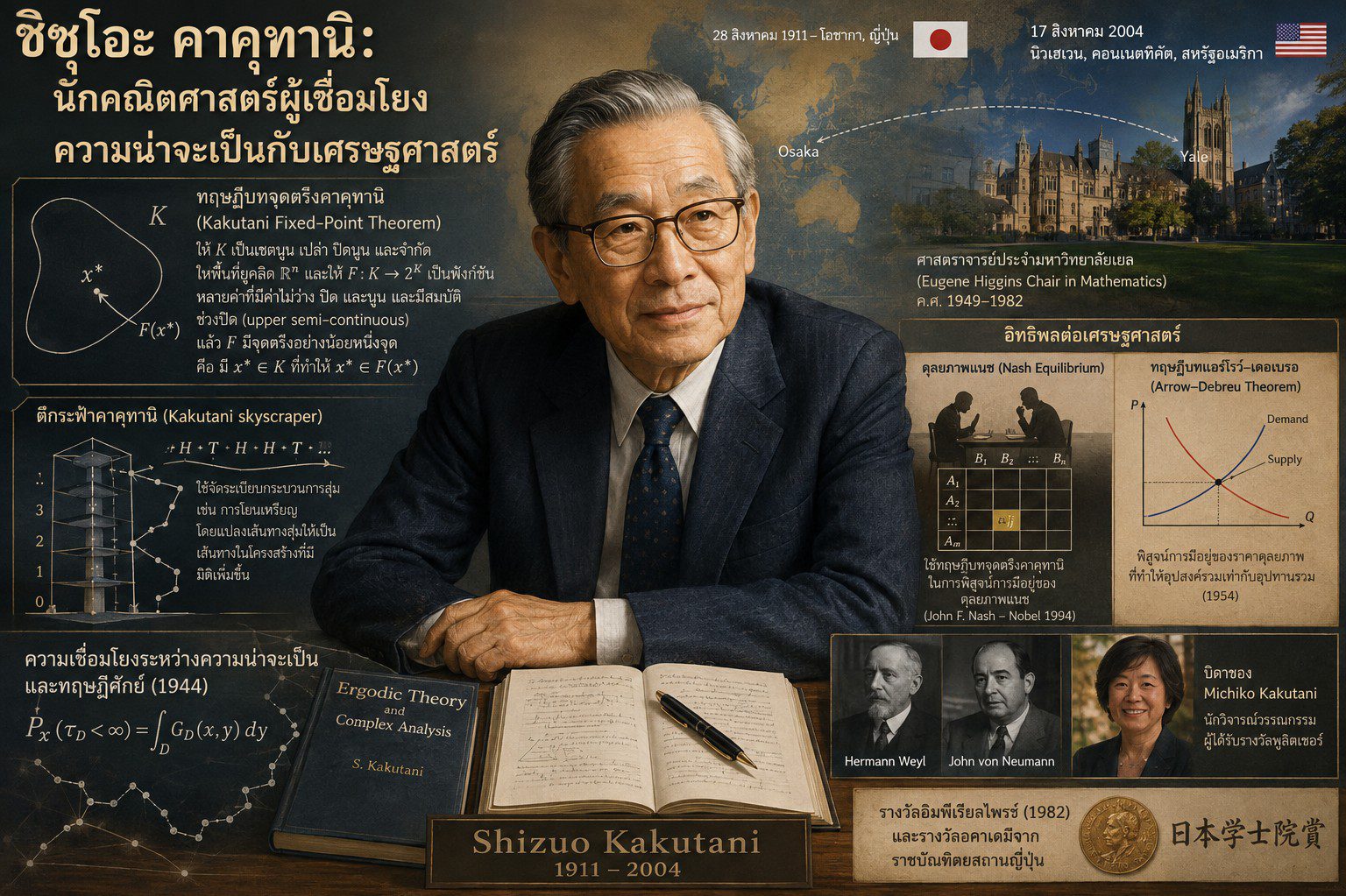
On August 17, 2004, in New Haven, Connecticut, USA, Shizuo Kakutani, a Japanese-American mathematician, passed away at the age of 92. He left behind work that was widely influential, not only in the field of pure mathematics but also affecting the field of Nobel Prize-winning economics.
From Osaka to Yale
Kakutani was born on August 28, 1911, in Osaka, Japan. He was the youngest son of a lawyer. He first became acquainted with mathematics through his older brother, who was eight years his senior and studied physics at Kyoto University, and often explained mathematical concepts to him when he came home to visit. Although his father hoped that one of his sons would follow in his footsteps as a lawyer, Kakutani chose to pursue a path in mathematics. He studied at Tohoku University in Sendai under the supervision of Tatsujirō Shimizu, before receiving his doctorate from Osaka University in 1941 and teaching there throughout World War II.
Early in his career, Kakutani was invited by Hermann Weyl, a famous mathematician, to work at the Institute for Advanced Study in Princeton for two years, where he met another influential mathematician, John von Neumann. After the war ended, he returned to the Institute for Advanced Study in 1948 before being appointed a professor at Yale University in 1949, a position he held until his retirement in 1982, holding the honorary Eugene Higgins Chair in Mathematics.
The Fixed-Point Theorem That Transformed Economics
Kakutani's most famous work is the Kakutani fixed-point theorem, which he proved in 1941. This theorem is an extension of Brouwer's fixed-point theorem to cover multi-valued functions and has become an important tool widely used not only in pure mathematics but also in the field of economics.
This theorem is a significant step in the original proof of the existence of the Nash equilibrium, which is the work that earned John Forbes Nash the Nobel Prize in Economics. In addition, it was used to prove the important Arrow-Debreu theorem in 1954, which demonstrated that there are prices of goods that equate aggregate demand with aggregate supply in an economic system. It serves as a clear example of how abstract mathematics can profoundly influence other fields.
Pioneer of probability theory and ergodic theory
Besides the fixed-point theorem, Kakutani also made significant contributions in several fields. He was the first person to discover the fundamental connection between probability theory and potential theory in 1944, which is a remarkable link between two seemingly unrelated fields. In addition, he developed a tool called the 'Kakutani skyscraper,' which is used to organize random processes, such as coin tossing, and he also made important contributions in ergodic theory and complex analysis.
A scholar who is beloved by their students
Although internationally known for his research, Kakutani is also remembered as a beloved teacher by his students at Yale. Many students consider the experience of studying with him the highlight of their education at Yale, no matter how challenging the assignments he gave were. Unlike the common image of mathematicians being solitary, Kakutani was sociable and enjoyed working with others. He just did not like to travel far, so colleagues often came to visit him at Yale instead. In 1982, he received the Imperial Prize and the Academy Award from the Japan Academy for his academic work.
Shizuo Kakutani is the father of Michiko Kakutani, the renowned literary critic and Pulitzer Prize winner from The New York Times. His academic legacy continues to exist in mathematics and economics textbooks worldwide, serving as a testament to the power of mathematical ideas to beautifully connect different fields of knowledge.