Salomon Bochner: The Connector of Fourier Analysis with Probability
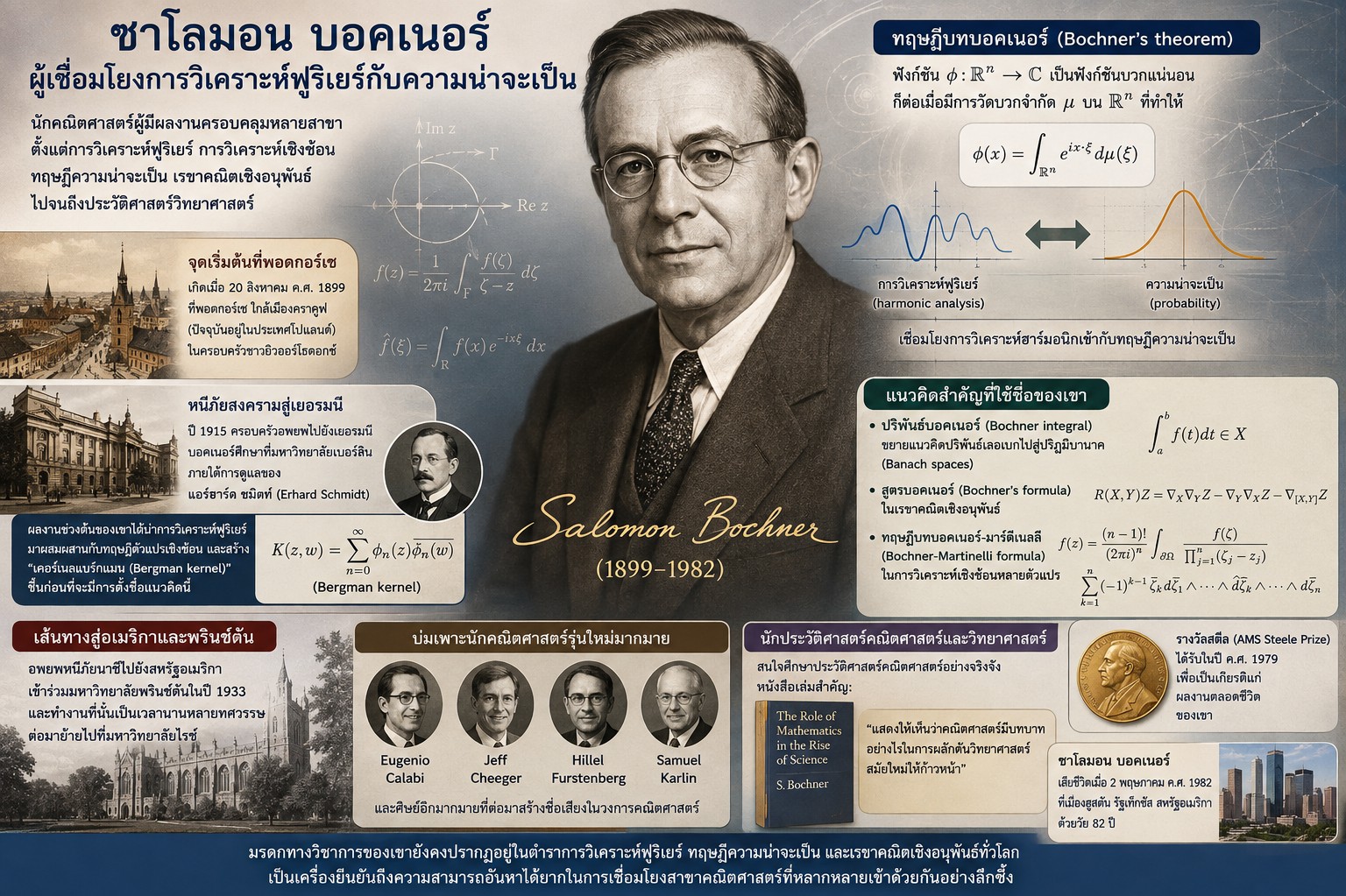
Salomon Bochner was born on August 20, 1899, in Podgórze, near Kraków, which at that time was part of the Austro-Hungarian Empire (now in Poland). He was born into a middle-class Orthodox Jewish family. His father, Joseph, ran a small business, while his mother, Ruda, had deep literary knowledge. From the age of only 9, his elementary school teacher had already predicted that he would grow up to be a mathematician in the future.
Fleeing from war to Germany
In 1915, amidst World War I, fearing Russian invasion in the region of Galicia, the Bockner family emigrated to Germany, which at the time was seen as a territory more friendly to Jews than Russia or even Austria-Hungary. Bockner continued his studies at the University of Berlin under the supervision of Erhard Schmidt, a renowned mathematician. His thesis, which was published as articles in 1921 and 1922, combined Fourier analysis with complex variable theory, and in this work, Bockner created what is now called the 'Bergman kernel' even before Stefan Bergman named the concept.
A diverse body of work covering multiple fields
Bochner was a mathematician whose work spanned remarkably across many fields, from almost periodic functions, classical Fourier analysis, complex analysis in one and several variables, differential geometry, Lie groups, probability theory, to the history of science. Although he rarely wrote long articles, each of his works had a profound influence on the development of mathematical analysis throughout three-quarters of the 20th century.
His most famous work is Bochner’s theorem, which provides a characterization of positive-definite functions in terms of the Fourier transform of a positive measure. This theorem has become an essential fundamental tool that connects harmonic analysis with probability theory and plays an important role in the analysis of various stochastic processes later on.
In addition, there are many other concepts named after him, such as the Bochner integral, which extends the concept of the Lebesgue integral to Banach spaces and is a fundamental basis for modern measure theory in probability theory, as well as Bochner’s formula in differential geometry and the Bochner-Martinelli formula in several complex variables analysis.
The Path to America and Princeton
Bockner began his career as a professor at the University of Munich before emigrating to the United States to escape the Nazis. He joined Princeton University in 1933 and worked there for many decades before moving to Rice University in the later part of his career. Throughout his working life, he nurtured a large number of young mathematicians who later became renowned in their own fields, including Eugenio Calabi, Jeff Cheeger, Hillel Furstenberg, and Samuel Karlin, all of whom became leading mathematicians in later years.
In the later stages of his life, Borkner turned to seriously studying the history of mathematics and science, writing books and articles about the role of concepts such as space, infinity, real numbers, functions, and continuity in the major turning points in the history of Western mathematics. His most famous work on this subject is the book The Role of Mathematics in the Rise of Science Published in 1966, which has been translated into many languages. In 1979, he received the Steele Prize from the American Mathematical Society in honor of his lifetime achievements.
Salomon Bochner passed away on May 2, 1982, in Houston, Texas, at the age of 82. His academic legacy still appears in textbooks on Fourier analysis, probability theory, and differential geometry worldwide to this day, serving as a testament to his rare ability to profoundly connect diverse fields of mathematics.