Giuseppe Peano: Father of the Axioms of Natural Numbers
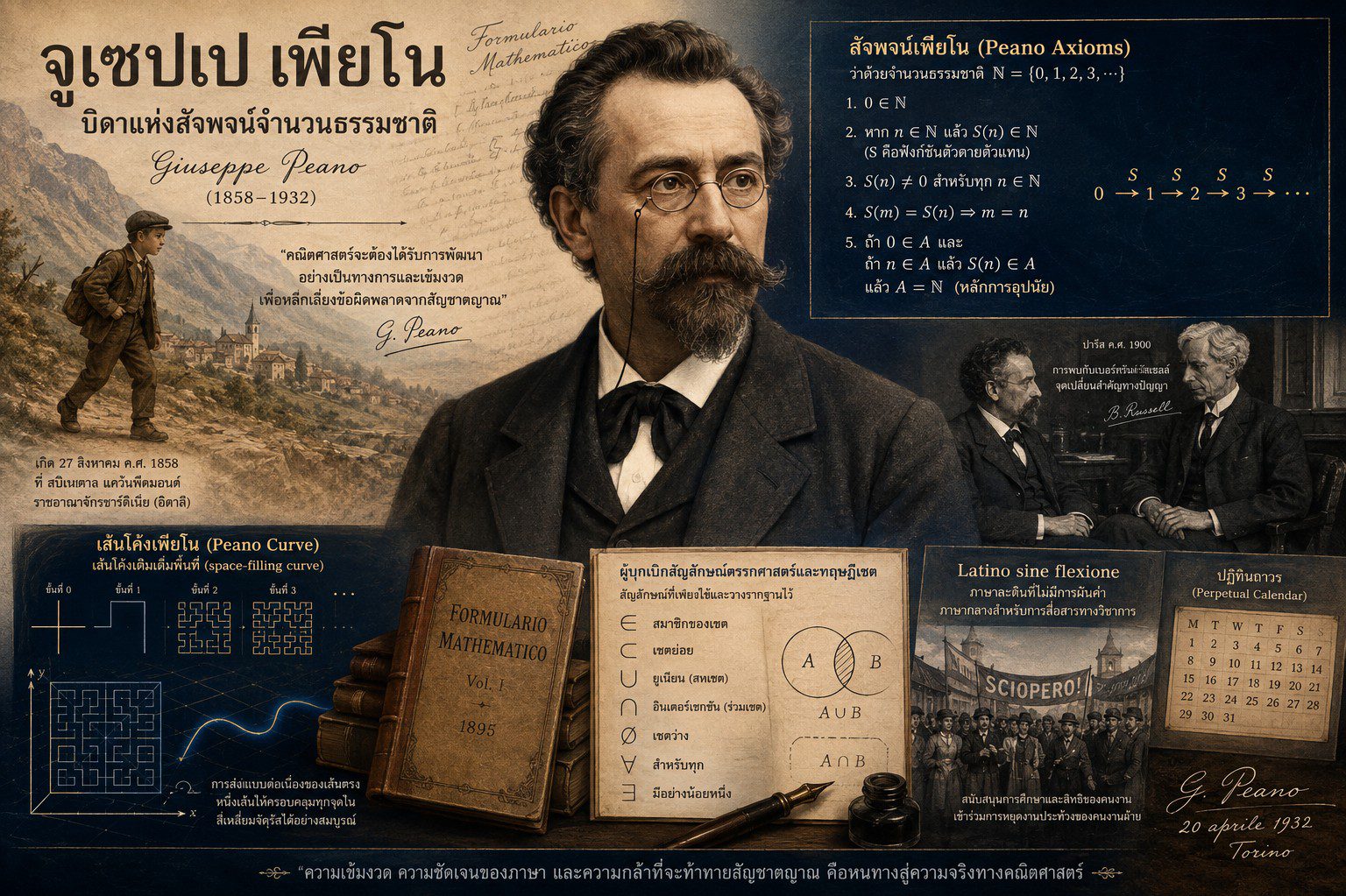
Giuseppe Peano was born on August 27, 1858, in the village of Spinetta, Piedmont, in the Kingdom of Sardinia (now part of Italy), into a poor farming family. He and his older brother had to walk to school in the nearby town of Cuneo. Although these obstacles seemed to block his educational path, due to his outstanding talent, at the age of 12, his uncle took him to the city of Turin, which marked the beginning of a journey that would lead him to become one of the most influential mathematicians of his era.
From Engineering to the Foundations of Mathematics
Piano graduated from Liceo Cavour High School in 1876 and continued his studies at the University of Turin. Although he initially intended to become an engineer, after studying analytical geometry, algebra, calculus, and descriptive geometry in the first two years, he discovered that his heart was truly attached to pure mathematics, becoming the only student in the third year to choose to continue studying pure mathematics. He completed his doctorate in 1880 under the supervision of Enrico D'Ovidio and was appointed as an assistant professor at the University of Turin in the same year, before becoming a full professor in 1889. Additionally, he also taught at the Military Academy in Turin between 1886 and 1901.
Axiom that lays the foundation for natural numbers
The work that made Peano's name immortal is the Peano axioms, which he proposed to define the natural numbers rigorously and systematically. This set of axioms specifies the fundamental properties that natural numbers must have, from having a starting number (zero or one) and having a successor function to the principle of mathematical induction, which Peano was the first to develop in a rigorous and systematic way. The Peano axioms became a crucial foundation of mathematical logic and modern set theory, and they remain the standard starting point for teaching the rigorous definition of number systems in mathematics curricula worldwide to this day.
A curve that fills the entire area
In 1890, Peano greatly surprised the mathematical community when he discovered the Peano curve, which was the first example of a "space-filling curve." He demonstrated a continuous mapping of a single line to cover every point in a square completely. This discovery completely contradicted the common geometric intuition that a one-dimensional curve should not be able to fill a two-dimensional space. This work became an important inspiration for Peano's belief that mathematics needed to be developed formally and rigorously to avoid errors arising from faulty intuition, and later it also became a key example of what is now called a fractal.
Pioneer of logical symbols and universal language
Peano was one of the founders of mathematical logic and set theory. He played a very significant role in the development of mathematical notation, including symbols for set operations that are still used today. In 1891, he began a project Formulario Mathematico Or the Encyclopedia of Mathematics, which aims to develop all of mathematics from basic axioms using logical symbols and his simple language. This series was first published in 1895 and the last volume in 1908, totaling five volumes.
At the International Philosophy Conference in Paris in 1900, Peano met Bertrand Russell, who later recorded that meeting Peano was a turning point in his intellectual life, because he noticed that Peano had greater precision than anyone in discussion and realized that Peano's symbols were an important tool for the logical analysis he had sought for many years.
In addition to his work in mathematics, Peano was also interested in linguistics. He developed an international language called Latino sine flexione (Latin without inflections) to be used as a common language for international academic communication.
A teacher who is controversial but dedicated to education
Peano was a teacher with a very distinctive personality. He insisted on teaching mathematical logic to all students and never held exams in a conventional manner, which caused conflicts with both his fellow teachers, who considered him unsuitable for the curriculum, and some students who were dissatisfied with having to learn “symbols” that they saw as useless in real life. It reached the point where there was a mocking term for students who enjoyed his subject, calling them as suffering from “Peanitis.” In 1901, he was forced to resign from the military academy and was removed from teaching engineering students at the university.
Even though he faced many academic conflicts, Piyano still remained happy in the later stage of his life. He played roles in organizations for primary and secondary education, developed a perpetual calendar, and became involved in politics in the cotton workers' strike, even hosting a reception for the protesters at his vacation home.
Giuseppe Pianosi died of a heart attack on April 20, 1932, in the city of Turin. Although academic controversies remained even after his passing, his intellectual legacy, both the Pianos' propositions and the Pianos' curves, continues to be an indispensable foundation of modern mathematics. It is a testament that rigor and the courage to challenge intuition can change the field of mathematics forever.