André-Louis Cholesky: The military mathematician who left his mark on the battlefield
One of the most widely used techniques in numerical linear algebra today comes from a mathematician who never had the chance to see his work published. That is André-Louis Cholesky, a French military engineer and mathematician, who died on August 31, 1918, on the battlefield in northern France, just a few months before the end of World War I.
Early life and path to the army
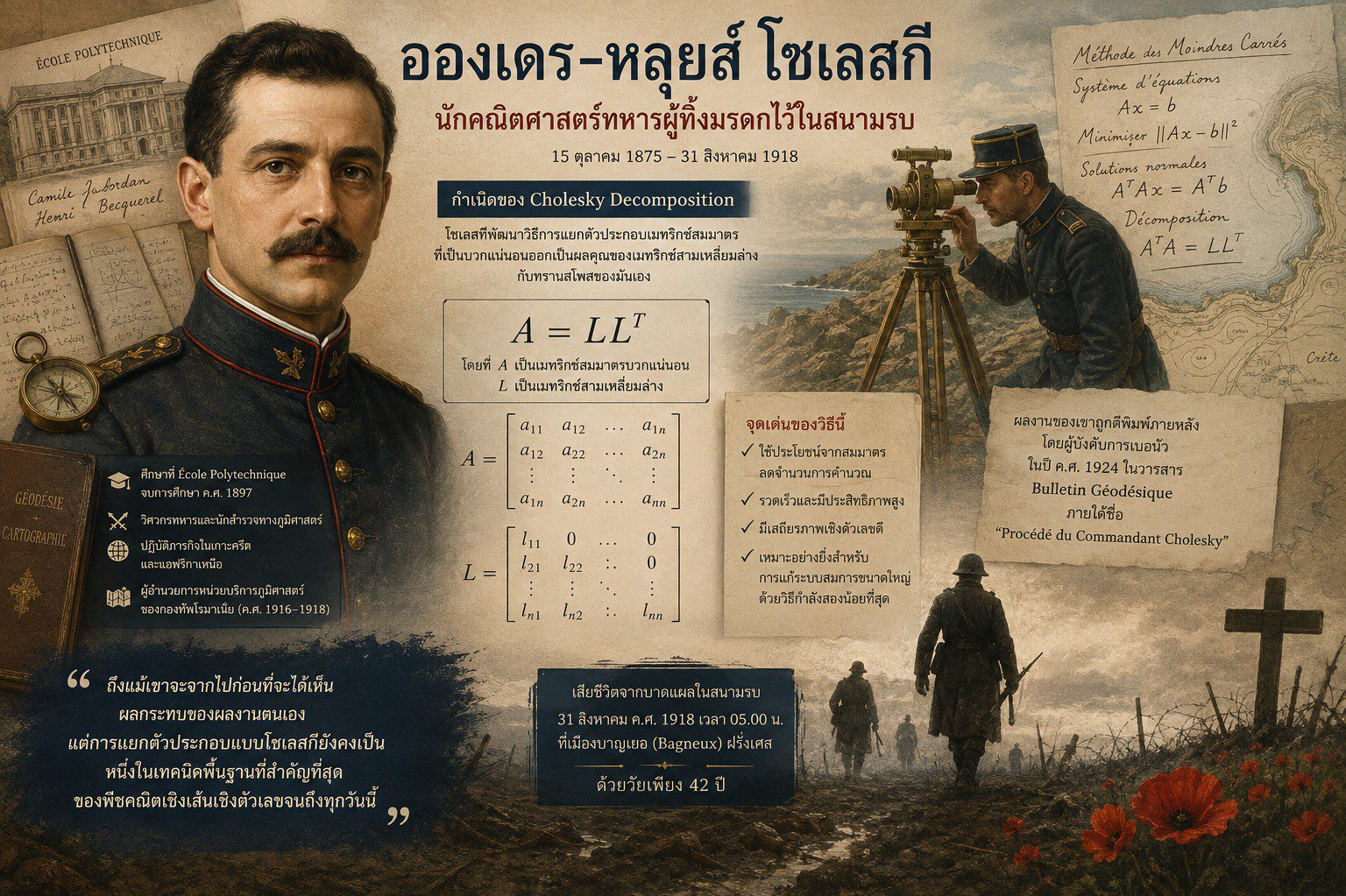
Cholesky was born on October 15, 1875, in the town of Montguyon in the southwest of France. His father's family descended from the Cholewski family, who emigrated from Poland during the Great Emigration. He studied at a high school in Bordeaux before passing the entrance examination to the École Polytechnique in 1895, where he had several renowned teachers, including the great mathematician Camille Jordan and the physicist Henri Becquerel, who discovered radioactivity.
After graduating in 1897, Choleski joined the army as a second lieutenant and continued his studies at the School of Artillery and Military Engineering (École d’Application de l’Artillerie et du Génie). He worked in geodesy and cartography, participating in surveys of Crete and North Africa before the outbreak of World War I.
The Origin of Cholesky Decomposition
While working in the field of geographic surveying, Cholesky faced the problem of solving large systems of linear equations arising from redundant measurements in survey work, which required the least squares method to obtain the most accurate solution. He developed a new matrix factorization method that was highly efficient for solving this problem, which later became known as the 'Cholesky decomposition'.
The principle of this method is to decompose a symmetric positive-definite matrix into the product of a lower triangular matrix and its own transpose. This method is much faster and has higher numerical stability compared to general methods of solving linear equations, as it takes advantage of the symmetry property of the matrix to significantly reduce the amount of computation.
Died on the battlefield before their work was published
Sholeski never had the opportunity to see his work published and distributed widely. In September 1916, he was sent on a military mission to Romania, serving as the director of the Geographic Service unit of the Romanian Army. He was promoted in July 1917 and continued to serve in Romania until February 1918.
Cholesky died from wounds received on the battlefield at 5 a.m. on August 31, 1918, in the town of Bagneux, northern France, at the age of only 42. After his death, his fellow officer, Commandant Benoît, had Cholesky's work published in the journal Bulletin Géodésique in 1924 under the name 'The Method of Commandant Cholesky' (Procédé du Commandant Cholesky).
The legacy that persists in numerical mathematics
Although Cholesky's work was published late and initially not widely known, the Cholesky decomposition gradually became one of the most fundamental techniques in numerical linear algebra in the computer era. Today, this method is widely applied in various fields, from solving large systems of linear equations, simulating financial scenarios (such as generating correlated random numbers in Monte Carlo models), to machine learning and signal processing.
The story of Cholesky is an impressive example of a mathematician who dedicated his life to military duties alongside academic research, and even though he himself never had the chance to see the great impact his work would have in the future, his name is still mentioned in every numerical mathematics textbook to this day.