Today in the History of Mathematics: George Green (July 14, 1793)
Whenever vector calculus students open their textbooks to Green’s Theorem—which transforms a line integral around a closed curve into a double integral over the enclosed region—hardly anyone imagines that the man behind the theorem was not originally a university professor, but a miller from Nottingham who received only a single year of formal schooling in his entire life.
From the Windmill to the Theorem
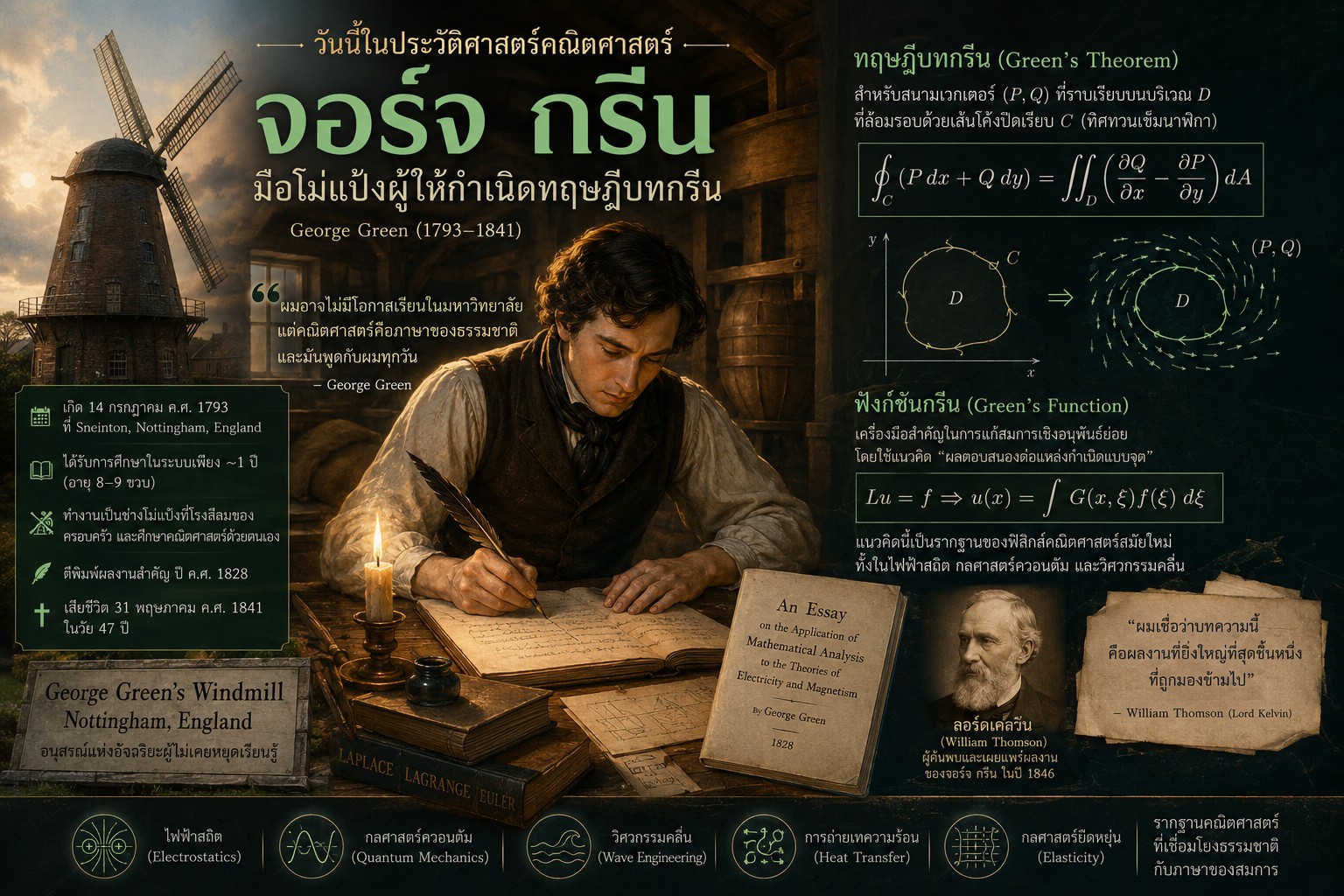
George Green was born in Sneinton, near Nottingham, England, and was baptized on July 14, 1793. His father was a baker who later prospered, eventually owning a brick windmill by 1807. Green received only about a year of formal schooling—between the ages of eight and nine—and was otherwise entirely self-taught; he spent his time studying mathematics on the upper floor of the windmill while working as a miller on the ground floor.
It is not known for certain how Green gained access to modern continental European mathematics texts. Historians speculate that he may have been influenced by the Reverend John Toplis, an expert in French mathematics who lived in the same area.
In 1828, Green self-published the most important work of his life, titled An Essay on the Application of Mathematical Analysis to the Theories of Electricity and Magnetism It was distributed via subscription to just 51 friends and acquaintances—most of whom did not even understand the content—yet it was in this very article that Green’s theorem and Green’s function first appeared.
The mathematical heart of Green's theorem
Green's theorem, in the form familiar to students, states that for a smooth vector field $(P, Q)$ on a region $D$ enclosed by a smooth, closed curve $C$ oriented counter-clockwise...
$$ \oint_C \left(P,dx + Q,dy\right) = \iint_D \left(\frac{\partial Q}{\partial x} – \frac{\partial P}{\partial y}\right) dA $$
This equation is the two-dimensional case of the Divergence Theorem and serves as a bridge between line integrals and area integrals—a core concept in vector analysis taught in mathematics curricula worldwide.
Equally important is the concept of the Green's function, which Green employed to solve Poisson's equation by expressing the solution to a partial differential equation as an integral involving a function representing the response to a point source. Today, this concept serves as a standard tool for solving partial differential equations in fields such as electrostatics, quantum mechanics, and wave engineering.
Fame that came too late
Sadly, Green's work was virtually unknown within the mathematical community during his lifetime. He passed away in 1841, having studied at Gonville and Caius College, University of Cambridge, at the age of 40. His work did not receive genuine attention until 1846, when Lord Kelvin (William Thomson) happened upon Green's paper and brought it to wider notice, thereby establishing Green's ideas as a cornerstone of modern mathematical physics.
The Green family's windmill has now been restored and opened as the George Green’s Windmill science museum in Nottingham, serving as a memorial to a mathematician who never attended university yet left an immense mathematical legacy to the world.
Thought-provoking activities
- Try proving Green's theorem for the special case where $D$ is a rectangle by considering the integrals along each side separately.
- Why is Green's Theorem considered a two-dimensional case of Stokes' Theorem? Try to describe the connection between these two theorems.
- What is the form of the Green's function for the Laplace equation on the unit disk? Research and explain its application in solving boundary value problems.
- What does Green's story reflect about self-taught mathematics in the current educational context?
References
Cannell, D. M. (2001). George Green: Mathematician and Physicist 1793–1841 (2nd ed.). Society for Industrial and Applied Mathematics.
O’Connor, J. J., & Robertson, E. F. (n.d.). George Green. MacTutor History of Mathematics Archive. University of St Andrews. https://mathshistory.st-andrews.ac.uk/Biographies/Green/
University of Nottingham. (n.d.). George Green – Mathematician, Physicist and Miller. https://www.nottingham.ac.uk/physics/about/history/george-green.aspx
This article is part of the “This Day in Mathematical History” series—retracing the stories of the mathematicians who shaped the world of mathematics, day by day throughout the year.