Today in the History of Mathematics: Maryam Mirzakhani (Died July 14, 2017)
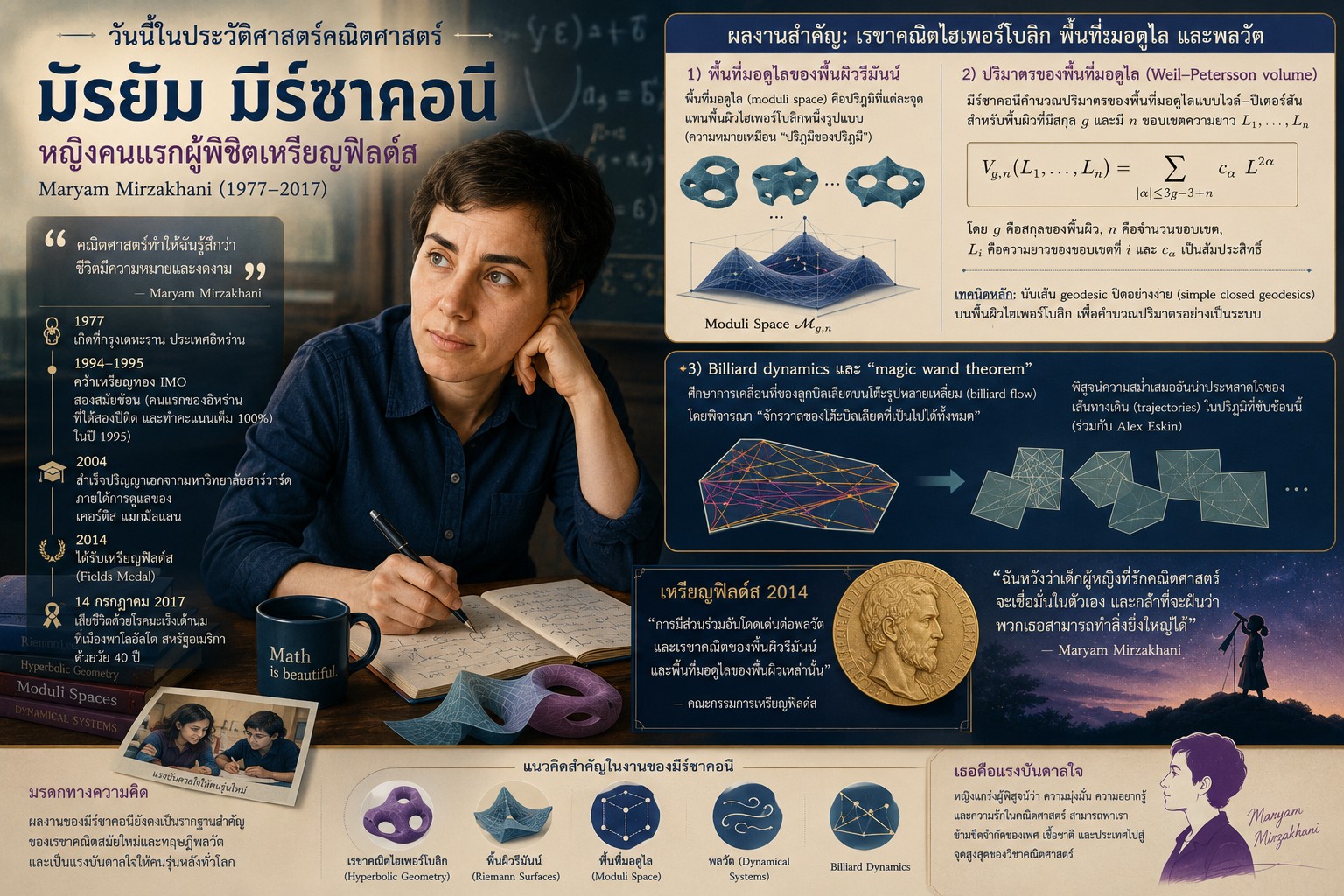
On July 14, 2017, the global mathematics community paused in mourning when Maryam Mirzakhani, an Iranian mathematician aged just 40, passed away from breast cancer in Palo Alto, California. She was the first woman and the first Iranian in history to be awarded the Fields Medal—the highest honor in mathematics, often considered the equivalent of the Nobel Prize.
From a young girl who loved reading to a world-class geometer.
Mirzakhani was born in Tehran, Iran, in 1977. As a child, she did not dream of becoming a mathematician; instead, she loved reading. Her talent became evident when she won gold medals at the International Mathematical Olympiad (IMO) in two consecutive years—1994 and 1995—with the latter achievement marking the first time a member of the Iranian team had scored a perfect 100%.
After graduating with a bachelor's degree from Sharif University of Technology, she went on to pursue a doctoral degree at Harvard University under the tutelage of Curtis McMullen, another Fields Medal recipient. Her dissertation was on Simple Geodesics on Hyperbolic Surfaces and Volume of the Moduli Space of Curves She laid the foundation for her lifelong research.
Moduli space and shortest paths on curved surfaces
Mirzakhani's primary research lay at the intersection of hyperbolic geometry, topology, and dynamical systems. She focused on Riemann surfaces—curved surfaces possessing hyperbolic geometry—and studied moduli spaces, which are spaces where each point represents a specific hyperbolic surface.
Her renowned work involves calculating the Weil–Petersson volume of moduli spaces, expressed as a polynomial function of boundary lengths:
$$ V_{g,n}(L_1, \dots, L_n) = \sum_{|\alpha| \le 3g-3+n} c_\alpha , L^{2\alpha} $$
Where $g$ is the genus of the surface and $n$ is the number of boundary components, she employed a technique involving the counting of simple closed geodesics to systematically calculate these volumes, thereby solving a problem that had remained open for decades.
Another equally renowned achievement is the collaboration with Alex Eskin on the dynamics of billiards on polygonal tables; rather than studying a single billiard table, they investigated the “universe of all possible billiard tables” and proved the “magic wand theorem,” which reveals a surprising regularity in the trajectories within these complex spaces.
A historic Fields Medal
In 2014, in Seoul, Mirzakhani was awarded the Fields Medal for her "outstanding contributions to the dynamics and geometry of Riemann surfaces and their moduli spaces." Upon receiving the award, she expressed her deep honor and her hope that she would inspire the next generation of female scientists and mathematicians.
Tragically, just three years later, she discovered that the breast cancer she had previously overcome had spread to her bone marrow; she passed away on July 14, 2017, leaving behind an intellectual legacy that continues to inspire future generations of mathematicians worldwide—particularly young women in science and mathematics who see that there is no ceiling on what is possible.
Thought-provoking activities
- Why is the moduli space of Riemann surfaces viewed as a “space of spaces,” and how does this concept differ from Euclidean geometry?
- Explain the difference between Euclidean geometry and hyperbolic geometry in terms of the sum of the angles of a triangle.
- How does Mirzakhani's research on billiard dynamics link geometry with dynamics? Let's consider a simple dynamical system that students are familiar with.
- Discuss Mirzakhani's role as an inspiration for gender equality in STEM.
References
Britannica. (2026, July). Maryam Mirzakhani. Encyclopædia Britannica. https://www.britannica.com/biography/Maryam-Mirzakhani
Klarreich, E. (2014, August 12). A tenacious explorer of abstract surfaces. Quanta Magazine.
Myers, A., & Carey, B. (2014, August 12). Stanford’s Maryam Mirzakhani wins Fields Medal. Stanford Report. https://news.stanford.edu/stories/2014/08/stanfords-maryam-mirzakhani-wins-fields-medal
This article is part of the “This Day in Mathematical History” series—retracing the stories of the mathematicians who shaped the world of mathematics, day by day throughout the year.