Today in the History of Mathematics: Augustin Fresnel (died July 14, 1827)
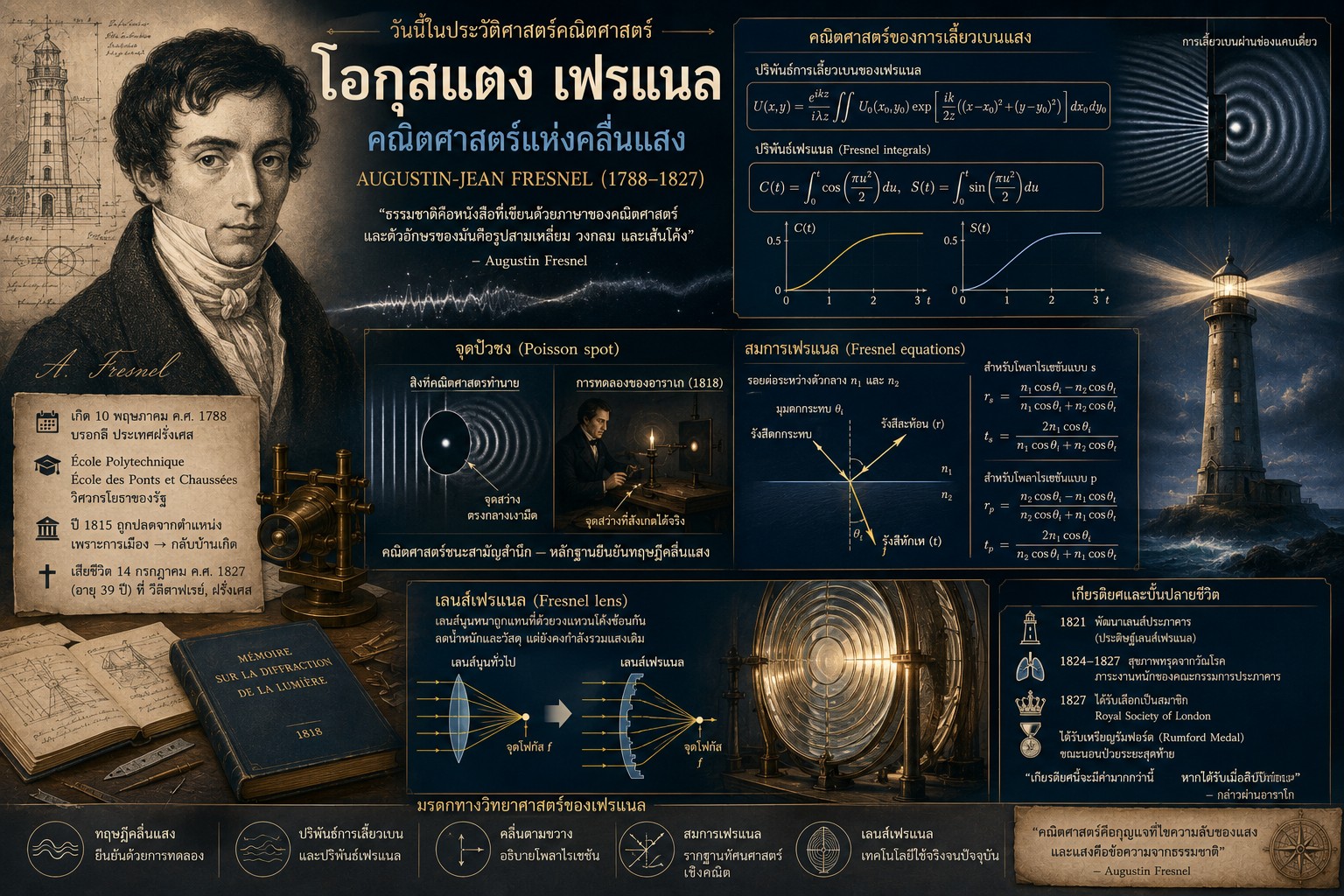
If 19th-century wave physicists had a "beach candy"—a peculiar, unexpected treat—it would surely be the "bright spot that shouldn't exist in the center of a dark shadow." This phenomenon was predicted purely through mathematics by Augustin-Jean Fresnel, a French civil engineer who suffered from chronic tuberculosis and passed away on July 14, 1827, at the age of just 39.
The engineer who revolutionized optics in his spare time.
Fresnel was born in Broglie, France, in 1788, the son of an architect. He was a slow learner in childhood—unable to read even at the age of eight—but later demonstrated exceptional talent at the École Polytechnique and the École des Ponts et Chaussées, eventually becoming a government civil engineer.
A major turning point occurred in 1815 when Napoleon escaped from Elba and returned to power. Fresnel, a royalist, chose to join the resistance; consequently, he was dismissed from his engineering post and placed under police surveillance, forcing him to return to his hometown unemployed—yet it was precisely this misfortune that gave him the free time to dedicate himself to the experiments on light that had fascinated him since 1814.
The mathematics of light diffraction
Fresnel developed a mathematical theory of diffraction—based on the Huygens–Fresnel principle of superposition—that is still taught in physics and applied mathematics textbooks today; the Fresnel diffraction integral takes the form...
$$ U(x,y) = \frac{e^{ikz}}{i\lambda z} \iint U_0(x_0,y_0), \exp!\left[\frac{ik}{2z}\big((x-x_0)^2+(y-y_0)^2\big)\right] dx_0, dy_0 $$
This leads to Fresnel integrals, which are defined from...
$$ C(t) = \int_0^t \cos!\left(\frac{\pi u^2}{2}\right) du, \qquad S(t) = \int_0^t \sin!\left(\frac{\pi u^2}{2}\right) du $$
In 1818, Fresnel submitted a paper on diffraction to the Académie des Sciences; among the judges was Siméon Denis Poisson, a skeptic of the wave theory of light. Using Fresnel's equations, Poisson calculated a result that seemed absurd—predicting a bright spot at the center of the shadow cast by an opaque spherical object—which contradicted the common-sense understanding associated with the particle theory of light. However, when François Arago.When the actual experiment was conducted, the bright spot appeared exactly as predicted by the mathematics. Today, this phenomenon is known as the Poisson spot—or sometimes the Arago-Fresnel spot—and it has become one of the most powerful pieces of evidence confirming the wave theory of light in the history of science.
Fresnel equations and stepped lenses
Fresnel also pioneered the concept that light is a transverse wave—rather than a longitudinal wave like sound, as previously believed—which fully explained the phenomenon of polarization and led to the Fresnel equations. These equations calculate the proportions of light reflected and refracted at the interface between two media and remain a fundamental basis of mathematical optics today.
In terms of practical applications, Fresnel was commissioned to develop a lens system for French lighthouses and invented the Fresnel lens in 1821; this design transformed a thick convex lens into a series of stacked concentric rings to reduce weight and material usage while maintaining the same light-focusing capabilities. This technology remains in use today in lighthouses, automotive headlights, and camera lenses.
The twilight of one's life
Fresnel suffered from tuberculosis throughout his life, and his health deteriorated severely after 1824 due to the heavy workload associated with the Lighthouse Commission. He was elected a Fellow of the Royal Society of London and awarded the Rumford Medal while on his deathbed; he conveyed his gratitude through Arago, remarking that the honor would have meant even more had he received it ten years earlier. Fresnel passed away on July 14, 1827, in Ville-d'Avray, near Paris.
Thought-provoking activities
- Explain why the "Poisson spot" phenomenon is considered a classic example of mathematics predicting a counterintuitive result that was subsequently confirmed by experiment.
- Try to find the relationship between the Fresnel integrals $C(t)$ , $S(t)$ and the Cornu spiral.
- Why can a Fresnel lens significantly reduce the amount of material used while maintaining the same light-gathering power? Let us make a geometric comparison with a conventional convex lens.
- Discuss the role of scientific debate (such as the case of Poisson versus Fresnel) in strengthening the development of theories.
References
Britannica. (2026, May). Augustin-Jean Fresnel. Encyclopædia Britannica. https://www.britannica.com/biography/Augustin-Jean-Fresnel
O’Connor, J. J., & Robertson, E. F. (n.d.). Augustin Fresnel. MacTutor History of Mathematics Archive. University of St Andrews. https://mathshistory.st-andrews.ac.uk/Biographies/Fresnel/
Institut Fresnel. (n.d.). Augustin Fresnel. https://www.fresnel.fr/wp/en/the-institute/presentation/augustin-fresnel/
This article is part of the “This Day in Mathematical History” series—retracing the stories of the mathematicians who shaped the world of mathematics, day by day throughout the year.