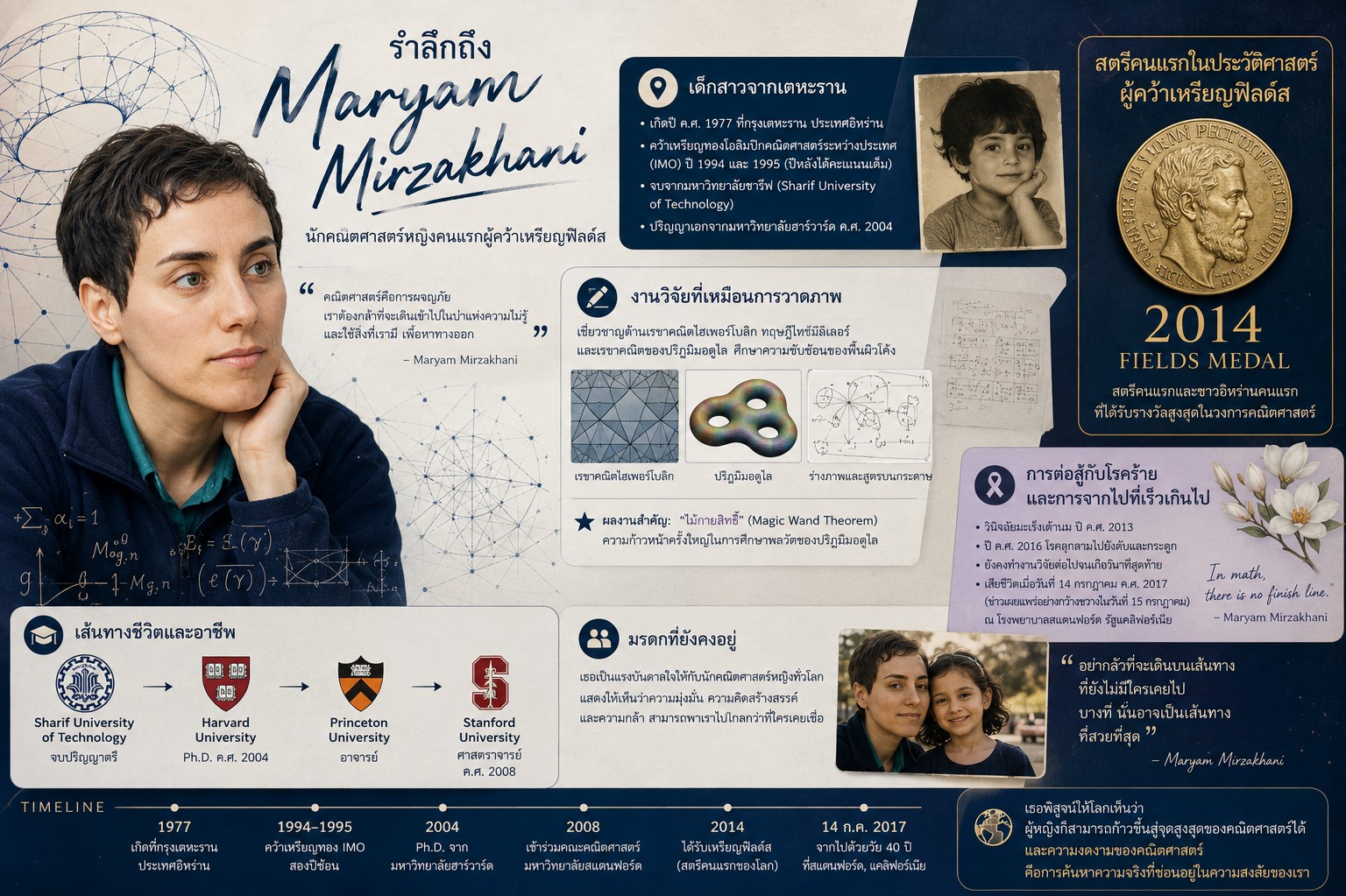
Remembering Maryam Mirzakhani, the first female mathematician to win the Fields Medal.
In mid-July 2017, the global mathematics community lost Maryam Mirzakhani—an Iranian mathematician and Stanford University professor—who passed away from breast cancer at the age of just 40, leaving behind a monumental academic legacy and an enduring source of inspiration for the next generation of mathematicians worldwide.
(Note: Stanford University and most sources state that she passed away on July 14, but news of her passing was released and became widely known on July 15.)
A young woman from Tehran who loves storytelling more than numbers.
Mirzakhani was born and raised in Tehran, Iran. As a child, she was more passionate about reading and storytelling than mathematics, but that passion gradually evolved into a love for the subject. She was the first female student from Iran to join the national team for the International Mathematical Olympiad, winning gold medals in two consecutive years—1994 and 1995—achieving a perfect score in the latter.
After graduating from Sharif University of Technology in Tehran, she pursued her doctoral studies at Harvard University, completing her degree in 2004. Her thesis was so outstanding that it was published as separate articles in three leading mathematics journals. She subsequently moved to teach at Princeton University before finally joining the mathematics faculty at Stanford University in 2008.
Research that resembles painting
Mirzakhani’s research focused on hyperbolic geometry, Teichmüller theory, and the geometry of moduli spaces—areas involving the in-depth study of the complexities of curved surfaces, such as spheres or donut-shaped surfaces. Although the subject matter belongs to the realm of advanced pure mathematics, it holds connections to quantum physics, engineering, and materials science.
What set her apart was her unique way of thinking. She would often sketch images and patterns on large sheets of paper, surrounding them with mathematical formulas—so much so that her daughter once described her work as simply "drawing." Mirzakhani herself likened her creative process to being lost in a forest, using all her knowledge to devise new approaches until she finally found a way out.
One of his important contributions, along with mathematician Alex Eskin, was the theorem nicknamed the "Magic Wand Theorem," which represented a major breakthrough in the study of modulospace dynamics.
The first woman in history to win the Fields Medal.
In 2014, Mirzakhani made history by becoming the first woman and the first Iranian to receive the Fields Medal—the highest honor in mathematics, often likened to a Nobel Prize in the field. Since the award was first presented in 1936, no woman had ever received this honor before.
News of her award sparked joy worldwide, particularly among women mathematicians, and became a powerful symbol demonstrating that women, too, can reach the pinnacle of a scientific field long dominated by men.
The battle against a deadly disease and a life cut too short.
Mirzakhani was diagnosed with breast cancer in 2013. Despite undergoing continuous treatment, the disease spread to her liver and bones in 2016. She continued her research until shortly before her passing; colleagues recounted that she faced her illness with a blend of realism and hope. Mirzakhani died at Stanford Hospital in California at the age of 40, with her husband—theoretical computer scientist Jan Vondrák—and her daughter, Anahita, by her side.
A legacy that remains.
Marc Tessier-Lavigne, then-President of Stanford University, remarked on her passing that although Mirzakhani left us too soon, the impact she made would endure through the thousands of women inspired by her to pursue paths in mathematics and science.
To this day, Maryam Mirzakhani is celebrated as a role model—a scholar who was both brilliant and humble. She never accepted honors for her own sake, but rather in the hope that they would inspire others to follow in her footsteps.
As time passes, the story of Maryam Mirzakhani continues to remind us that the beauty of mathematics is not confined to mere numbers and equations; it encompasses the courage to explore the previously uncomprehended—and that regardless of gender, race, or background, everyone has a place in this world of knowledge.