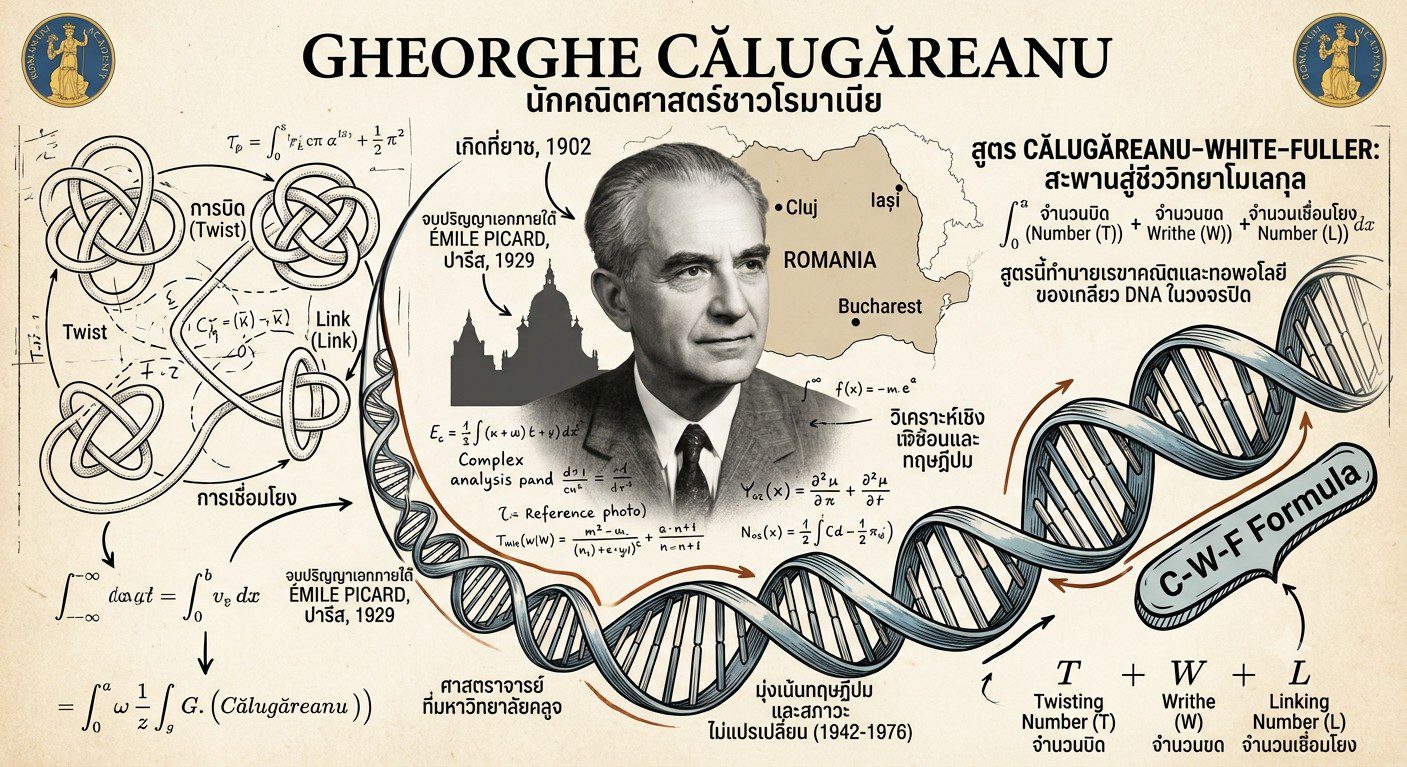
Gheorghe Călugăreanu: From the geometry of nodes to the structure of DNA.
Today is the birthday of Gheorghe Călugăreanu, a Romanian mathematician, born on July 16, 1902, in Iași into an academic family. His father, Dimitrie Călugăreanu, was a renowned physician and physiologist.
The academic journey from Bucharest to Paris.
Kalugarian Nurian attended Gheorghe Lazăr High School in Bucharest before continuing his studies at the University of Cluj, which had recently been incorporated into Romania. After graduating in 1924, he received a scholarship from the Romanian government to study at the Sorbonne University in Paris, where he earned his doctorate in 1929 under the supervision of the renowned mathematician Émile Picard, with Édouard Goursat and Gaston Julia serving as dissertation examiners.
After returning to Romania, he rose from research assistant to professor at the University of Cluj, and later became rector. He was also elected an associate member of the Romanian Academy in 1955 and a full member in 1963.
Diverse research but with a single core message.
Kalugarianu's research spanned complex variable function theory, differential geometry, and algebraic topology. He once explained to younger mathematicians that, although his work covered many fields, it all shared a common "guiding thread": the concept of invariance.
His particular passion was Knot Theory, which he dedicated himself to studying continuously from 1942 until the end of his life. The problem he attempted to solve was finding a perfect topological invariance system to classify the isotopes of different types of knots.
From pure mathematical formulas to molecular biology.
Between 1942 and 1961, Kalugarianu discovered a set of invariants in the form of an integral (similar to a Gaussian integral) that linked the number of twists of a ribbon or strand to the linking number of its two edges. This work remained largely unexplored in pure mathematics for a time until three American mathematicians—W. F. Pohl (1968), J. H. White (in his 1969 thesis), and F. Brock Fuller (1971)—revived the concept and applied it to describe the twisting of DNA molecules, a major problem in molecular biology.
This formula is now known as the Călugăreanu–White–Fuller formula and has become a fundamental tool linking differential geometry to DNA topology. It is used to describe how a double helix of DNA twists and intertwines when in a closed loop structure. It is a classic example of how pure mathematics of one era became a cornerstone of biological science decades later.